






Definition and Meaning
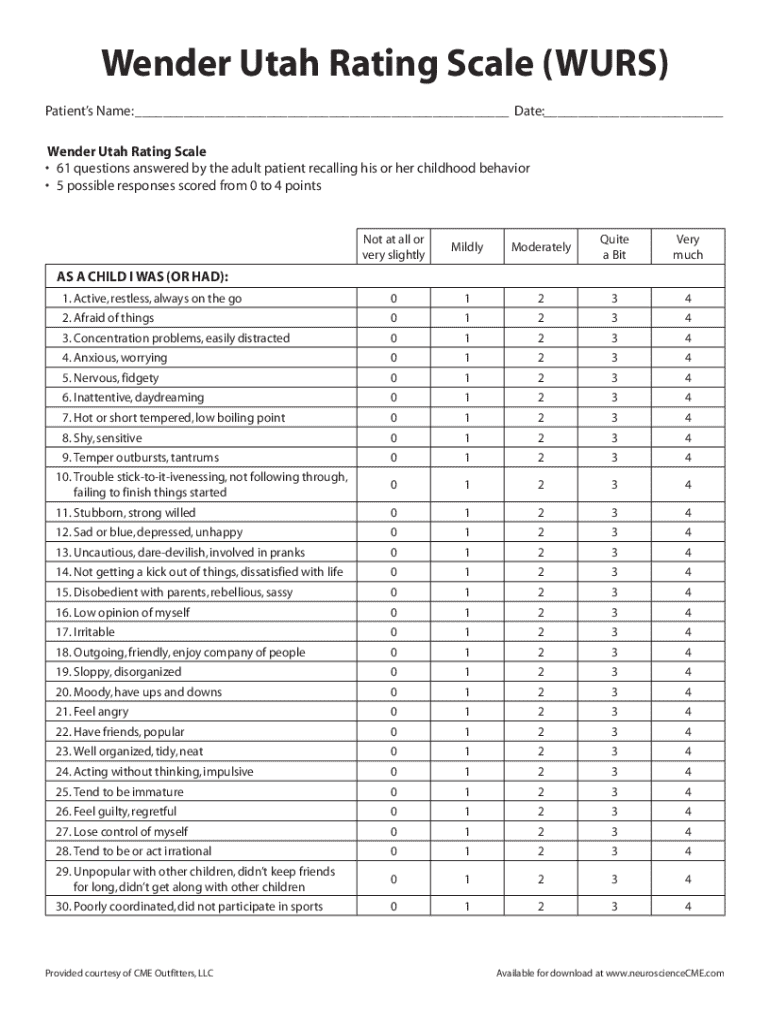
The Wender Utah Rating Scale (WURS) is a diagnostic instrument consisting of 61 questions. It is designed to help adults recall childhood behaviors that may be symptomatic of Attention Deficit Hyperactivity Disorder (ADHD). Each question offers five response options, scored from zero to four, allowing for a retrospective assessment of ADHD symptoms. This tool aids clinicians in identifying behaviors consistent with ADHD patterns, making it an essential component in adult ADHD diagnosis.
How to Use the Wender Utah Rating Scale
Steps for Completion
-
Understand the Purpose: Familiarize yourself with ADHD symptoms and how they relate to your experiences. The purpose of the WURS is to provide a structured reflection on past behaviors.
-
Answering Questions: Respond to each of the 61 items honestly, based on how you recall your behavior as a child. Consider each question carefully and select the response that best represents your experience.
-
Scoring Responses: Use the scoring system provided (zero to four) to assign scores based on your responses. Higher scores typically indicate more significant ADHD symptoms.
-
Evaluate Results: Once you have completed the scale, consult with a healthcare professional to interpret your score and discuss potential next steps.
Practical Example
Consider a question about hyperactivity. Reflect on occasions in your childhood when you were more active or distracted than others. This reflective process contributes to an accurate assessment of historical ADHD symptoms.
Who Typically Uses the Wender Utah Rating Scale
The WURS is primarily used by psychologists, psychiatrists, and other mental health professionals working with adults seeking insight into ADHD. It is especially helpful for clinicians during the initial assessment phase, providing a basis for further diagnostic evaluation. Additionally, adults suspecting they have ADHD due to persistent difficulties with attention and hyperactivity may use the scale to better understand their condition.


Key Elements of the Wender Utah Rating Scale
Assessment Focus
-
Childhood Behaviors: The scale focuses on behaviors observed between ages five and twelve, which is crucial for understanding ADHD's developmental aspects.
-
Symptom-Clustering: Questions are grouped to evaluate specific symptom clusters, such as inattention, hyperactivity, and impulsivity.
-
Subscore Calculation: Allows for the computation of subscores that help differentiate ADHD from other psychiatric conditions.
Important Terms Related to the Wender Utah Rating Scale
Terms to Know
-
ADHD: A neurodevelopmental disorder characterized by patterns of inattention, hyperactivity, and impulsivity.
-
Subscore: A specialized score derived from specific clusters of questions aimed at pinpointing particular symptom groupings.
-
Retrospective Diagnosis: A medical assessment method where past behaviors are used to diagnose a current condition.
Legal Use of the Wender Utah Rating Scale
The WURS is a legitimate tool used in the clinical setting for the evaluation of ADHD. It must be administered by a qualified professional to ensure accurate interpretation and compliance with legal requirements for mental health assessments. The ESIGN Act supports the use of electronic records in healthcare environments, facilitating digital completion and documentation as necessary.
Software Compatibility and Digital Version
Digital Ease of Use
-
Accessibility: The WURS can be administered in both paper and digital formats. With platforms like DocHub, users can easily complete the scale electronically.
-
Integration: Tools such as DocHub offer seamless integration with digital platforms, enhancing accessibility for both clinicians and patients.
Benefits of Digital Format
-
Efficiency: Allows for immediate scoring and analysis of results.
-
Security: Platforms ensure confidentiality through encryption and secure data management.
State-Specific Rules for the Wender Utah Rating Scale
The use and interpretation of the WURS may be subject to state-specific guidelines and professional licensure requirements. Mental health practitioners must adhere to local regulations regarding patient data confidentiality and electronic record-keeping standards. Consultation with legal advisers may be necessary to ensure compliance with state-specific mandates.
Examples of Using the Wender Utah Rating Scale
Real-World Applications
-
Case Study: An adult experiencing career struggles due to inattention uses the WURS to trace back symptoms to childhood, leading to an ADHD diagnosis and subsequent treatment plan.
-
Clinical Scenario: A psychologist administering the WURS in a mental health facility to support comprehensive ADHD evaluations.
Each real-world use demonstrates the scale's effectiveness in uncovering ADHD symptoms and guiding treatment decisions.