Watershed Sanitary Survey Inspection Report 2026

Get Form
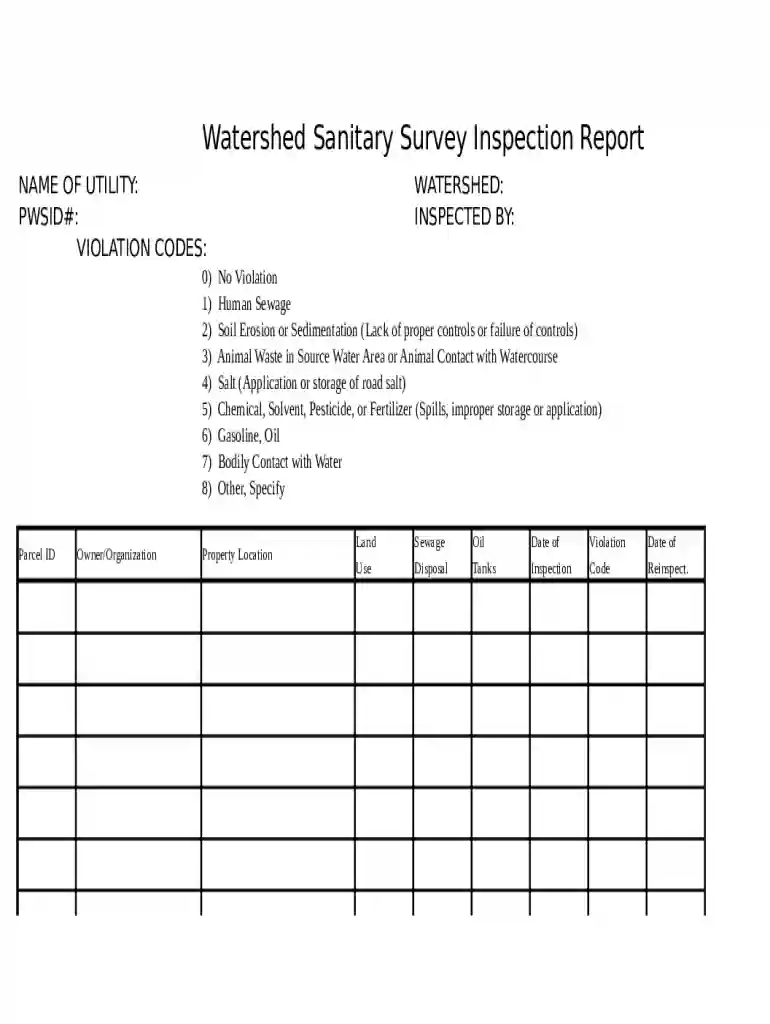
Watershed Sanitary Survey Inspection Report Preview on Page 1

Here's how it works

01. Edit your form online
Type text, add images, blackout confidential details, add comments, highlights and more.

02. Sign it in a few clicks
Draw your signature, type it, upload its image, or use your mobile device as a signature pad.

03. Share your form with others
Send it via email, link, or fax. You can also download it, export it or print it out.

Definition & Meaning

The Watershed Sanitary Survey Inspection Report is a detailed document used to evaluate and monitor the sanitary conditions of a utility's watershed area. It serves as a comprehensive record of potential violations related to contaminants such as human sewage, soil erosion, animal waste, and chemical spills. This inspection report is an essential tool for ensuring water quality and safety, capturing the intricacies of environmental assessments, and documenting key findings and recommendations for corrective actions.

Components of the Report

  • Violation Codes: These codes categorize different types of violations observed during the inspection. They help in the systematic documentation and analysis of sanitary hazards.
  • Property Location: This section records the geographic specifics of where inspection activities take place, aiding in location tracking and further analysis.
  • Inspection Remarks: Observations and notes from the inspection are documented here, providing additional context and insights into the findings.

Steps to Complete the Watershed Sanitary Survey Inspection Report

Completing this report involves a series of focused steps designed to capture the sanitary conditions accurately.

  1. Preparation Phase: Gather any historical data, maps, and previous reports related to the watershed area under inspection.

  2. Field Inspection: Conduct a thorough inspection of the watershed area, making note of any visible signs of pollution, sources of contaminants, or environmental hazards.

  3. Documentation: Use the report to document findings meticulously, including specific areas of concern, and potential sources of contamination.

  4. Coding Violations: Assign appropriate violation codes to each identified issue for easier reference and analysis.

  5. Input Inspection Remarks: Add detailed notes and observations from the field inspection in the remarks section, offering further insight into each finding.

  6. Review and Analysis: Carefully review the collected information to ensure accuracy and comprehensiveness. Evaluate any potential impact on water quality and public health.

  7. Submission: Submit the completed report to relevant authorities or internal departments for further action and compliance checks.

Follow-up Actions

  • Correction Plans: Develop a plan to address identified violations and prevent future occurrences. This could involve infrastructure improvements, policy changes, or enhanced monitoring strategies.

Key Elements of the Watershed Sanitary Survey Inspection Report

Several elements form the backbone of the report, each crucial for a comprehensive sanitary assessment:

  • Environmental Impact Assessment: Evaluating the potential impact of contaminants on water quality and surrounding ecosystems.
  • Source Identification: Pinpointing the origin of pollutants, whether from agricultural runoff, industrial waste, or failing sanitation systems.
  • Mitigation Strategies: Outlining strategies for contamination prevention and remediation, tailored to specific challenges within the watershed.
  • Regulatory Compliance: Ensuring the inspection practices align with state and federal environmental regulations to avoid penalties and ensure public safety.

Important Terms Related to Watershed Sanitary Survey Inspection Report

Understanding the terminology associated with this report is vital for proper completion and comprehension.

  • Contaminants: Substances that pollute the watershed, including chemicals, waste materials, and pathogens.
  • Erosion: The process by which soil is removed from one area and deposited in another, often accelerating waterway contamination.
  • Pollution Sources: Locations or activities that introduce contaminants into the watershed, such as farms, factories, or waste treatment plants.
  • Compliance Codes: Regulatory standards that must be met to ensure safe drinking water and environmental health.

Legal Use of the Watershed Sanitary Survey Inspection Report

This inspection report is a critical document for legal compliance and environmental management.

  • Regulatory Framework: The report ensures that utilities comply with laws such as the Clean Water Act, which mandates regular sanitary surveys of watershed areas to prevent pollution and safeguard public health.
  • Enforcement Actions: Should violations be found, the report may be used to guide legal actions or enforcement measures against entities failing to meet health and environmental standards.
  • Public Health Protection: By identifying and addressing potential sanitary issues, the report plays a vital role in protecting community health from waterborne diseases and contaminants.

Who Typically Uses the Watershed Sanitary Survey Inspection Report

This specialized report is utilized by various stakeholders in the water management sector.

  • Utility Companies: Regularly conduct sanitary inspections to maintain water quality and comply with regulatory requirements.
  • Environmental Agencies: Use the reports to monitor and enforce environmental protection standards.
  • Public Health Departments: Rely on the report data to assess risks and develop health advisories related to water quality.
  • Policy Makers: Utilize insights from the reports to shape and update legislation, ensuring that public health and environmental protection remain priorities.
decoration image ratings of Dochub

Versions or Alternatives to the Watershed Sanitary Survey Inspection Report

Different regions or organizations might have variations of the report to meet specific needs.

  • Regional Variants: Adaptations of the report may address unique challenges or regulatory requirements present in particular geographic areas.
  • Digital Versions: Many agencies now offer digital forms of the report, enabling easier data entry, sharing, and analysis.
  • Supplementary Reports: Additional documents may accompany the main report, providing more detailed analysis on specific contaminants or threats.

State-by-State Differences

Regulations and requirements for completing watershed sanitary surveys can vary significantly across different states.

  • California: Often has more stringent environmental regulations and may require more detailed assessments related to agricultural runoff.
  • Texas: Focuses heavily on managing industrial pollution sources, given its significant industrial activities and diverse water sources.

How to Obtain the Watershed Sanitary Survey Inspection Report

Acquiring this report involves navigating multiple sources and channels.

  • Local Utility Providers: Often serve as the initial point of contact for obtaining the report and additional documentation regarding the watershed area.
  • State Environmental Agencies: Offer access to previous reports and relevant data, useful for background research and comparative analysis.
  • Online Portals: Some states or agencies provide digital access to these reports, facilitating easier distribution and access for permitted users.
be ready to get more

Complete this form in 5 minutes or less

Get form

Security and compliance

At DocHub, your data security is our priority. We follow HIPAA, SOC2, GDPR, and other standards, so you can work on your documents with confidence.

Learn more
ccpa2
pci-dss
gdpr-compliance
hipaa
soc-compliance