Definition and Meaning of NY Divorce
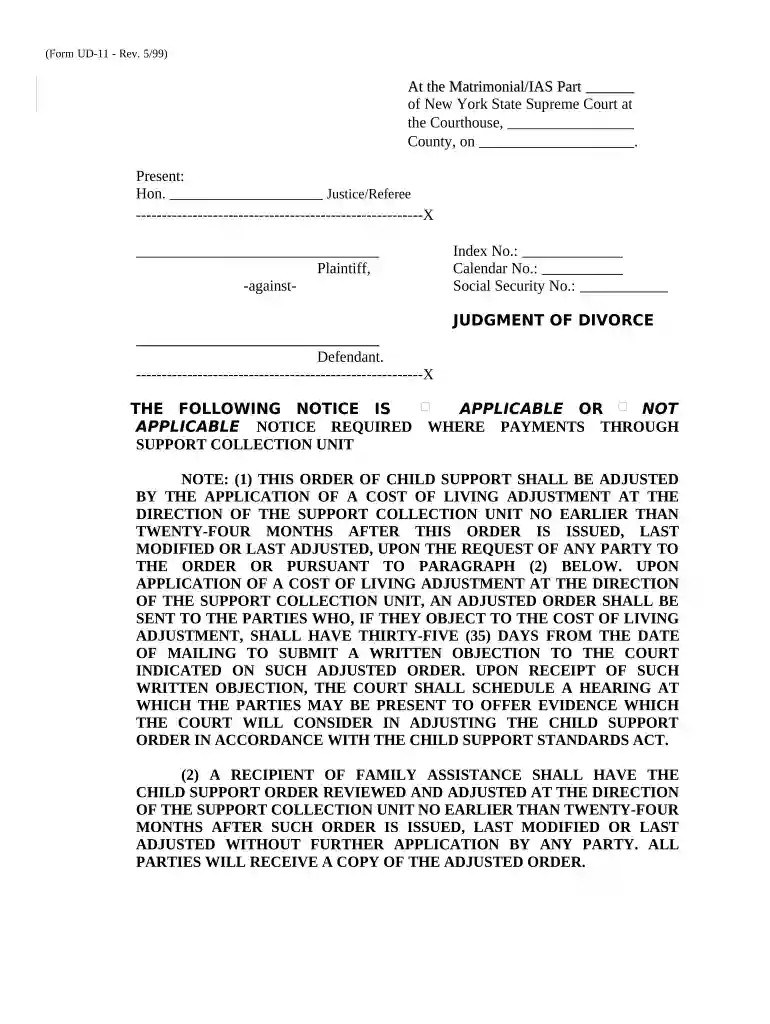
A divorce in New York, often referred to as a Judgment of Divorce, is a legal document issued by a court that finalizes the dissolution of a marriage. This decree outlines various terms related to the separation, including the division of assets, child custody arrangements, visitation rights, and child support obligations. It serves as the official record of the marital dissolution and is essential for both parties to establish their rights and responsibilities moving forward.
Components of a New York Divorce Decree
- Division of Assets: Details how marital assets and debts will be divided between the parties.
- Child Custody and Visitation: Specifies the custody arrangements for any children involved, including primary residency and visitation schedules.
- Child Support: Outlines the financial responsibilities each parent has towards their children, including the amount and frequency of payments.
- Maintenance Obligations: Addresses any spousal support, also known as alimony, that one party may be required to pay to the other.
- Enforcement Provisions: Details the methods of enforcement if either party fails to comply with the agreed terms.
Steps to Complete the NY Divorce Process
Completing a divorce in New York involves several structured steps. Understanding this process can help ensure that all necessary actions are taken in a timely manner.
- Determine Grounds for Divorce: Identify the legal reasons for seeking a divorce. New York accepts both fault and no-fault grounds.
- Complete Required Forms: Prepare necessary documents, including the summons, divorce petition, and if applicable, a statement of net worth.
- File with the Court: Submit completed forms to the appropriate New York Supreme Court. There is typically a filing fee.
- Serve the Other Spouse: Once the document is filed, the other spouse must be served with the divorce papers.
- Await Response: The receiving spouse has a limited time to respond to the petition. If no response is received, a default judgment may be sought.
- Negotiate Terms: If required, negotiate child custody, visitation, and support arrangements. Mediation can be beneficial in reaching amicable agreements.
- Attend Court Hearing: In some cases, a court hearing will be necessary to finalize the divorce, where both parties present their arguments.
- Receive Divorce Judgment: Once the court approves the divorce decree, both parties will receive a copy.
Important Terms Related to NY Divorce
Understanding key terminology associated with New York divorce can significantly aid individuals navigating the process.
- Judgment of Divorce: The final ruling by the court that officially ends the marriage.
- No-Fault Divorce: A type of divorce where couples can separate without proving wrongdoing by either party.
- Custody: Refers to the legal arrangement regarding who will care for the children, which can be sole, joint, legal, or physical.
- Support Obligations: Financial responsibilities that may include child support and spousal maintenance.
- Summons: A document notifying one party of legal action taken against them, requiring their response.
Required Documents for NY Divorce
Several documents must be gathered and completed when filing for a divorce in New York. Proper documentation helps in ensuring a smooth process.
- Divorce Petition: This initiates the divorce process and outlines the desired outcomes.
- Summons: This document is served to the other spouse to inform them of the divorce action.
- Affidavit of Service: Proof that the other spouse has been formally served the divorce papers.
- Statement of Net Worth: A financial disclosure detailing the assets and debts of both parties.
- Child Support Worksheet: Required if there are minor children involved, detailing the financial needs of the children.
Examples of Using the NY Divorce
Navigating divorce in New York can be complex, with various scenarios demonstrating how different aspects of the process apply in practical situations.
- Contested Divorce Scenario: In this situation, one spouse contests the divorce terms, leading to court hearings to resolve disputes over asset division and child custody.
- Uncontested Divorce Example: Both parties agree on all terms, including asset division and custody arrangements, allowing for a more straightforward court approval of the divorce decree.
- Modification of Support: A previously determined child support amount may require adjustment if either parent’s financial situation changes significantly, necessitating legal action to modify the initial agreement.
Key Elements of the NY Divorce Process
Several critical elements shape the divorce process in New York, impacting the outcome for the involved parties. Understanding these can help streamline the experience.
- Equitable Distribution: New York follows an equitable distribution law, which means that marital property is divided fairly, though not necessarily equally.
- Child Support Guidelines: The state follows specific formulas to determine child support amounts based on income and the number of children involved.
- Spousal Support: The court considers several factors when determining whether spousal support (alimony) is necessary, including the duration of the marriage and the financial circumstances of each party.
- Custody Determination: Courts prioritize the best interests of the child when determining custody arrangements, often conducting evaluations if disputes arise.
Legal Use of the NY Divorce
Understanding the legal implications of a New York divorce is essential, as it establishes rights and responsibilities for both parties moving forward.
- Binding Agreement: A divorce decree serves as a legally binding agreement governing the conduct of both parties post-divorce.
- Right to Remarry: Once the divorce is finalized, both parties have the legal right to remarry without restrictions.
- Enforcement of Orders: Terms set forth in the divorce decree can be enforced in court if one party fails to comply, allowing for legal recourse to resolve disputes.
Filing Deadlines and Important Dates in NY Divorce
Awareness of key deadlines and dates can significantly affect the filing process and subsequent proceedings.
- Filing Deadline: The time limit imposed varies based on residency requirements; however, applicants must ensure that they file in compliance with state regulations.
- Response Time for Spouse: The spouse served with divorce papers typically has twenty days to respond if served in New York, or thirty days if served outside the state.
- Summer Picking Dates: Certain months may affect court scheduling; filing during these times may lead to delays.
Digital vs. Paper Version of NY Divorce Forms
In today's digital age, individuals have the option to file for divorce using digital methods or traditional paper submissions.
- Digital Submission: Many courts allow electronic filing (e-filing), which can expedite processing times but may require adherence to specific technical guidelines.
- Paper Submission: Traditional method of submitting documents in person or via mail, which may be preferable for individuals less comfortable with technology or those requiring immediate verification of filing.
By understanding these critical aspects, individuals seeking a divorce in New York can navigate the process more effectively, ensuring that their rights and responsibilities are clearly defined and legally recognized.