




01. Edit your modified barthel index calculator online
Type text, add images, blackout confidential details, add comments, highlights and more.

Type text, add images, blackout confidential details, add comments, highlights and more.

Draw your signature, type it, upload its image, or use your mobile device as a signature pad.

Send barthel index via email, link, or fax. You can also download it, export it or print it out.
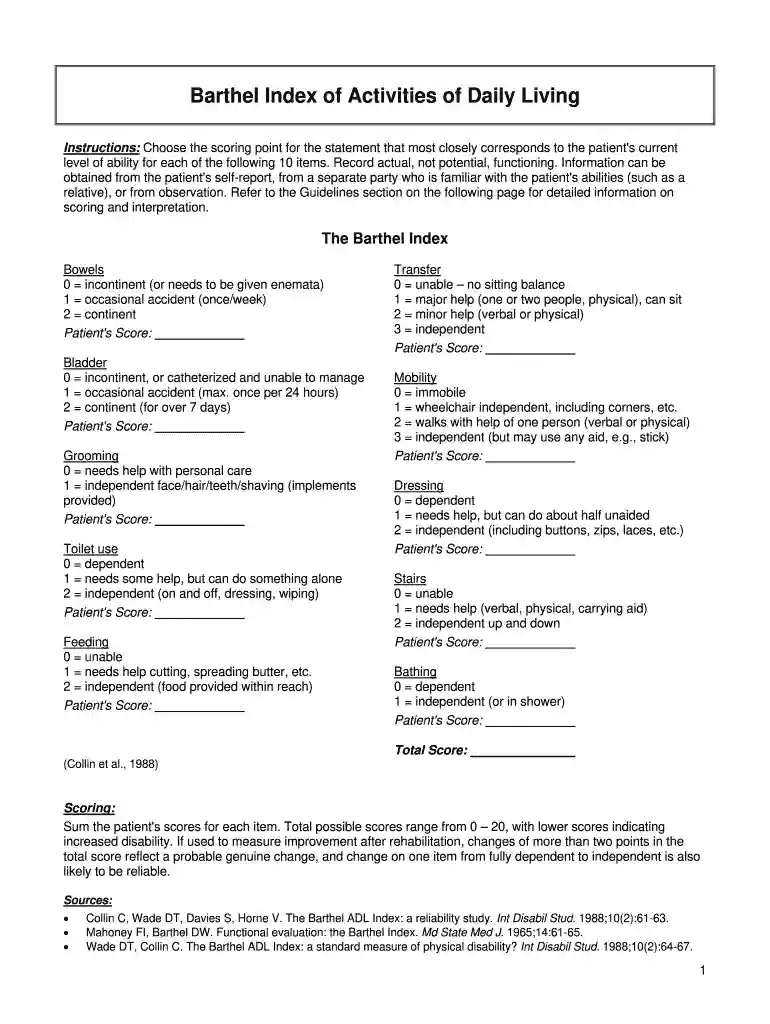
The Barthel Index, often referred to as the Barthel Index of Activities of Daily Living (ADL), is a widely recognized assessment tool used to measure an individual's level of independence in performing daily tasks. Primarily designed for older adults or individuals recovering from illness or injury, the index evaluates ten specific activities that are crucial for personal care and mobility. These activities include feeding, bathing, grooming, dressing, bowel control, bladder control, toilet use, transfers (bed to chair), mobility (walking), and stair climbing.
The scoring for the Barthel Index ranges from zero to twenty, with higher scores representing greater independence. Scores of zero indicate total dependence, while a score of twenty denotes complete independence in all assessed activities. This scale offers healthcare providers a standardized method to assess functional status, monitor progression, and tailor rehabilitation strategies effectively.
Using the Barthel Index form printable is straightforward, making it accessible for healthcare professionals and caregivers. Here’s a step-by-step approach to efficiently utilize the form for assessment:
Obtain the Form: First, download or print the Barthel Index form printable. This can commonly be found on healthcare resource websites or through healthcare providers.
Identify the Individual: Clearly denote the name of the individual being assessed at the top of the form. It is important to gather personal information to maintain accurate records.
Assess Each Activity: Evaluate the individual against each of the ten activities listed. The form provides criteria to score performance in each category, whether the person requires complete assistance, partial assistance, or can perform the activity independently.
Score the Responses: Based on the assessment, provide a score for each activity according to the established guidelines. Make sure to document the scores accurately on the form.
Calculate the Total Score: After all activities have been scored, total the scores to determine the overall Barthel Index score for the individual.
Interpret the Results: Use the total score to assess the level of independence. Scores will inform care strategies and decision-making regarding additional support or rehabilitation.
Completing the Barthel Index form printable requires attention to detail and an understanding of the person's abilities. Here’s how to navigate through the form's sections methodically:
Review the Activities: Familiarize yourself with the ten activities listed in the index. Each activity has specific scoring criteria, making it critical to understand what each score reflects.
Conduct an Observational Assessment: Ideally, assess the individual in their daily living environment to obtain the most accurate representation of their abilities. This context may reveal nuances in their independence.
Consult with the Individual: If possible, involve the person being assessed in the process. This engagement can provide insights into their confidence and perceived abilities.
Document Responses Clearly: As you fill out the form, ensure that responses are clear and legible. Inconsistent or illegible entries can lead to misinterpretations.
Review and Validate: Before finalizing the form, review the scores with another professional or caregiver if applicable. This practice can help ensure accuracy and a consensus about the individual's capabilities.
Store the Form Securely: After completing the assessment, store the form securely in the individual’s medical records or care plan for future reference.
The Barthel Index form printable serves multiple purposes that contribute significantly to evaluating and enhancing patient care:
Standardized Assessment: The use of a standardized tool like the Barthel Index ensures that evaluations are consistent and reliable across different healthcare settings.
Identifying Rehabilitation Needs: By determining the level of independence, healthcare professionals can tailor rehabilitation programs to meet specific needs, enabling more effective and personalized care strategies.
Monitoring Progress: Regular assessments using the Barthel Index allow for tracking changes in an individual’s functional status over time, facilitating timely adjustments in care approaches.
Facilitating Communication: The Barthel Index provides a clear framework for communicating an individual's capabilities among healthcare providers, caregivers, and families, enhancing collaboration in care planning.
Insurance and Legal Documentation: The documentation generated through the Barthel Index may be required for insurance purposes or medical legal documentation, reinforcing its importance in clinical practice.
The Barthel Index form printable is utilized by a diverse range of professionals and caregivers involved in the assessment and support of individuals with varying levels of functional independence:
Healthcare Providers: Physicians, nurses, and occupational therapists rely on the Barthel Index to evaluate patients' functional abilities in settings such as hospitals, rehabilitation centers, and long-term care facilities.
Physical Therapists: These professionals use the index to gauge patients’ progress during physical rehabilitation, adjusting therapy plans based on assessment outcomes.
Caregivers: Family members and formal caregivers who wish to understand and document the abilities of their loved ones or clients often find the Barthel Index form beneficial.
Researchers: In clinical studies and trials, the Barthel Index serves as a valid measure for evaluating functional outcomes, making it an essential tool for researchers investigating interventions in populations with disabilities.
Insurance Assessors: Professionals responsible for reviewing claims and providing assessments for long-term care insurance may utilize the Barthel Index to decide on eligibility and benefits.


The Barthel Index form printable contains crucial elements that ensure comprehensive assessments:
Personal Information Section: This includes fields for the individual’s name, age, gender, and medical history, assisting in contextualizing the assessment.
Activity Evaluation Table: Each of the ten ADLs is presented in a structured table format for scoring, ensuring clarity and facilitating easy completion.
Score Calculation Field: This section allows for quick reference to tally scores accurately, leading to an efficient assessment process.
Interpretation Guidelines: The form often includes scoring interpretations, explaining what the recorded scores mean in terms of independence levels and care recommendations.
Signature Line for Evaluators: A space for the evaluator’s signature is included to authenticate the assessment, adding credibility and accountability to the evaluation process.
Date of Assessment: Documenting the date ensures that tracking progress over time can be straightforward and organized.
The Barthel Index form printable stands as a valuable tool in the healthcare landscape, synthesizing essential information to foster better outcomes for individuals requiring support with daily activities.
We've got more versions of the modified barthel index calculator form. Select the right modified barthel index calculator version from the list and start editing it straight away!
| Versions | Form popularity | Fillable & printable |
|---|---|---|
| 2025 | 4 Satisfied (34 Votes) | |
| 2025 | 4.8 Satisfied (31 Votes) | |
| 2025 | 4.3 Satisfied (34 Votes) | |
| 2025 | 4.2 Satisfied (34 Votes) | |
| 2025 | 4.6 Satisfied (55 Votes) | |
| 2025 | 4.5 Satisfied (44 Votes) | |
| 2025 | 4.2 Satisfied (37 Votes) | |
| 2025 | 4.7 Satisfied (34 Votes) | |
| 2024 | 4.3 Satisfied (21 Votes) | |
| 2024 | 4.6 Satisfied (51 Votes) | |
| 2024 | 4.5 Satisfied (23 Votes) | |
| 2024 | 4.8 Satisfied (29 Votes) | |
| 2024 | 4.1 Satisfied (28 Votes) | |
| 2024 | 4.9 Satisfied (51 Votes) | |
| 2024 | 4.4 Satisfied (31 Votes) |
At DocHub, your data security is our priority. We follow HIPAA, SOC2, GDPR, and other standards, so you can work on your documents with confidence.
The objective of the programme is to elaborate and publish in the form of monographs critical reviews of data on carcinogenicity for chemicals and complexRead more
See full PDF downloadDownload PDF. THE Patient Name: Linda BARTHEL Rater Name: Arwinda Nur Rahma INDEX Date: 25th April 2020 Activity Score FEEDING 0Read more


