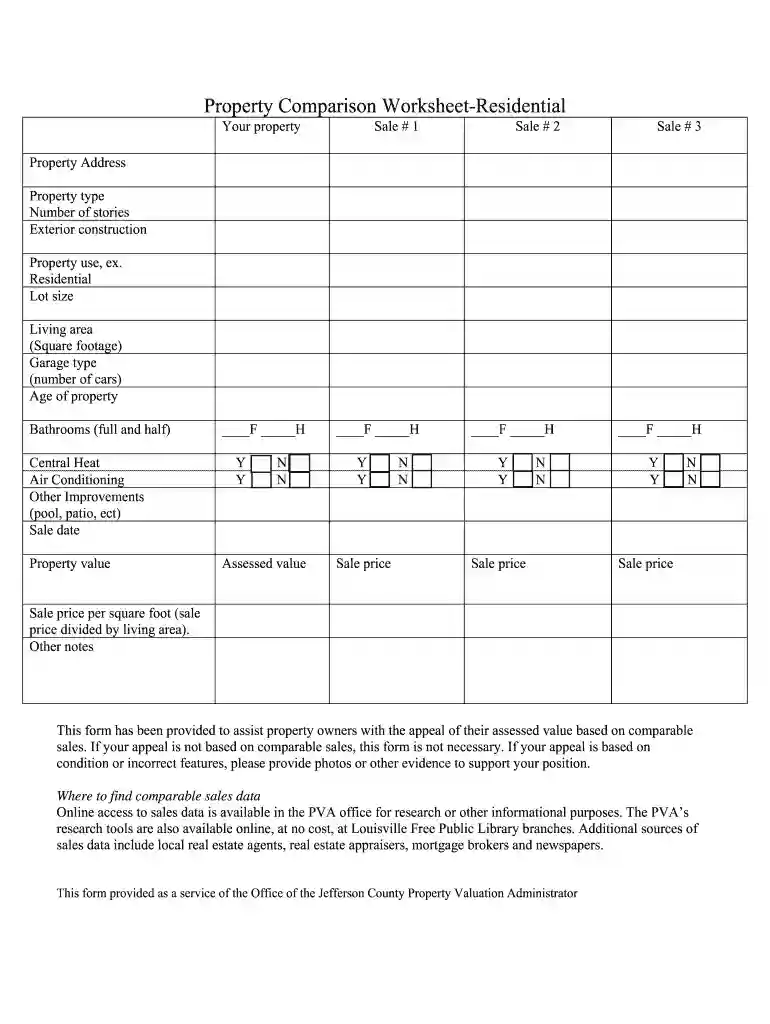
Property comparison worksheet 2026

Get Form
property comparison worksheet Preview on Page 1

Here's how it works

01. Edit your property comparison worksheet online
Type text, add images, blackout confidential details, add comments, highlights and more.

02. Sign it in a few clicks
Draw your signature, type it, upload its image, or use your mobile device as a signature pad.

03. Share your form with others
Send apartment comparison spreadsheet via email, link, or fax. You can also download it, export it or print it out.

How to use or fill out property comparison worksheet with our platform

Form edit decoration
9.5
Ease of Setup
DocHub User Ratings on G2
9.0
Ease of Use
DocHub User Ratings on G2
  1. Click ‘Get Form’ to open the property comparison worksheet in the editor.
  2. Begin by entering the property address for Sale #1 in the designated field. Ensure accuracy as this is crucial for comparison.
  3. Fill in the property type, number of stories, and exterior construction details. This information helps categorize properties effectively.
  4. Input the lot size and living area (square footage) to provide a clear picture of each property's dimensions.
  5. Indicate garage type and age of the property. These factors can significantly influence market value.
  6. Complete the sections for bathrooms, central heat, air conditioning, and any other improvements like pools or patios.
  7. Record sale dates and values for each comparable sale. This data is essential for assessing your property's worth against others.
  8. Finally, add any additional notes that may support your appeal regarding assessed value discrepancies.

Start using our platform today to streamline your property comparisons effortlessly!

See more property comparison worksheet versions

We've got more versions of the property comparison worksheet form. Select the right property comparison worksheet version from the list and start editing it straight away!
Versions Form popularity Fillable & printable
2010 4.8 Satisfied (123 Votes)
be ready to get more

Complete this form in 5 minutes or less

Get form

Got questions?

We have answers to the most popular questions from our customers. If you can't find an answer to your question, please contact us.
Contact us
Todays technology and online resources allow homeowners and investors to run comps without the help of a real estate agent or the MLS. Factors to consider when choosing the best comps include the sale date, location of the comp, square footage, number of bedrooms and bathrooms, and lot size and shape.
Here are several methods that you can use to help determine your homes value: Use online home valuation tools. Hire a professional appraiser. Consult an agent for a comparative market analysis. Pull comps on similar properties. Use automated valuation models (AVMs) Review property tax assessments.
Even if you dont have access to the MLS, you can use Zillow to run comps for free and find out how much your house is worth. With a bit of work, you should be able to get a far more accurate number than Zillows Zestimate or other automated valuations.
There are several additional resources for finding comps: Public property records: If you want to find the sale price of a specific comparable, the county usually keeps those records. Zillow: Search on Zillow using the Recently Sold filter. Zillow pricing tool: Try this pricing tool to find comps in your area.
But you can also find general comps yourself, for free, by looking online at recent sales in your neighborhood. Listing sites like Zillow or Realtor.com can be useful for this. Find the recently-sold homes most similar to yours and check prices to see how much they sold for.

Security and compliance

At DocHub, your data security is our priority. We follow HIPAA, SOC2, GDPR, and other standards, so you can work on your documents with confidence.

Learn more
ccpa2
pci-dss
gdpr-compliance
hipaa
soc-compliance
be ready to get more

Complete this form in 5 minutes or less

Get form

People also ask

Compare Properties These should be analyzed to determine how they match up to the property being sold in terms of square footage, location, the number of bathrooms and bedrooms, the lot size, the age of the property, its layout, and its condition.
Here are five ways you can compare house prices in your area. Use an automated valuation model (AVM) AVMs use data about your home and about the surrounding market to estimate home value. Perform a comparative market analysis (CMA) Stay in the neighborhood. Keep track of trends. Hire a real estate agent.

adding comparison web property