Get and manage Uniform Anatomical Gift Act online

Speed up your file operations using our Uniform Anatomical Gift Act category with ready-made templates that meet your requirements. Get your document, alter it, fill it, and share it with your contributors without breaking a sweat. Begin working more efficiently with your documents.

The best way to use our Uniform Anatomical Gift Act:

  1. Open our Uniform Anatomical Gift Act and look for the form you need.
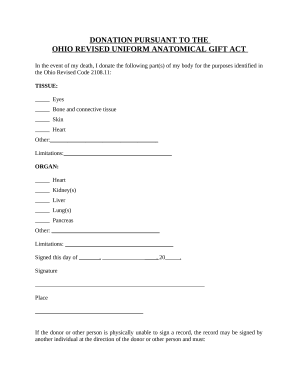
  2. Preview your document to ensure it’s what you want, and click on Get Form to begin working on it.
  3. Edit, add new text, or highlight important information with DocHub tools.
  4. Fill out your form and save the modifications.
  5. Download or share your form with other people.

Explore all of the opportunities for your online file management with the Uniform Anatomical Gift Act. Get a totally free DocHub profile right now!


Video Guide on Uniform Anatomical Gift Act management

video background

Commonly Asked Questions about Uniform Anatomical Gift Act

The Uniform Anatomical Gift Act of 1968 The first Uniform Anatomical Gift Act was created after the first successful heart transplant in 1967; the operation was performed by Dr. Christiaan Barnard. In 1968, Congress approved the UAGA and recommended that all states adopt it.
Legal framework for the donation of organs, tissues and other human anatomy parts in the US. Passed in 1968, revised in 1987 and 2006. Ensures/regulates health and safety of American workers through regulations, laws and their enforcement.
The Uniform Anatomical Gift Act (UAGA or the Act) was passed in the US in 1968 and has since been revised in 1987 and in 2006. The Act sets a regulatory framework for the donation of organs, tissues, and other human body parts in the US. The UAGA helps regulate body donations to science, medicine, and education.
Introduction. Organ and tissue donation occurs after a person has died. Transplantable organs and tissue can be donated to help the lives of individuals in need. Anatomical gift means a donation of all or part of a human body, after death, for the purpose of transplantation, therapy, research or education.
1987 Uniform Anatomical Gift Act, 1987 Version, A model statute, intended for adoption in every jurisdiction. A revision to the original 1968 UAGA to deem a persons legal consent to donate before death irrevocable (without an indication that the consent was no longer valid).
What was the purpose of the creation of the Uniform Anatomical Gift Act? To allow individuals to donate their bodies to science after death.
The act allows a decedent or surviving relatives to donate certain parts of the decedents organs for certain purposes, such as giving to those in need or for medical research. The act was revised in 1987 and again in 2006. The revisions made in 2006 aimed to address shortages and encourage donation.