Revised Uniform Anatomical Gift Act Donation - Idaho 2026

Get Form
Revised Uniform Anatomical Gift Act Donation - Idaho Preview on Page 1

Here's how it works

01. Edit your form online
Type text, add images, blackout confidential details, add comments, highlights and more.
02. Sign it in a few clicks
Draw your signature, type it, upload its image, or use your mobile device as a signature pad.
03. Share your form with others
Send it via email, link, or fax. You can also download it, export it or print it out.

How to use or fill out Revised Uniform Anatomical Gift Act Donation - Idaho with our platform

Form edit decoration
9.5
Ease of Setup
DocHub User Ratings on G2
9.0
Ease of Use
DocHub User Ratings on G2
  1. Click ‘Get Form’ to open the Revised Uniform Anatomical Gift Act Donation - Idaho in the editor.
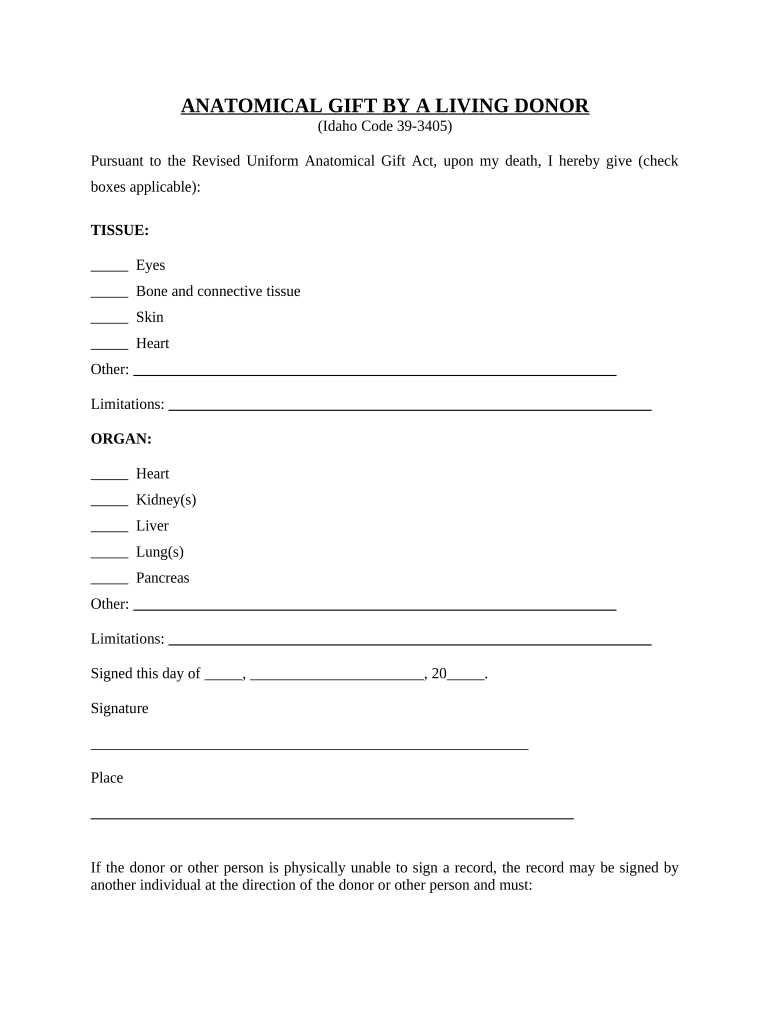
  2. Begin by selecting the tissues you wish to donate. Check the applicable boxes for Eyes, Bone and connective tissue, Skin, Heart, or specify any other tissue in the provided space.
  3. Next, indicate any limitations regarding your tissue donation in the designated area.
  4. Proceed to the organ donation section. Check the boxes for Heart, Kidney(s), Liver, Lung(s), Pancreas, or write down any other organ you wish to donate.
  5. Again, specify any limitations related to your organ donation in the provided space.
  6. Sign and date the form at the bottom. Ensure that your signature is clear and legible.
  7. If you are unable to sign yourself, have another individual sign on your behalf while ensuring it is witnessed by at least two adults as per the guidelines provided.
  8. Complete the witness section by having witnesses sign and provide their names and addresses.

Start using our platform today for free to complete your anatomical gift donation form effortlessly!

be ready to get more

Complete this form in 5 minutes or less

Get form

Got questions?

We have answers to the most popular questions from our customers. If you can't find an answer to your question, please contact us.
Contact us
Introduction. Organ and tissue donation occurs after a person has died. Transplantable organs and tissue can be donated to help the lives of individuals in need. Anatomical gift means a donation of all or part of a human body, after death, for the purpose of transplantation, therapy, research or education.
The act eliminates the specific bar on post-mortem donations by someone who knows the decedent refused to donate. Instead, it bars anyone, other than the parents of a deceased minor, from making a donation if the donor refused in writing to donate and did not revoke this refusal or expressly indicate otherwise.
(1) Adult means an individual who is at least eighteen (18) years of age. (b) Expressly authorized to make an anatomical gift on the principals behalf by any other record signed by the principal.
The primary law governing organ donation in the United States is the Uniform Anatomical Gift Act (UAGA) (1). The UAGA is a model legislation drafted by the Uniform Commissioners that is then passed into law state by state.
The Uniform Act, which is appended, received the endorsement of the American Bar Association on Aug 7, 1968. The Act is designed to facilitate the donation and use of human tissues and organs for transplantation and other medical purposes and provides a favorable legal environment for such activities.

Security and compliance

At DocHub, your data security is our priority. We follow HIPAA, SOC2, GDPR, and other standards, so you can work on your documents with confidence.

Learn more
ccpa2
pci-dss
gdpr-compliance
hipaa
soc-compliance

People also ask

After donation, the donor is taken to a funeral home, and the OPO works with the funeral director to honor the donor and donor familys funeral wishes. An open casket funeral is possible after organ donation.
The 2006 revised act: expanded the list of persons who can consent to organ donation on behalf of an individual; gave every individual the opportunity to donate their organs at or near death; and stated that individuals who refuse to donate must explicitly state so.

Related links