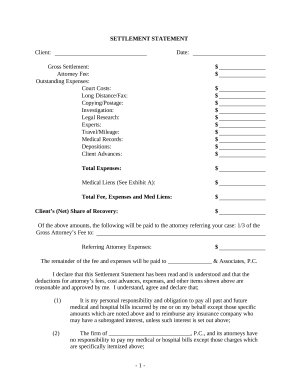
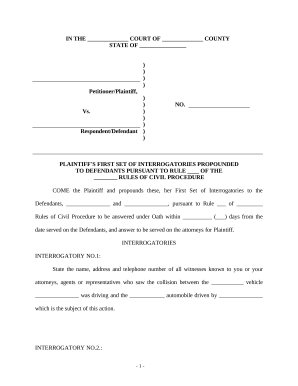
Transform your form administration with Accident & Injury Law

Your workflows always benefit when you can discover all the forms and documents you require at your fingertips. DocHub gives a a large collection forms to alleviate your daily pains. Get hold of Accident & Injury Law category and easily discover your form.

Start working with Accident & Injury Law in several clicks:

  1. Access Accident & Injury Law and get the form you require.
  2. Click on Get Form to open it in our editor.
  3. Begin editing your file: add fillable fields, highlight sentences, or blackout sensitive data.
  4. The application saves your adjustments automatically, and after you are all set, you can download or distribute your form with other contributors.

Enjoy effortless file administration with DocHub. Check out our Accident & Injury Law category and locate your form right now!


Video Guide on Accident & Injury Law management

video background

Commonly Asked Questions about Accident & Injury Law

Canadian personal injury law operates under the principle of contributory negligence. This means that even if you share some responsibility for the accident, you may still be eligible for compensation. However, your awarded damages will be reduced based on your degree of fault.
Canadas common law has already set a limit for general damages, or for pain and suffering, that an injured person may demand from the other party. It was decided in 1978, when three cases decided by the Supreme Court held that general damages will be subject to an upper limit of $100,000.
Auto coverage provides protection for personal injury and property damage. Across Canada, the minimum coverage you are required by law to purchase is also referred to as mandatory coverage. Where and how you can purchase auto insurance coverage is set out by provinces and territories.
For instance, in Ontario, you generally have two years from the accident date to file a lawsuit, while in other provinces, it could be different. Impact on Legal Action: Missing the deadline could bar you from filing a lawsuit, rendering you unable to seek compensation for damages resulting from the accident.
In a car accident lawsuit, you may claim various types of damages, including: Medical Expenses: Compensation for past and future medical treatments related to the accident. Lost Wages: Reimbursement for income lost due to the accident. Pain and Suffering: Compensation for physical pain and emotional distress.
The Supreme Court set an upper limit of $100,000 (equivalent to approximately $447,550 in April of 2024 after adjusting for inflation) for non-pecuniary damages, which include pain and suffering, loss of enjoyment of life, and loss of amenities.
Personal injury law, or sometimes referred to as tort law, covers cases where a person is hurt or injured, as a result of someone elses negligence. This is a form of civil law, which means one private party is suing another, unlike criminal law where the government prosecutes someone.
Canadian law provides for compensation for pain and suffering for injured people. General damages for pain and suffering are intended to compensate an injured victim for the pain and suffering, loss of amenities of life, inconvenience, and loss of enjoyment of life.