




01. Edit your form online
Type text, add images, blackout confidential details, add comments, highlights and more.

Type text, add images, blackout confidential details, add comments, highlights and more.

Draw your signature, type it, upload its image, or use your mobile device as a signature pad.

Send it via email, link, or fax. You can also download it, export it or print it out.
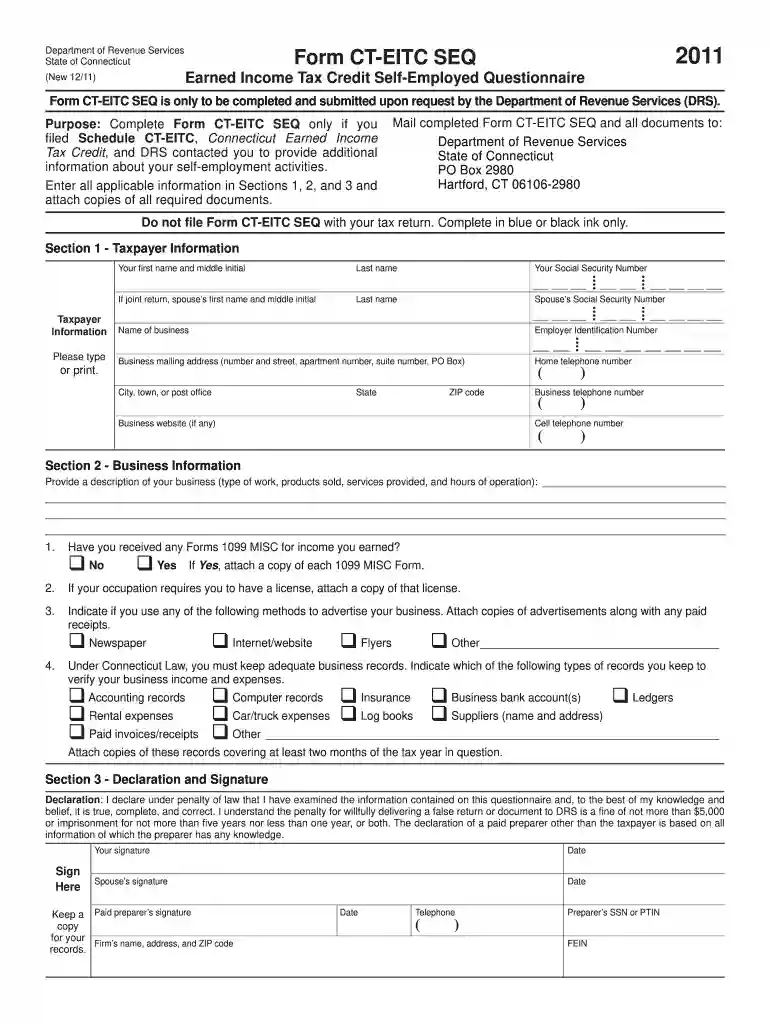
The "EITC Forms 2011" refer to the specific documentation required for claiming the Earned Income Tax Credit (EITC) for the tax year 2011. This credit is a federal tax benefit designed to assist low-to-moderate income working individuals and families by reducing the amount of tax owed or providing a refund. The EITC helps increase the financial stability of eligible taxpayers by supplementing their earnings.
The EITC forms typically include IRS Form 1040, Schedule EIC for individuals with qualifying children, and other related documentation that validates income, family size, and filing status. In 2011, the eligibility criteria and credit amounts varied by the number of qualifying children and income level, necessitating specific forms to ensure accurate credit calculation.
Gather Required Documents: Start by collecting all necessary information, including W-2s, 1099 forms, and any other income documentation. Ensure you have Social Security numbers for all qualifying children.
Determine Eligibility: Use the income thresholds and qualifying child guidelines specific to 2011 to confirm your eligibility. Refer to IRS Publication 596 for detailed criteria.
Complete Form 1040: Enter your personal information and calculate your taxable income. Make sure to indicate your filing status, which impacts your EITC eligibility.
Fill Out Schedule EIC: If you have one or more qualifying children, fill out Schedule EIC, providing details about each child, such as age, relationship to you, and residency.
Calculate Your Credit: Use the EITC worksheet in the instructions for Form 1040 to determine the amount of credit you qualify for based on your filing status and income.
Submit the Forms: Mail your completed forms to the IRS or file electronically. Electronic filing can expedite processing and ensure your forms are accurate and complete.
The IRS outlines specific guidelines for claiming the EITC, emphasizing the importance of accuracy and honesty in reporting. Misreporting your income or dependents can lead to denial of the credit and potential penalties.
Eligibility for the 2011 EITC depends on several factors, including income level, filing status, and the number of qualifying children. It's essential to:


To access the EITC forms for 2011, you can download them directly from the IRS website or request paper copies from the IRS by phone. Additionally, tax preparation software often includes these forms and instructions, which can facilitate easier completion and submission.
Failure to comply with EITC requirements or fraudulent filing can lead to significant penalties. Consequences may include:
While the EITC is a federal program, some states offer their own version of the credit, which may require additional paperwork or adherence to different standards. Residents should check state-specific guidelines, as these credits can augment the federal EITC, providing further benefits.
Using software such as TurboTax or QuickBooks can streamline the process of filing for the EITC. These programs often provide step-by-step guidance, automatic calculations, and built-in error checks to ensure compliance with all IRS guidelines.
This comprehensive guide should help you navigate the EITC forms for 2011 effectively, ensuring a smooth filing process and maximizing potential benefits.
We've got more versions of the eitc forms 2011 form. Select the right eitc forms 2011 version from the list and start editing it straight away!
| Versions | Form popularity | Fillable & printable |
|---|---|---|
| 2024 | 4.1 Satisfied (36 Votes) | |
| 2023 | 4.7 Satisfied (22 Votes) | |
| 2021 | 4.8 Satisfied (55 Votes) | |
| 2020 | 4.2 Satisfied (60 Votes) | |
| 2019 | 4.2 Satisfied (72 Votes) | |
| 2018 | 4.4 Satisfied (166 Votes) | |
| 2016 | 4.3 Satisfied (308 Votes) | |
| 2015 | 4 Satisfied (35 Votes) | |
| 2013 | 3.9 Satisfied (52 Votes) | |
| 2011 | 4.2 Satisfied (67 Votes) |
At DocHub, your data security is our priority. We follow HIPAA, SOC2, GDPR, and other standards, so you can work on your documents with confidence.
Jan 12, 2012 To claim the EIC, you must meet certain rules. These rules are summarized in Table 1. Table 1. Earned Income Credit in a Nutshell. Second, youRead more
Earned Income Tax Credit (EITC). In FY 2011, AMTAP reviewed almost. 1.8 During FY 2011, the IRS updated forms to help taxpayers comply with filing.Read more
by N Eissa 2011 Cited by 141 The structure of the EITC, which takes the form of an earnings subsidy that is phased out at earnings above around $15,000, provides incentives to increase.Read more


