




01. Edit your ct eitc seq online
Type text, add images, blackout confidential details, add comments, highlights and more.

Type text, add images, blackout confidential details, add comments, highlights and more.

Draw your signature, type it, upload its image, or use your mobile device as a signature pad.

Send ct eitc information request notice via email, link, or fax. You can also download it, export it or print it out.
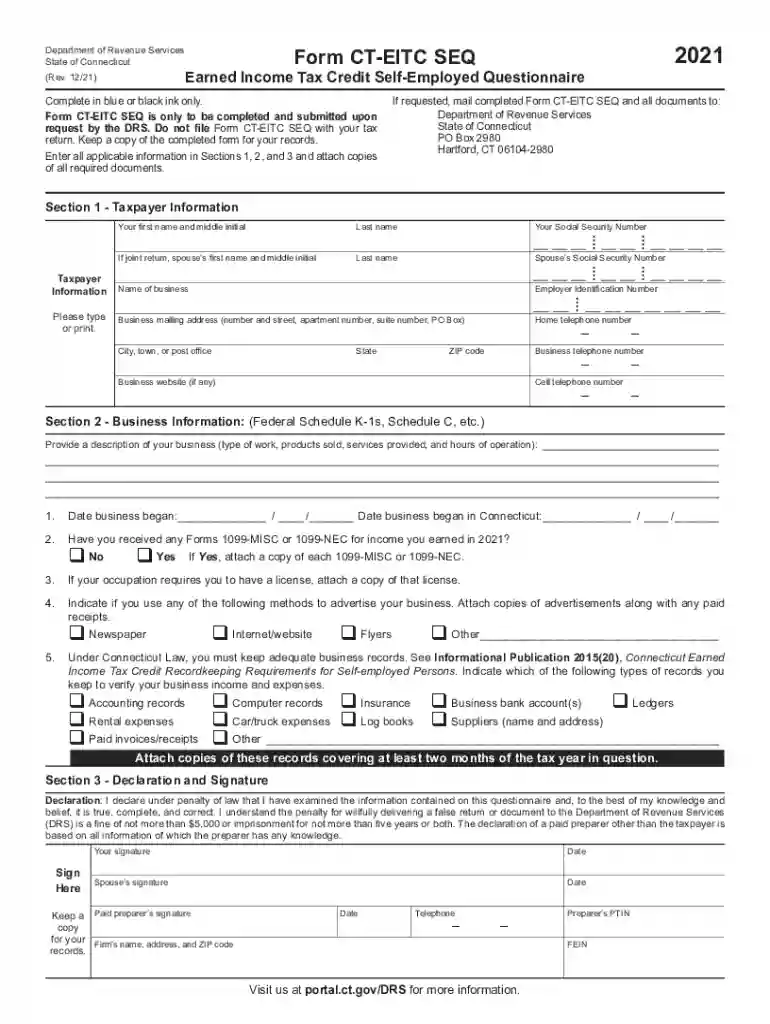
The CT-EITC, or Connecticut Earned Income Tax Credit, is a state-level tax credit program that mirrors the federal Earned Income Tax Credit (EITC) to support low-to-moderate-income working individuals and families. The primary aim of the CT-EITC is to reduce the amount of tax owed and potentially increase the tax refund for eligible taxpayers by matching a percentage of the federal EITC. In Connecticut, this form provides additional financial relief, enhancing the taxpayer's ability to meet necessary expenses.
To gain access to the CT-EITC, eligible taxpayers must claim it using the state tax form. This involves reporting the federal EITC already claimed, as the CT-EITC is calculated as a percentage of that amount. Individuals do not need to fill out a separate form solely for CT-EITC but should ensure their state return accurately reflects pertinent financial data regarding earnings and family size.
Completing the CT-EITC involves a precise process ensuring all eligibility criteria are met and documented. This process requires close attention to detail in both federal and state filings.
Understanding certain terminologies is crucial when dealing with the CT-EITC to avoid errors and ensure proper filing.
The CT-EITC eligibility hinges on meeting specific income thresholds and family conditions. Applicants should thoroughly comprehend these requirements to successfully claim the credit.


To claim the CT-EITC, accuracy in documentation is crucial. Necessary paperwork supports your eligibility and credit amount.
Submitting the CT-EITC requires specific methods to ensure the seamless processing of your tax return and subsequent credit.
Non-compliance with the CT-EITC regulations can lead to penalties, emphasizing the importance of accuracy and honesty in your application.
Timing is critical when filing for CT-EITC to avoid penalties and ensure timely receipt of the credit.
We've got more versions of the ct eitc seq form. Select the right ct eitc seq version from the list and start editing it straight away!
| Versions | Form popularity | Fillable & printable |
|---|---|---|
| 2024 | 4.1 Satisfied (36 Votes) | |
| 2023 | 4.7 Satisfied (22 Votes) | |
| 2021 | 4.8 Satisfied (55 Votes) | |
| 2020 | 4.2 Satisfied (60 Votes) | |
| 2019 | 4.2 Satisfied (72 Votes) | |
| 2018 | 4.4 Satisfied (166 Votes) | |
| 2016 | 4.3 Satisfied (308 Votes) | |
| 2015 | 4 Satisfied (35 Votes) | |
| 2013 | 3.9 Satisfied (52 Votes) | |
| 2011 | 4.2 Satisfied (67 Votes) |
At DocHub, your data security is our priority. We follow HIPAA, SOC2, GDPR, and other standards, so you can work on your documents with confidence.
You meet the gross income test (see below);; You had a federal alternative minimum tax liability;; You are claiming the Connecticut earned income tax credit (CTRead more
EITC payments were issued improperly. The. IRS is unlikely to achieve an CT, Arkansas (Sep. 14, 2015), where an IRA was not protected by bankruptcyRead more
The Connecticut Earned Income Tax Credit (or CT EITC) is a refundable state income tax credit for low to moderate income working individuals and families.Read more


