

Ut intent division water 2026

Get Form
ut intent division water Preview on Page 1

Here's how it works

01. Edit your form online
Type text, add images, blackout confidential details, add comments, highlights and more.
02. Sign it in a few clicks
Draw your signature, type it, upload its image, or use your mobile device as a signature pad.
03. Share your form with others
Send it via email, link, or fax. You can also download it, export it or print it out.

How to use or fill out ut intent division water with our platform

Form edit decoration
9.5
Ease of Setup
DocHub User Ratings on G2
9.0
Ease of Use
DocHub User Ratings on G2
  1. Click ‘Get Form’ to open the ut intent division water in the editor.
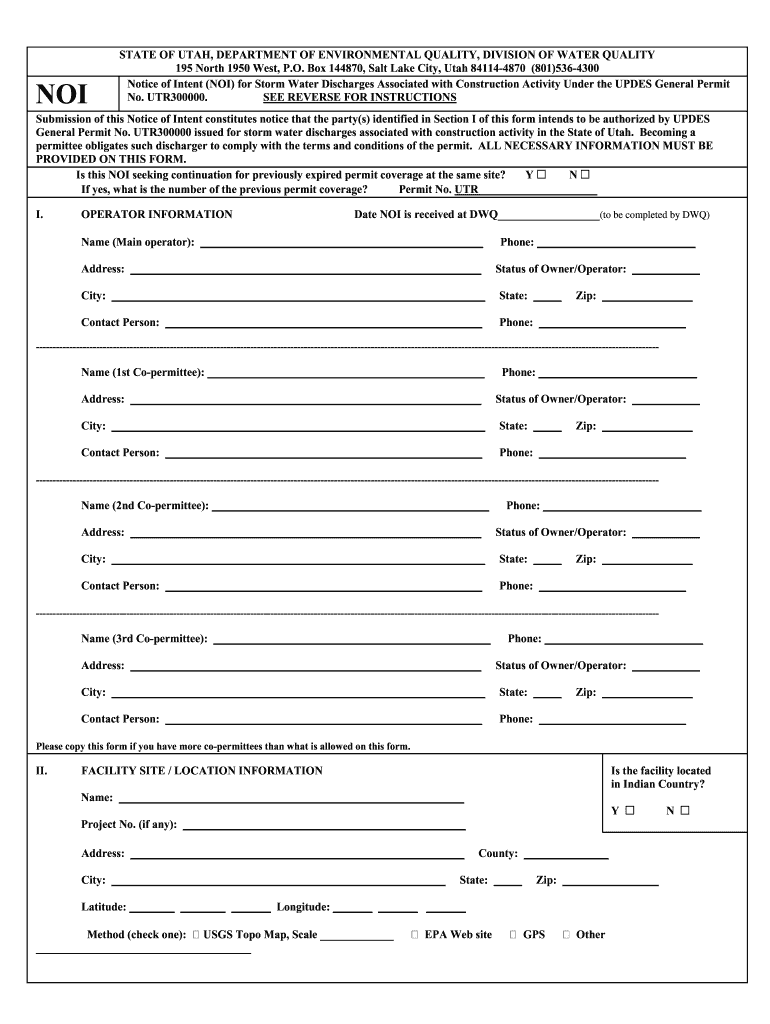
  2. Begin by filling out Section I, 'Operator Information.' Enter the main operator's name, phone number, and address. Ensure you indicate the status of the owner/operator.
  3. If applicable, add co-permittee information by filling out their names, contact details, and addresses in the designated fields.
  4. Proceed to Section II for 'Facility Site/Location Information.' Provide the facility name, project number (if any), complete address, and geographical coordinates.
  5. In Section III, detail site activity information including MS4 operator name and receiving water body. Estimate distances as required.
  6. Check all applicable types of construction in Section IV and identify best management practices in Section V to control stormwater runoff.
  7. Complete Section VI with project start and completion dates. Confirm compliance with sediment and erosion plans.
  8. Finally, certify your application in Section VII by providing signatures from responsible parties along with the permit fee amount.

Start using our platform today for free to streamline your document editing and submission process!

be ready to get more

Complete this form in 5 minutes or less

Get form

Got questions?

We have answers to the most popular questions from our customers. If you can't find an answer to your question, please contact us.
Contact us
The Utah Legislature expanded the powers of the states conservancy districts in 1949 with the Water Conservancy Act Amendments. This further enabled districts to construct, operate, and main- tain water projects, and to collaborate with state and federal agencies on water conservation initiatives.
Most of the water in Utah is hard water. All of the water is safe to drink with the exception of some hose water. Some cities use irrigation water for the hose spickets. This water is not drinkable. It is basically mountain run-off which has not been filtered.
All waters in Utah are public property. A water right is a right to divert (remove from its natural source) and beneficially use water.
The lake is considered hypereutrophic, meaning it is overly rich in nutrients such as nitrogen and phosphorous. These excessive concentrations of nutrients can cause large seasonal algal blooms, elevated pH, and possible cyanotoxin production during harmful algal blooms.
Key points Drinking water utilities clean (treat) water to remove harmful germs and chemicals and meet safety standards. Utilities must make sure the water they deliver to your tap is safe to drink. Different utilities will use different treatment steps depending on the initial quality of the water.

Security and compliance

At DocHub, your data security is our priority. We follow HIPAA, SOC2, GDPR, and other standards, so you can work on your documents with confidence.

Learn more
ccpa2
pci-dss
gdpr-compliance
hipaa
soc-compliance
be ready to get more

Complete this form in 5 minutes or less

Get form

People also ask

Some Utah Facts The Division of Water Resources has determined that Utahs per capita water use is approximately 321 gallons per day, while the average water use for the Rocky Mountain States is 245.
About: The Utah Water Use Program is a cooperative effort administered by the US Geological Survey and the Utah Divisions of Water Resources , Drinking Water, and Water Rights.
A single person household uses approximately 149 litres of water per day, a two-person household consumes 276 litres, and a four-person household uses around 450 litres. Key Statistics: A single person household in the UK uses approx. 149 litres of water per day.

Related links