
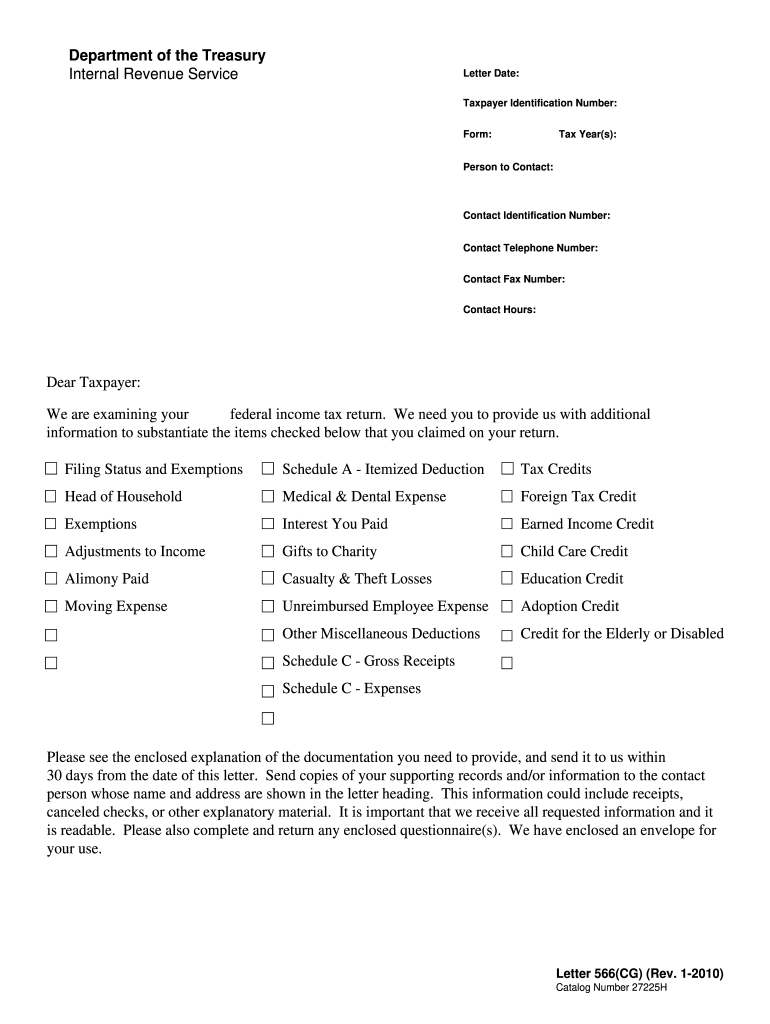







Definition and Meaning of CP566 Notice
The CP566 Notice is an official communication from the Internal Revenue Service (IRS) to a taxpayer, indicating that their federal income tax return is under examination. This notice serves as both an alert and a request for additional documentation to substantiate various items claimed on the tax return, such as deductions, credits, and exemptions. Receiving a CP566 Notice does not inherently imply wrongdoing; instead, it signifies that the IRS needs further information to verify the accuracy of the taxpayer's reported figures.
Understanding the implications of a CP566 Notice is crucial for any taxpayer. It is a formal request that necessitates action within a specified timeframe, typically indicated in the notice itself. Failure to respond appropriately or within the deadline can lead to adjustments in tax liability and potential penalties. Thus, comprehending the nature and purpose of the CP566 Notice is the first step in ensuring compliance and avoiding further complications with one's tax obligations.
How to Use the CP566 Notice
Upon receipt of a CP566 Notice, a taxpayer should first thoroughly read and understand the contents of the notice. The document will detail the specific areas under scrutiny, such as claimed deductions, credits, or exemptions. Knowing precisely what the IRS needs will aid in curating an effective response.
Typically, the notice will include instructions on how to submit the required documents. Taxpayers must gather all pertinent evidence, such as receipts, invoices, or financial statements that can substantiate the items questioned by the IRS. It's crucial to ensure that these documents are organized and labeled clearly to facilitate efficient review by the IRS.
Taxpayers have 30 days to respond to the CP566 Notice. During this period, they should compile and submit the necessary documentation either electronically or via mail, depending on the instructions contained within the notice. Engaging a tax professional may be advantageous, particularly if the taxpayer is uncertain about the process or the validity of the contested claims.
How to Obtain the CP566 Notice
The CP566 Notice is issued directly by the IRS, typically following a preliminary review of a taxpayer's submitted return where certain discrepancies or atypical entries require deeper scrutiny. Taxpayers do not actively seek out a CP566 Notice, as it is a correspondence generated by the IRS itself.
Upon deciding that an examination is necessary, the IRS will send the CP566 Notice to the address listed on the most recent tax return. To avoid missing such critical communications, taxpayers must ensure their address is up-to-date with the IRS.
If a taxpayer anticipates the arrival of a CP566 Notice, perhaps due to unique or complex tax entries, they should regularly monitor their mail. Additionally, creating an IRS account online can be helpful as it allows taxpayers to view digital copies of notices and letters directly.
Steps to Complete the CP566 Notice
To address a CP566 Notice effectively, taxpayers must follow a structured approach:
-
Review the Notice: Read through the document carefully to understand which items are being questioned and what specific information is requested.
-
Collect Documentation: Gather supporting documents such as bank statements, invoices, receipts, and any other evidence that can substantiate the items in question.
-
Organize Your Response: Create labeled folders or separate electronic files for each category of documentation related to the notice to ensure ease of review for IRS agents.
-
Prepare an Explanatory Letter: Draft a concise yet detailed cover letter that explains your position and how the attached documents support your claims.
-
Submission: Send the documents and letter either via mail or electronically, adhering strictly to the submission instructions provided in the notice.
-
Verify Receipt: Use certified mail or a service with delivery tracking for physical submissions, or confirmation options for electronic submissions, to ensure that the IRS received your response.
Key Elements of the CP566 Notice
Understanding the structure and content of the CP566 Notice is essential for an accurate response:
- Notice Date and Tax Year: The top section includes the date the notice was issued and the corresponding tax year under examination.
- Summary of Discrepancies: This section outlines the specific items or discrepancies identified by the IRS, providing a rationale for the notice's issuance.
- Requested Documentation: Clearly lists the types of evidence required to substantiate the contested items, including formats or specific documents.
- Response Deadline: Clearly states the deadline by which the taxpayer must respond to avoid potential penalties or default adjustments.
- Contact Information: Includes details on how to reach the IRS for questions or clarifications regarding the notice.
IRS Guidelines
The IRS provides specific guidelines on how to approach a CP566 Notice. Compliance with these guidelines can facilitate a smoother process. According to the IRS, taxpayers should:
- Address each item listed in the notice with corresponding documentation.
- Provide a clear explanation if certain documents are unavailable and the steps taken to procure or reconstruct such records.
- Maintain proper communication lines with the IRS, reaching out for clarifications if any aspect of the notice is unclear.
- Consider professional assistance from tax advisors or attorneys if the scope of the examination is extensive or complex.
- Safeguard copies of all submitted materials for personal records and potential future reference.
Required Documents
To ensure a timely and accurate response to a CP566 Notice, taxpayers should prepare to submit the following documents, contingent on the specifics addressed in the notice:
- Receipts and Invoices: For deductions or expenses claimed on the tax return.
- Bank and Investment Statements: To verify income or credits.
- Employment Records: Including W-2s or 1099 forms for discrepancies in reported income.
- Legal Documents: Relevant to claims such as alimony, asset transfer, or ownership.
- Correspondence: With relevant entities such as financial institutions or between spouses for joint tax matters.
Comprehensive documentation addressing each element in question is vital to resolve the issues outlined in the CP566 Notice effectively.
Penalties for Non-Compliance
Failing to respond to a CP566 Notice within the prescribed timeframe can result in several adverse outcomes:
- Automatic Adjustments: The IRS may alter the taxpayer's filings based on available information, which might not favor the taxpayer.
- Financial Penalties: These can include additional taxes owed, interest on unpaid amounts, and possible fines for inaccurate filings.
- Collection Actions: In cases of continuous non-compliance, the IRS might initiate enforced collection actions, such as wage garnishments or levies.
Addressing the CP566 Notice promptly can help mitigate these potential consequences.




