Checklist of Self-management Skills 2026

Get Form
Checklist of Self-management Skills Preview on Page 1

Here's how it works

01. Edit your form online
Type text, add images, blackout confidential details, add comments, highlights and more.

02. Sign it in a few clicks
Draw your signature, type it, upload its image, or use your mobile device as a signature pad.

03. Share your form with others
Send it via email, link, or fax. You can also download it, export it or print it out.

Definition and Meaning of the Checklist of Self-management Skills

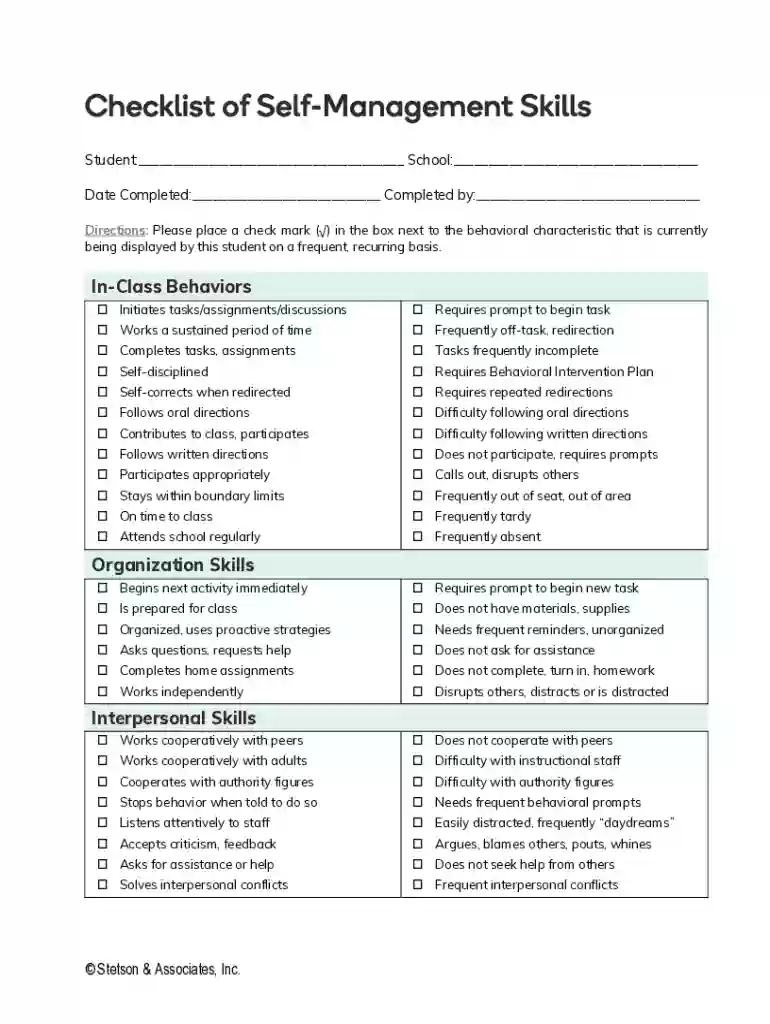
The Checklist of Self-management Skills serves as an evaluative tool designed to determine student behaviors in various areas such as class participation, organization, and interpersonal interactions. This checklist provides educators with a structured format to assess how frequently and effectively students demonstrate specific self-management skills, identifying areas that may require additional support or improvement. Self-management skills encompass a range of competencies, including time management, goal-setting, and self-evaluation, which are crucial for personal and academic success.

Practical Applications

  • Classroom Assessment: Teachers can use the checklist to monitor student behavior and progress over time.
  • Parent-Teacher Meetings: Share insights derived from the checklist to inform discussions with parents about their child's development.
  • Personal Development Plans: Create customized plans tailored to individual student needs based on checklist findings.

Importance

The checklist provides a clear, standardized method for evaluating and supporting student development in vital self-management competencies, which contributes to improved academic outcomes and personal growth.

Key Elements of the Checklist

The Checklist of Self-management Skills includes specific elements that educators assess to understand a student's capabilities and areas of improvement. These elements are vital in creating a comprehensive profile of a student's self-management abilities.

Essential Components

  • Task Completion: Evaluates how efficiently a student begins and completes tasks.
  • Time Management: Assesses the ability to allocate appropriate time for various activities and deadlines.
  • Organizational Skills: Looks at how well a student keeps track of materials and schedules.
  • Interpersonal Skills: Evaluates communication and collaboration with peers and educators.

Evaluation Scale

Each of the elements is typically rated on a scale (e.g., always, often, sometimes, never) to provide nuanced insights into the student's strengths and weaknesses.

How to Use the Checklist of Self-management Skills

The effective use of the checklist requires a clear understanding of its structure and objectives. Teachers and educators can follow specific steps to ensure that the checklist is utilized to its fullest potential.

Step-by-Step Guide

  1. Familiarize with Elements: Understand each element of the checklist and its significance.
  2. Establish a Baseline: Conduct an initial assessment to determine a student's starting point.
  3. Regular Monitoring: Consistently use the checklist to track changes over time.
  4. Analyze Results: Review the collected data to identify patterns or areas needing support.
  5. Feedback and Action: Provide feedback to students and develop strategies to improve identified weaknesses.

Real-World Scenarios

  • Implementing the checklist in classrooms to tailor instruction methods based on individual needs.
  • Using data from the checklist to adjust teaching strategies and provide targeted interventions.

Steps to Complete the Checklist

Completing the Checklist of Self-management Skills involves several steps that ensure comprehensive assessment and effective data collection.

Detailed Instructions

  1. Gather Documentation: Collect any previous assessments or relevant materials that might inform your checklist use.
  2. Schedule Assessment Sessions: Plan specific times to conduct observations in natural settings to ensure authentic assessments.
  3. Conduct Observations: Use the checklist during normal classroom activities to assess behaviors accurately.
  4. Document Findings: Record observations carefully on the checklist, ensuring clarity and detail.

Edge Cases

Ensure variability in observations across different days and contexts to account for inconsistencies in behavior due to external factors, such as stress or illness.

Who Typically Uses the Checklist

The Checklist of Self-management Skills is a versatile tool used by various individuals in different roles and contexts. Understanding who uses this checklist can highlight its significance in educational settings.


decoration image ratings of Dochub

Primary Users

  • Educators: Daily use in classrooms to tailor educational strategies and support student development.
  • Guidance Counselors: To help students develop personal growth plans.
  • Parents: Aids in understanding their child’s educational needs and development.

Additional Stakeholders

  • School Administrators: To assess overall student development programs and enhance curriculum design.
  • Special Education Professionals: Customize strategies for students requiring additional support.

Legal Use of the Checklist

Understanding the legal aspects surrounding the use of the Checklist of Self-management Skills ensures compliance and appropriate application within educational settings.

Legal Considerations

  • Confidentiality: Ensure that any data collected from the checklist is kept secure to maintain student privacy.
  • Parental Consent: Obtain necessary permissions when the checklist is used in assessments that inform special education.

Compliance

Adhering to local and federal educational standards is crucial, including any guidelines specific to assessment and record-keeping processes.

Versions or Alternatives to the Checklist

While the Checklist of Self-management Skills is a widely used tool, various versions or alternatives may be available to suit different needs or preferences.

Available Alternatives

  • Behavioral Assessment Scales: Offer more granular data focused primarily on behavioral issues.
  • Organizational Skills Inventories: Focus specifically on skills related to organization and time management.

Choosing the Right Tool

Selecting the appropriate version depends on specific goals, the student population in focus, and the particular skills being assessed.

Digital vs. Paper Version

In the digital age, educators often have a choice between digital and paper versions of the checklist, each offering distinct advantages.

Digital Benefits

  • Ease of Use: Digital versions allow for easy data entry, analysis, and sharing.
  • Accessibility: Can be accessed across different devices for convenience.

Paper Benefits

  • Simplicity: Ideal where technology use is limited.
  • Tangible Records: Provides physical copies that could be stored with other hard-copy student records.

Considerations

Choosing between digital and paper depends on the specific needs of the school or classroom environment, as well as the availability of technological resources.

be ready to get more

Complete this form in 5 minutes or less

Get form

Security and compliance

At DocHub, your data security is our priority. We follow HIPAA, SOC2, GDPR, and other standards, so you can work on your documents with confidence.

Learn more
ccpa2
pci-dss
gdpr-compliance
hipaa
soc-compliance