






Definition & Purpose of Foreign Inward Remittance Disposal Instruction
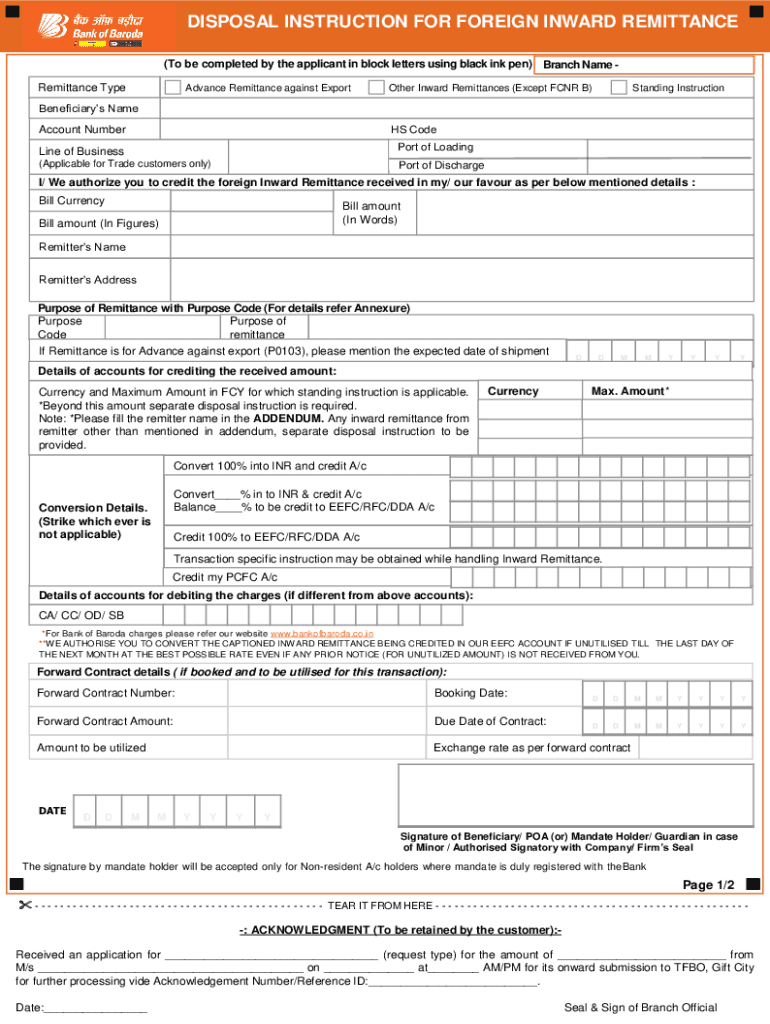
The Foreign Inward Remittance Disposal Instruction is a critical document used in financial and banking sectors to guide the handling of funds received from abroad. This form provides detailed directives on how inward remittances should be allocated, complying with regulations and ensuring accurate processing. It is primarily utilized by financial institutions to streamline and standardize the allocation of incoming international funds.
Components of the Form
- Applicant Information: Includes the remitter's details, such as name and contact information, to ensure accurate identification and processing of funds.
- Remittance Details: Specifies the amount, currency, and the remitting bank’s particulars, which are essential for financial calculations and conversion procedures.
- Purpose of Remittance: Outlines the reason for receiving funds, which could range from business transactions to personal gifts or educational expenses.
Importance in Financial Transactions
The form serves a crucial role in aiding banks and financial institutions to systematically manage and allocate foreign currency transfers. This ensures compliance with national and international regulations, providing a structured approach for handling incoming transactions.
Steps to Complete the Foreign Inward Remittance Disposal Instruction
Completing the Foreign Inward Remittance Disposal Instruction involves a series of steps to ensure accuracy and compliance. These steps are essential for both the remitter and the receiving entity.
Step-by-Step Guide
-
Gather Necessary Information:
- Collect remitter details, including their name and address.
- Ensure the accurate recording of the remittance amount and currency.
-
Fill Personal Details:
- Input the applicant’s contact details.
- Accurately record the financial institution’s branch name associated with the transaction.
-
Specify Remittance Type:
- Classify the remittance as either an advance remittance against export or another inward category.
- Provide a detailed purpose for the funds, like payment for services or loan repayment.
-
Complete Authorization:
- Sign the form in the designated area to authorize the transaction.
- Verify all information is correct and complete any required sections in block letters for legibility.
Common Mistakes to Avoid
- Omitting or incorrectly filling out crucial sections can result in delays or non-compliance penalties.
- It's vital to use dark ink for the form and write legibly to avoid any processing errors.
Importance of Using the Foreign Inward Remittance Disposal Instruction
This document is essential as it ensures that incoming remittances are accurately recorded and processed. Its utilization aids in compliance with financial regulations and contributes significantly to efficient fund management.
Benefits for Individuals and Businesses
- For Individuals: It ensures that personal remittances are correctly allocated, providing peace of mind and financial security.
- For Businesses: Facilitates the tracking and application of funds for operations such as import/export activities and foreign investments, aiding in financial planning and regulatory compliance.
Who Typically Uses the Foreign Inward Remittance Disposal Instruction
The form is predominantly used by:


Individuals
- U.S. citizens receiving funds from family members or associates abroad for personal use.
- People engaging in international transactions or receiving gifts from overseas entities.
Businesses
- Exporters and importers managing international trade transactions.
- Corporations receiving investment or operational funds from foreign partners.
Financial Institutions
Banks and other financial services organizations use this form to uphold compliance in processing foreign transactions, ensuring proper channels and protocols are followed.
Legal Aspects & Compliance
Using the Foreign Inward Remittance Disposal Instruction is not only a practical necessity but also a legal requirement in certain transactions involving cross-border funds. Compliance ensures that transactions are transparent, traceable, and within the bounds of national financial regulations.
Legal Implications
- Non-compliance Penalties: Failure to use or correctly complete the form can lead to penalties or delays.
- Audit Trails: Ensures a clear paper trail for auditing and verification purposes, essential during financial reviews or investigations.
Necessary Provisions
Adhering to legal requirements, the form mandates accurate completion and timely submission to facilitate smooth processing and prevent potential legal disputes.
Examples of Using Foreign Inward Remittance Disposal Instruction
Understanding practical scenarios aids in comprehending the utility and necessity of the form.
Scenario One: Individual Remittance
An individual receiving funds from a family member in Europe would employ this form to direct their bank on how to allocate and process the transferred amount.
Scenario Two: Corporate Investment Transfer
A U.S.-based corporation receiving investment funding from an overseas partner would use the form to instruct its bank on how the funds should be applied—whether to a specific project, operational budget, or savings.
Scenario Three: Export Transactions
An exporter using the form to capture remittances resulting from international sales ensures that proceeds are appropriately credited, facilitating accurate financial records.
Required Documents & Submission Methods
Submitting the Foreign Inward Remittance Disposal Instruction necessitates several supporting documents to ensure the correct processing of the form.
Essential Documents
- Identification documents of the remitter and recipient.
- Transaction receipts or proof of remittance to validate fund details.
- Detailed invoice or contract in case of business transactions.
Submission Options
- Online Submission: Many financial institutions offer platforms for electronic submission to expedite processing.
- Mail or In-Person: Traditional submission methods remain available for cases where digital systems are inaccessible or for individuals preferring direct banking interactions.
Practical Tip
Always confirm with your financial institution regarding the preferred submission method and any additional documentation required to accompany the form to ensure smooth processing.