






Definition & Meaning
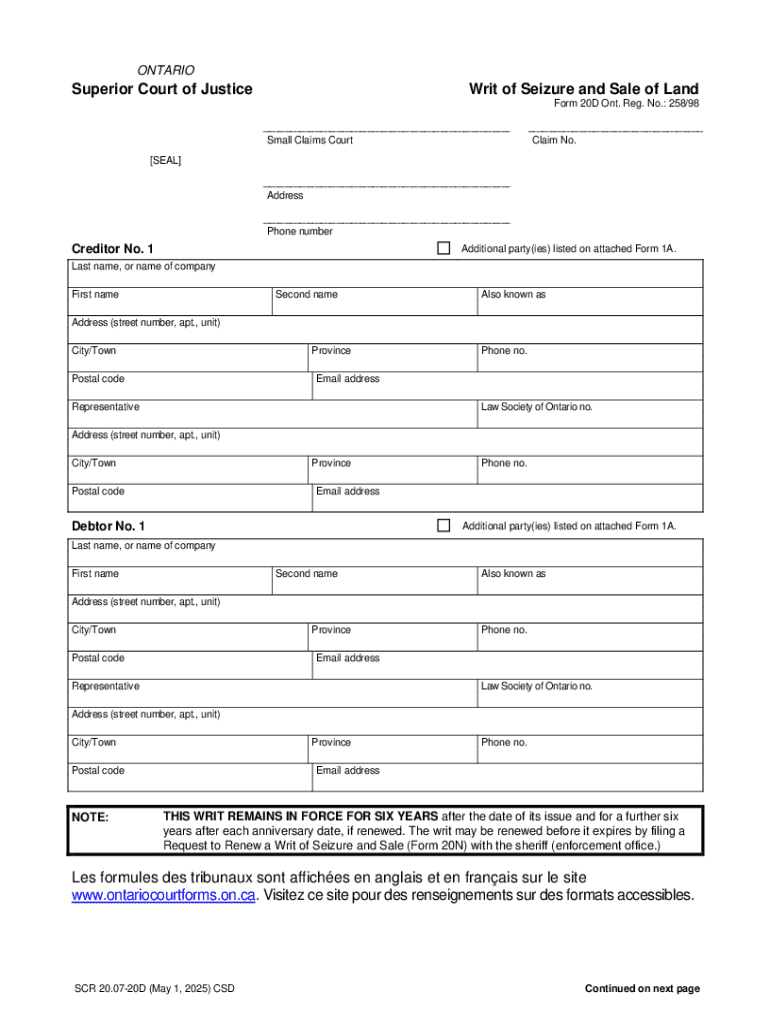
The Ontario Superior Court Writ of Seizure and Sale of Land is a legal instrument used to enforce a court judgment by allowing the seizure and sale of a debtor's land to satisfy an outstanding debt. It serves as a last resort for creditors seeking to recover owed money when a debtor has failed to fulfill financial obligations. This document, formally known as Form 20D under the Ontario Regulations, is crucial in civil litigation, particularly within the context of unpaid judgments. The writ authorizes the sheriff to take possession of the debtor’s land, facilitating its sale to repay creditors.
Specific Components
- Judgment Enforcement: Permits the creditor to enforce a court judgment through property seizure.
- Property Details: Includes specific information related to the land targeted for seizure.
- Creditor and Debtor Information: Lists the parties involved, including detailed identification of the debtor and creditor.
How to Use the Ontario Superior Court Writ of Seizure and Sale of Land
Utilizing the writ involves several critical steps, ensuring proper execution and compliance with legal requirements. It is initiated following a court judgment that remains unsatisfied despite other collection efforts.
Execution Process
- Obtain the Judgment: Secure a court judgment indicating an unpaid debt by the debtor.
- File the Writ: Submit Form 20D to the Ontario Superior Court registrar.
- Engage the Sheriff: The sheriff executes the writ by taking steps to seize and sell the property.
Practical Considerations
- Legal Counsel: Often requires consultation with a legal professional to ensure compliance.
- Timeliness: The process must adhere to prescribed timelines to prevent unnecessary delays.
Steps to Complete the Ontario Superior Court Writ of Seizure and Sale of Land
Completing Form 20D involves detailed and precise documentation to ensure legal standing and effectiveness. Accuracy in filing is crucial as errors may delay enforcement.
Key Steps
- Gather Necessary Information: Collect creditor and debtor details, judgment specifics, and property description.
- Complete Form 20D: Accurately fill out the form with all required data.
- Submit to Court: Deliver the completed form to the court for verification and approval.
Common Errors to Avoid
- Incomplete Information: Failing to include all relevant information can invalidate the writ.
- Incorrect Details: Double-check all entries for accuracy, particularly property identifiers.
Why Should You Use the Ontario Superior Court Writ of Seizure and Sale of Land
Utilizing this writ can be a powerful tool in recovering debt, especially in situations where other collection methods have failed. It leverages the court's authority to take actionable steps toward debt recovery.
Benefits
- Effective Debt Recovery: Offers a structured, legally-backed method for reclaiming owed money.
- Final Recourse: Acts as a decisive measure when other collection attempts are unsuccessful.
Who Typically Uses the Ontario Superior Court Writ of Seizure and Sale of Land
The writ is primarily used by creditors, legal practitioners, and financial institutions involved in debt recovery. It is particularly relevant to those seeking enforcement of a court-issued judgment.


Common Users
- Creditors: Individuals or entities with a legitimate claim to outstanding debts.
- Sheriff’s Office: Government authority responsible for executing the seizure and sale.
- Legal Professionals: Lawyers managing judgment enforcement on behalf of their clients.

Legal Use of the Ontario Superior Court Writ of Seizure and Sale of Land
The writ must be used within the context of legal norms and ethical practices, ensuring it aligns with statutory regulations.
Compliance Requirements
- Court Authorization: Requires approval from the Ontario Superior Court to proceed.
- Sheriff’s Involvement: Execution only done through official sheriff channels to guarantee legal conformity.
Key Elements of the Ontario Superior Court Writ of Seizure and Sale of Land
Understanding the composition of the writ is critical to its effective use. It encompasses several main elements that outline the scope and application of the process.
Main Components
- Judgment Details: Specifics of the court ruling being enforced.
- Property Information: Comprehensive description of the land to be seized.
- Parties Involved: Identification of all parties, including any additional named parties in attachments.
State-Specific Rules for the Ontario Superior Court Writ of Seizure and Sale of Land
The application and enforcement of the writ are governed by provincial laws that dictate the procedural framework.
Jurisdictional Considerations
- Ontario-Specific Legislation: Compliance with Ontario regulations, including Form 20D requirements.
- Court Procedures: Adherence to local court procedures regarding filing and execution.
Examples of Using the Ontario Superior Court Writ of Seizure and Sale of Land
Exploring practical scenarios helps to illustrate the application and impact of the writ in real-world contexts. These examples demonstrate common situations where the writ is an effective legal tool.
Practical Scenarios
- Debt Collection: Utilization by a bank to repossess land after mortgage default.
- Contract Disputes: Enforcement following breach of contract where land serves as collateral.
Additional Use Cases
- Business Debts: Recovery of unpaid business loans through property seizure.
- Personal Judgments: Application in cases involving substantial personal debt recovery.