ST-556, Sales Tax Transaction Return Instructions 2026

Get Form
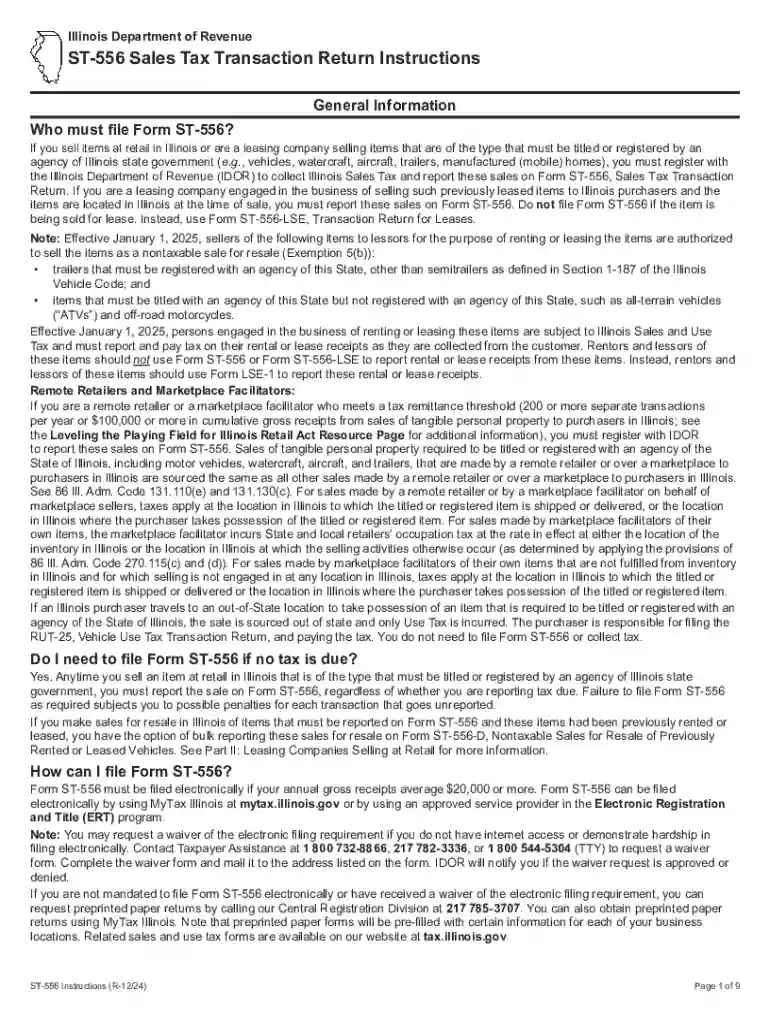
ST-556, Sales Tax Transaction Return Instructions Preview on Page 1

Here's how it works

01. Edit your form online
Type text, add images, blackout confidential details, add comments, highlights and more.

02. Sign it in a few clicks
Draw your signature, type it, upload its image, or use your mobile device as a signature pad.

03. Share your form with others
Send it via email, link, or fax. You can also download it, export it or print it out.

Definition & Purpose of the ST-556, Sales Tax Transaction Return Instructions

Form ST-556 is a Sales Tax Transaction Return utilized in the state of Illinois. It is primarily used by retailers and leasing companies to report the sale of items that require a title or registration. This form is essential for documenting transactions involving vehicles, aircraft, watercraft, trailers, and other titled or registered goods. The ST-556 instructions provide detailed guidance on how to accurately complete the form, ensuring compliance with state tax regulations. Notably, the form captures sales tax information crucial for maintaining a transparent and lawful tax process.

Key Elements of the ST-556, Sales Tax Transaction Return Instructions

The ST-556 instructions comprise several critical components designed to facilitate proper completion. These elements include:

  • Seller Information: Details about the retailer or leasing company, including their identification number and contact information.
  • Purchaser Information: Essential data regarding the buyer, such as their name, address, and taxpayer identification number.
  • Transaction Details: Comprehensive information about the sale, including the date of sale, sale price, and any applicable trade-in values.
  • Tax Calculation: A step-by-step method for determining the correct sales tax due, including any applicable exemptions or tax rates.
  • Signature and Certification: Requirements for signing to attest to the accuracy of the reported information, with an understanding of the legal implications for false statements.

Steps to Complete the ST-556, Sales Tax Transaction Return Instructions

Filling out the ST-556 form involves a series of methodical steps. Following these can help ensure accuracy and compliance:

  1. Gather Required Information: Collect details about both parties involved in the transaction, along with specifics about the item being sold.
  2. Complete Seller and Purchaser Information Fields: Enter the retailer's and buyer's information as outlined in the document.
  3. Record Transaction Details: Document the sale specifics, ensuring dates, item descriptions, and amounts are accurate.
  4. Calculate Sales Tax: Follow the form’s guidance to compute the applicable sales tax, considering any trade-ins or deductions.
  5. Review and Sign: Thoroughly review the form for accuracy before signing, verifying all sections are complete.

How to Obtain the ST-556, Sales Tax Transaction Return Instructions

Retailers and leasing companies can access the ST-556 instructions through several channels:

  • Online Access: The Illinois Department of Revenue provides downloadable resources on their website, including fillable forms and instructions.
  • Direct Request: Hard copies can be requested by contacting the department directly for retailers preferring physical documentation.
  • Industry Associations: Specific industry associations may offer copies or guidance related to the ST-556 as part of their resource offerings to members.

Penalties for Non-Compliance with the ST-556

Failure to properly file the ST-556 form can lead to severe consequences:

  • Financial Penalties: Retailers may incur fines or interest on unpaid sales tax for incorrect or late submissions.
  • Legal Repercussions: Inaccurate reporting or fraudulent entries can result in legal actions, including hearings by the Illinois Department of Revenue.
  • Operational Impacts: Revocation of business licenses or heightened scrutiny by tax authorities may result from repeated non-compliance.

Who Typically Uses the ST-556, Sales Tax Transaction Return Instructions

The primary users of the ST-556 instructions are businesses engaged in selling items requiring titling or registration:


  • Retail Vehicle Dealerships: Essential for the sale of cars, trucks, and motorcycles.
  • Leasing Companies: Required for leasing transactions that involve title transfers upon lease termination.
  • Non-Auto Retailers: Sellers of boats, trailers, and aircraft also rely on this form for their transactions.
decoration image ratings of Dochub

Required Documents for Completing the ST-556

When completing the ST-556 form, the following documents are commonly required:

  • Bill of Sale: Details the transaction term, necessary for confirming sales price and purchase date.
  • Title or Vehicle Identification Number (VIN): Specific identifiers to accurately document the asset being sold.
  • Trade-In Documentation: Records of any trade-ins applied to the transaction for tax calculation purposes.

Filing Deadlines for the ST-556

Timely submission of the ST-556 form is critical:

  • Standard Filing Period: The form is generally required to be filed no later than 20 days after the sale or leasing transaction.
  • Extensions and Exceptions: In certain cases, extensions may be requested, but these must be applied for and approved by the Illinois Department of Revenue.

State-Specific Rules for the ST-556

Illinois imposes unique considerations related to the ST-556:

  • Exemption Clauses: The state specifies conditions under which sales tax might be exempt, such as sales to non-residents or governmental entities.
  • Marketplace Facilitators: Specific rules apply to transactions facilitated by a third party, significantly when involving remote sales.

These components are foundational in understanding and appropriately utilizing the ST-556 form, supporting businesses in fulfilling their tax obligations accurately and efficiently.

be ready to get more

Complete this form in 5 minutes or less

Get form

Security and compliance

At DocHub, your data security is our priority. We follow HIPAA, SOC2, GDPR, and other standards, so you can work on your documents with confidence.
Learn more
ccpa2
pci-dss
gdpr-compliance
hipaa
soc-compliance