




01. Edit your form online
Type text, add images, blackout confidential details, add comments, highlights and more.

Type text, add images, blackout confidential details, add comments, highlights and more.

Draw your signature, type it, upload its image, or use your mobile device as a signature pad.

Send it via email, link, or fax. You can also download it, export it or print it out.
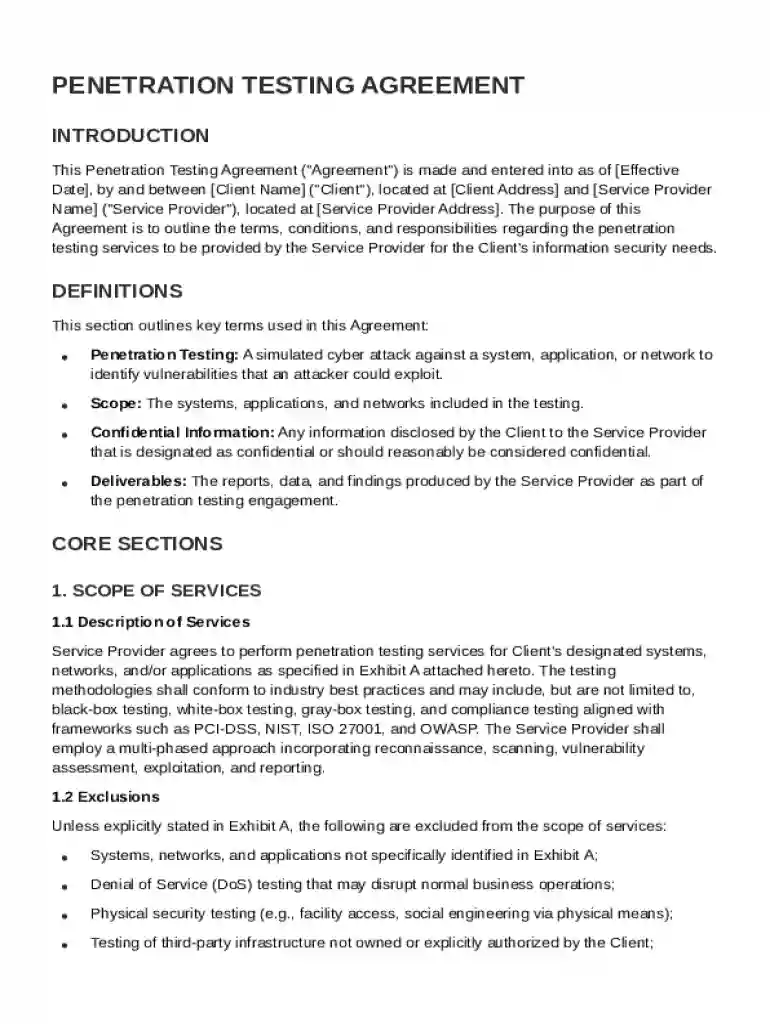
The "Penetration Testing Agreement Template" is a structured legal document used to outline the terms and conditions between a service provider and a client engaging in penetration testing services. This template serves a crucial role in defining the scope, objective, and confidentiality agreements associated with penetration testing. Such testing aims to uncover vulnerabilities within a client's systems, applications, or networks. The agreement ensures both parties understand their responsibilities, as well as the methodologies and deliverables involved.
The template is built around several critical components that form the backbone of the agreement. Each element plays a significant role in ensuring that the penetration testing process is effective and legally sound.
Within the United States, the Penetration Testing Agreement template is used as a legal instrument to solidify the contractual relationship between the service provider and the client. Legal compliance is integral to its framework to avoid any future disputes.
Completing the template requires meticulous attention to detail, as accuracy impacts both the efficacy and legality of the agreement. Here are the steps usually involved:
Understanding critical terminology assures that both parties are fully informed and prepared for potential scenarios during the testing:
In practice, organizations leverage this template to secure their digital assets through tailored penetration testing. Here are some scenarios:
The template is predominantly utilized by a diverse group engaged in digital security:


Drafting, editing, and reviewing the Penetration Testing Agreement can be conveniently managed via various software solutions:
Being aware of these specifics ensures comprehensive and legally secure agreements that are actionable and protective.
At DocHub, your data security is our priority. We follow HIPAA, SOC2, GDPR, and other standards, so you can work on your documents with confidence.


General Purpose. The general purpose of this Agreement is to engage the services of Consultant to perform the services and provide the deliverables
Jul 20, 2021 Interconnection Security Agreement (ISA): In this guide, an agreement established between the organizations that own and operate connected
Sep 29, 2023 The objective is to ensure satisfactory THECB compliance with the requirements of Texas. Government Code 2054.516. Awarded Respondent will


