
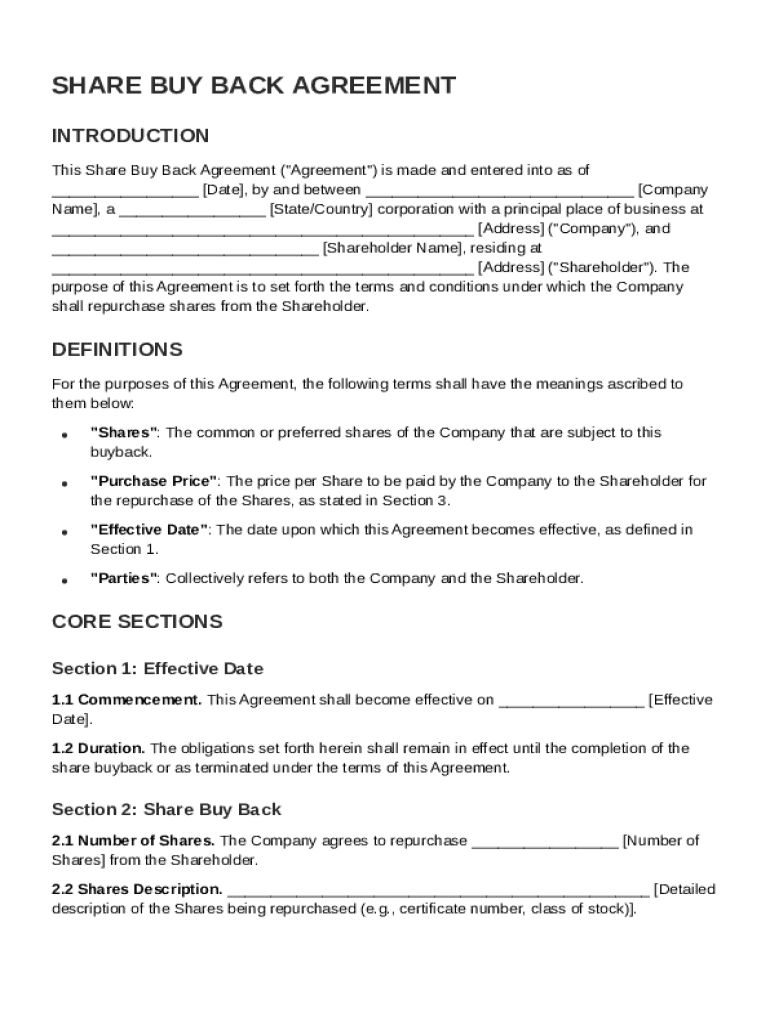







Understanding the Share Buy Back Agreement Template
The Share Buy Back Agreement Template is a legal tool that outlines the fundamental terms and conditions for a company to repurchase its shares from shareholders. This agreement is a crucial document as it helps define each party's rights and responsibilities, ensuring clarity and mutual understanding. By detailing provisions such as the effective date, number of shares, and purchase price, the template provides a comprehensive framework for executing a share buyback transaction.
Key Elements of the Share Buy Back Agreement Template
Understanding the primary components of the Share Buy Back Agreement Template is essential for a thorough grasp of its implications:
- Definitions and Parties Involved: Clearly outlines each term used throughout the agreement and identifies the company and shareholder entering into the agreement.
- Effective Date and Terms: Specifies when the agreement becomes operational and the timeline for completing the buyback process.
- Number of Shares and Purchase Price: Lists the exact number of shares to be repurchased and the agreed purchase price for those shares.
- Representations and Warranties: Both parties provide assurances regarding their authority to enter into the agreement and the condition of the shares.
- Closing Procedures: Details the process for completing the transaction, including document exchanges and final payment terms.
- Indemnification Clauses: Protects the parties from potential claims or liabilities arising from the transaction.
- Governing Law and Miscellaneous Provisions: Establishes the legal jurisdiction governing the agreement and other specific conditions as necessary.
Steps to Complete the Share Buy Back Agreement Template
Completing the Share Buy Back Agreement Template involves a series of methodical steps to ensure accuracy and compliance:
- Gather Necessary Information: Collect details such as the number of shares, purchase price, and corporate governance considerations.
- Review Legal Requirements: Ensure that legal requirements at both state and federal levels are satisfied to facilitate a compliant buyback.
- Customize Template Provisions: Adapt template sections to accurately reflect the specific details and terms agreed upon by the company and shareholder.
- Obtain Necessary Approvals: Secure board and shareholder approvals where mandated by corporate laws and company bylaws.
- Finalize and Preview: Carefully review the completed agreement for accuracy and completeness before finalizing.
- Execute the Agreement: Both parties sign the document, acknowledging their understanding and acceptance of the terms.
Why Use the Share Buy Back Agreement Template
Businesses and shareholders benefit from using this template to streamline and formalize share buyback transactions. Here are several reasons why utilizing the Share Buy Back Agreement Template is advantageous:
- Clarity and Precision: It ensures all agreed terms are clearly documented, reducing potential disputes or misunderstandings.
- Legal Compliance: Facilitates compliance with regulatory requirements, limiting legal risks and fostering transparency.
- Efficiency: Provides a structured format that expedites negotiations and agreement execution processes.
Who Typically Uses the Share Buy Back Agreement Template
The template is commonly employed by various business entities and their stakeholders, including:
- Corporations: Public and private companies seeking to manage equity ownership strategically through share repurchases.
- Shareholders: Individuals or institutions participating in share buyback programs to capitalize on offering liquidity or investment returns.
- Legal Teams: Attorneys and corporate counsels use the template to ensure that the transaction complies with applicable laws and regulations.

Legal Use of the Share Buy Back Agreement Template in the U.S.
In the United States, the legal use of the Share Buy Back Agreement Template is subject to several guidelines and constraints:
- Corporate Governance: Companies must adhere to corporate governance rules, including shareholder rights and fiduciary responsibilities.
- Securities Regulations: Adherence to securities regulations, such as those enforced by the SEC, is mandatory to protect investor interests.
- State-Specific Laws: Variations in state laws necessitate customization of agreement templates to align with jurisdiction-specific legal standards.
State-specific Rules and Considerations
When utilizing the Share Buy Back Agreement Template, understanding state-specific laws is crucial:
- California: Requires explicit shareholder approval for share repurchase agreements, including specific disclosures.
- Delaware: Allows flexibility in buyback agreements but mandates compliance with statutory and common law principles.
- New York: Imposes specific corporate and procedural formalities that must be reflected within the template to ensure validity.
Important Terms Related to the Agreement
Several terms are essential when drafting or analyzing a Share Buy Back Agreement Template, including:
- Issuer: The company whose shares are being repurchased.
- Repurchase Limitations: Conditions or caps on the volume or frequency of share buybacks.
- Market Value: The current valuation of repurchased shares, key for determining financial implications.
- Escrow: A neutral holding entity for shares or funds during the completion of the transaction.
Selecting and delving into these nuanced blocks ensures a comprehensive understanding of the Share Buy Back Agreement Template, fostering informed decision-making in business and legal realms.




