






Definition & Meaning
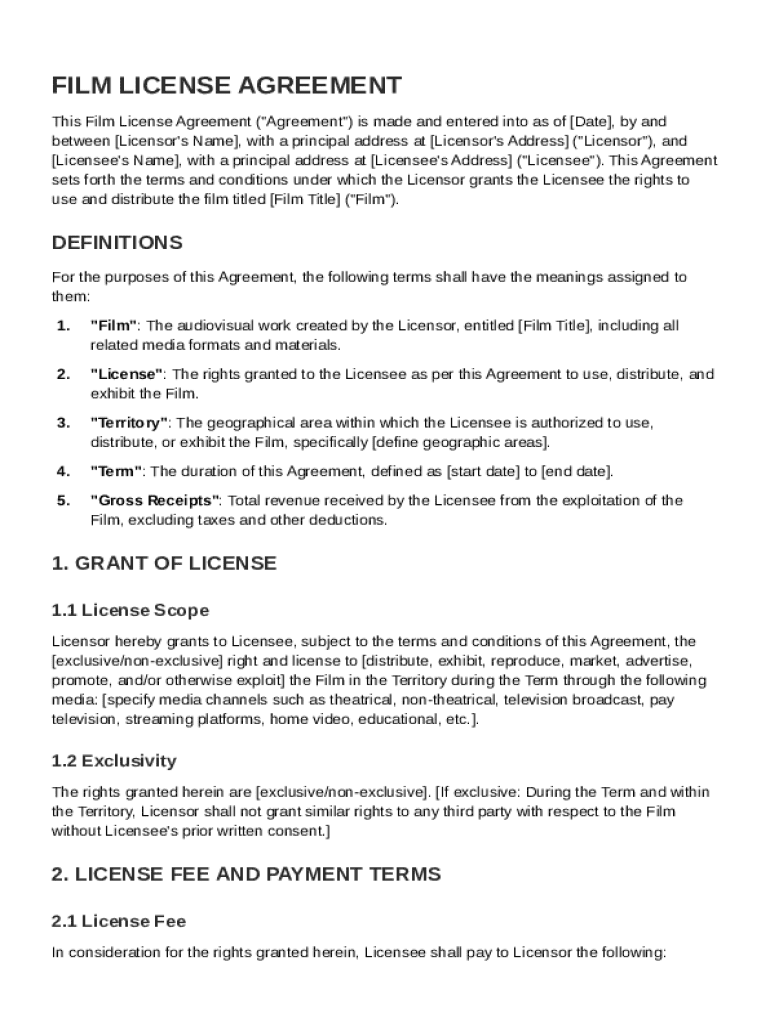
A Film License Agreement Template is a crucial legal document that outlines the terms under which a licensor grants a licensee the rights to use and distribute a specified film. This template is designed to ensure that all legal aspects related to film distribution are clearly defined, thereby protecting the interests of both parties involved. The agreement typically includes key definitions, the scope of the license, payment terms, and the obligations of both the licensor and licensee. Additionally, it covers representations and warranties, indemnification clauses, and conditions for termination, ensuring comprehensive legal coverage.
Key Elements of the Film License Agreement Template
The template encompasses several essential elements critical for both licensors and licensees. Key components include:
- Scope of the License: Defines the geographical, duration, and media scope within which the licensee can distribute the film.
- Payment Terms: Detailed specifications of the financial agreement, including licensing fees, royalty structures, and payment schedules.
- Obligations of Parties: Clearly states the duties each party must fulfill, such as marketing responsibilities or film maintenance and preservation.
- Termination Conditions: Outlines scenarios and conditions under which the agreement can be prematurely terminated by one or both parties.
- Governing Law & Jurisdiction: Specifies which state's laws will govern the agreement and which court will have jurisdiction in case of disputes.
How to Use the Film License Agreement Template
Using the Film License Agreement Template is straightforward with some essential steps:
- Customization: Tailor the template to fit the specific film and distribution deal, ensuring all sections are relevant and accurate.
- Legal Consultation: Consult with a legal professional to review the document, ensuring that all clauses comply with current film distribution laws.
- Finalization: Both parties should review and ensure that the terms are satisfactory before signing the document.
- Execution: Execute and store the signed document securely for future reference and legal enforcement if necessary.
Steps to Complete the Film License Agreement Template
Filling out the Film License Agreement Template requires attention to detail:
- Enter Basic Information: Fill out the names and addresses of both the licensor and licensee.
- Define Scope and Terms: Clearly delineate the scope of license, including duration and geographical reach.
- Specify Payment Arrangements: Outline the agreed-upon payment terms and schedules.
- Review Obligations: Detail the responsibilities of each party in adherence to the agreement.
- Legal Endorsements: Obtain signatures from both parties and notarize if required for additional legal validity.
Who Typically Uses the Film License Agreement Template
The template serves a diverse user base in the film industry, including:
- Independent Filmmakers: Individuals producing and distributing lower-budget films.
- Production Companies: Corporations involved in producing, marketing, and distributing films.
- Distributors: Entities responsible for marketing and delivering films to various media platforms and geographical markets.
- Streaming Platforms: Online services licensing films to distribute over the internet.


Important Terms Related to the Film License Agreement Template
Understanding key terminology is vital for effective use of the template:
- Licensor: The owner of the film rights who grants the license.
- Licensee: The party receiving the rights to distribute the film.
- Royalty: A payment for the ongoing use of the film rights, usually as a percentage of revenues.
- Exclusive/Non-Exclusive License: Determines if the licensee has sole distribution rights.
Legal Use of the Film License Agreement Template
Ensuring the legal use of the template involves:
- Compliance with Laws: Adhering to local, state, and federal laws relevant to film distribution.
- Authentic Signatures: Ensuring that signatures are genuine and all parties signing have the authority to do so.
- Modification Ban: Any changes to the agreement post-signature usually require mutual consent from both parties documented in writing.
State-Specific Rules for the Film License Agreement Template
Different states may impose variations in laws affecting the Film License Agreement:
- Governing Laws: Certain states may have unique regulations regarding intellectual property and contract enforcement.
- Jurisdiction Clauses: Clearly identify which state's jurisdiction will govern the resolution of any disputes arising under the agreement.
- Local Compliance: Ensure that specific regional laws regarding film distribution and royalties are adhered to avoid legal complications.
Examples of Using the Film License Agreement Template
Practical examples demonstrate the application of the template:
- Independent Films: Small-scale filmmakers licensing films to regional distributors for local screenings.
- Blockbuster Deals: Major film studios using the template to secure international distribution rights with large distributors.
- Digital Streaming: Online platforms acquiring rights to stream films globally, tailored by the template to include digital terms and conditions.