
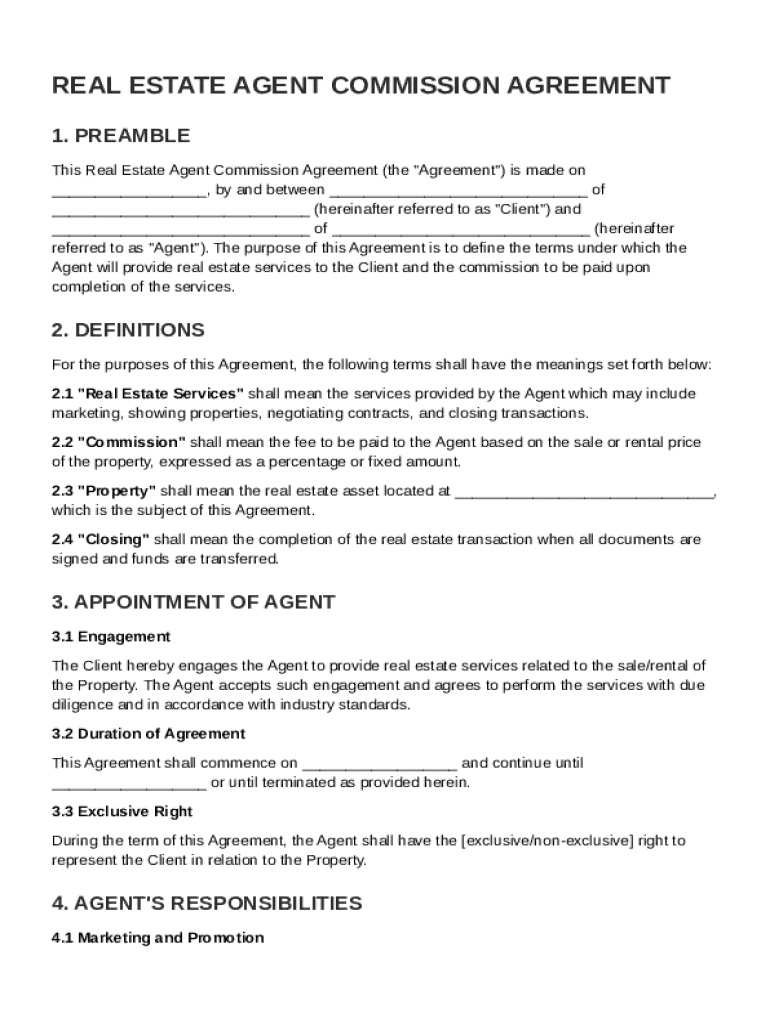







Definition and Meaning
The Real Estate Agent Commission Agreement Template is a legal document that outlines the terms and conditions between a real estate agent and a client. This agreement sets forth critical elements such as the commission structure, the scope of real estate services, and the responsibilities of each party involved. Additionally, it defines key terms like 'Real Estate Services' and 'Commission,' contributing to a shared understanding between both parties. This template serves as a comprehensive framework to ensure transparent and compliant dealings during real estate transactions.
Key Components
- Commission Structure: Details how much the agent will earn upon the successful sale or lease of a property.
- Agent Responsibilities: Information about marketing efforts, property showings, negotiations, and more.
- Client Obligations: The duties the client must perform, including payment timelines and documentation.
- Termination Conditions: Includes the scenarios under which the agreement can be terminated.
Key Elements of the Real Estate Agent Commission Agreement Template
For a comprehensive and effective Real Estate Agent Commission Agreement, several key elements should be included:
Commission Agreements
- Fixed-Rate vs. Percentage-Based: Specify whether the commission is a fixed dollar amount or a percentage of the sale price.
- Payment Schedule: Clarify the timeline for payment, such as upon closing or at specific milestones.
Timeframe
- Duration of Agreement: Specifies how long the agreement will be in effect, including start and end dates.
- Renewal Options: Any provisions for automatic renewal or extension of the agreement.
Responsibilities
- Marketing Obligations: The agent's duties related to advertising and promoting the property.
- Legal Compliance: Requirement for the agent to comply with local real estate laws and ethical standards.
Important Terms Related to Real Estate Agent Commission Agreement Template
Understanding the terminology within a Real Estate Agent Commission Agreement is crucial:
Common Terms
- Listing Agreement: Refers to the contract between a real estate agent and a property owner that authorizes the agent to act in the sale.
- Exclusive Right to Sell: Grants the agent exclusive rights to sell the property, entitling them to a commission regardless of who finds the buyer.
- Dual Agency: A situation where one agent represents both buyer and seller, its legality varying by state.
Legal Implications
- Breach Clause: Outlines what occurs if either party fails to adhere to the agreement's terms.
- Dispute Resolution: Provides methods for resolving disputes, such as through mediation or arbitration.
Steps to Complete the Real Estate Agent Commission Agreement Template
Completing a Real Estate Agent Commission Agreement Template involves several steps:
- Gather Necessary Information: Includes the names and contact information of both parties, property details, and desired terms.
- Define Scope and Duration: Clearly outline the services to be provided and the agreement's duration.
- Detail Commission and Fees: Specify the commission structure, any associated fees, and the payment schedule.
- Review Legal Provisions: Ensure that terms comply with local real estate laws and include necessary legal clauses for dispute resolution.
- Collaborate for Finalization: Both parties should review the draft, suggest amendments, and reach a mutual agreement.
- Sign and Secure: Once finalized, both parties sign the document, and it is stored securely for future reference.
Who Typically Uses the Real Estate Agent Commission Agreement Template
The Real Estate Agent Commission Agreement Template is primarily used by:


Real Estate Agents
- Independent Agents: Use it to formalize client relationships and ensure they're compensated for their services.
- Brokerage Firms: Employ these agreements in supervising multiple agents under their brand.
Property Owners
- Individual Sellers: Engage agents to aid in selling residential or commercial properties.
- Property Developers: Enlist agents for large-scale property transactions or developments.
Examples of Using the Real Estate Agent Commission Agreement Template
Real-world scenarios illustrate the utility of this template:
Residential Sale Example
A homeowner in Texas decides to sell their house. They use the Real Estate Agent Commission Agreement Template to hire an agent from a reputable brokerage firm, agreeing on a 5% commission. The agent is responsible for preparing the home for sale, conducting open houses, and managing negotiations.
Commercial Leasing Use
A commercial property owner leases office space in New York. They use the agreement to set terms with a commercial real estate agent, agreeing to pay a commission equal to one month's rent upon successful leasing to a qualified tenant.
State-Specific Rules for the Real Estate Agent Commission Agreement Template
Different states have unique regulations impacting these agreements:
Variations by State
- California: Mandates disclosures about agency representation and requires written agreements for commissions.
- Florida: Allows non-exclusive agreements to include open listings, where any agent can sell the property.
- Texas: Has specific disclosure requirements concerning agency relationships and real estate transactions.
State Compliance
Agents must ensure the agreement complies with state laws and represents all parties fairly and ethically. This often involves familiarity with regional real estate commission practices and licensing requirements.
Software Compatibility with the Real Estate Agent Commission Agreement Template
The Real Estate Agent Commission Agreement Template can be efficiently managed and edited using compatible software:
Compatible Platforms
- DocHub: As a versatile platform, DocHub offers tools for editing, signing, and sharing the agreement template digitally without the need for conversion.
- Google Workspace: Integration with Google Drive and Gmail allows for smooth document handling within the Google ecosystem.
- Microsoft Office Suite: The agreement can be imported and edited using Word, ensuring broad compatibility with other Office products.
Digital Versus Paper Versions
- Advantages of Digital: Allows for easy edits, secure electronic signatures, and real-time collaboration.
- Paper Considerations: Some clients may prefer a hard copy for their records, though this can be generated with ease from the digital version.




