Definition and Meaning
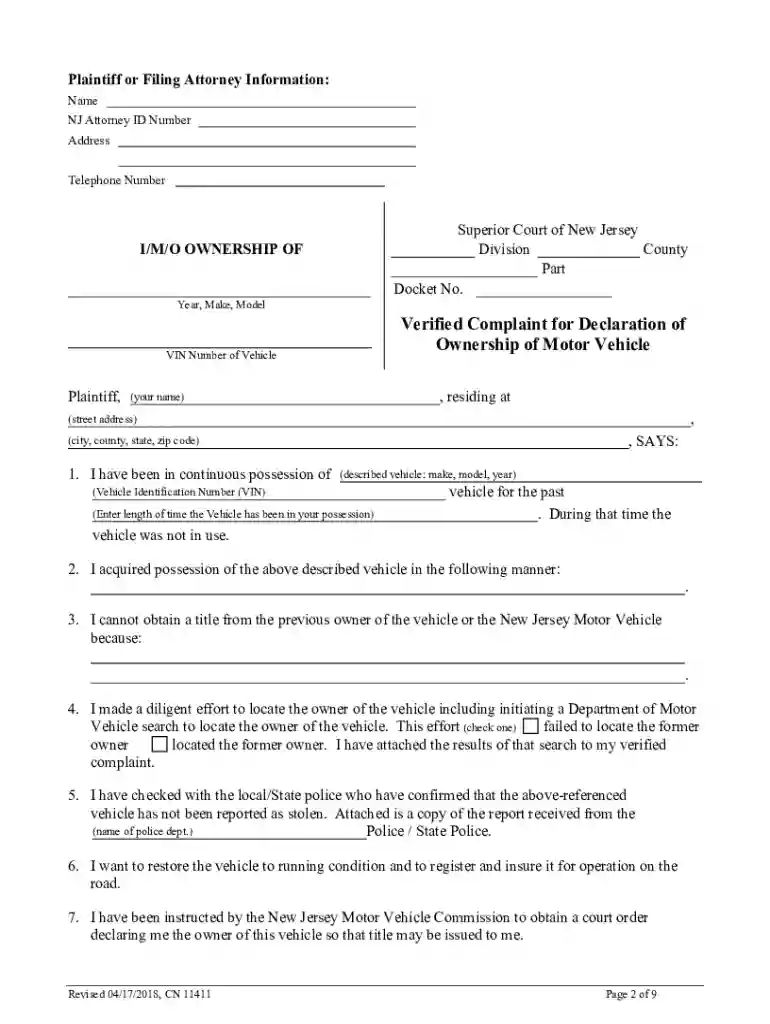
The "Complaint and Proposed Form of Order for Action Seeking Title" is a legal document utilized by individuals or entities aiming to obtain a court order that establishes ownership of a motor vehicle. This is particularly necessary when the previous owner of the vehicle is untraceable, and the individual seeking the title needs to secure ownership legally. This form is employed primarily in cases involving disputes over vehicle ownership and requires adherence to specific legal protocols to ensure the legitimacy of the claim.
How to Use the Complaint and Proposed Form of Order for Action Seeking Title
To effectively utilize the "Complaint and Proposed Form of Order for Action Seeking Title," individuals must follow a structured process:
- Complete the Form: Fill out the necessary sections of the document, providing details on the vehicle and the circumstances necessitating the title change.
- Attach Supporting Documentation: Include necessary evidence, such as a bill of sale, any previous titles, or proof of attempts to contact the prior owner.
- Filing with the Court: Submit the completed form and supporting documents to the appropriate court, typically where the vehicle is registered or the petitioner resides.
- Attend Court Hearing: If required, attend a court hearing to present your case and provide any additional information requested by the judge.
Steps to Complete the Complaint and Proposed Form of Order for Action Seeking Title
Completing the form involves several detailed steps:
- Basic Information: Enter your personal or business information along with details about the vehicle, such as the make, model, VIN, and any relevant registration numbers.
- Statement of Claim: Document the facts leading to the title dispute, including attempts made to contact the previous owner and any other pertinent details that support your claim.
- Order to Show Cause: Prepare an argument for why the court should grant you the title, focusing on the necessity and fairness of transferring ownership.
- Certification of Service: Verify that all necessary parties have been informed about the filing. This usually involves detailed instructions on how notification was made.
Legal Use of the Complaint and Proposed Form of Order for Action Seeking Title
This form's primary legal purpose is to establish ownership where there is doubt or a lack of clarity regarding a vehicle's title. It is often employed in cases of failed transactions, such as when a seller disappears after a sale, or in situations where the vehicle was inherited, and no formal transfer of title occurred. The legal framework ensures rightful ownership is granted only after careful examination and validation by a court.
Key Elements of the Complaint and Proposed Form of Order for Action Seeking Title
Critical components of the form include:
- Petitioner's Information: Details of the person or entity filing the complaint to establish legitimacy.
- Vehicle Details: Comprehensive information about the vehicle in question to accurately identify the asset.
- Nature of the Claim: A clear outline of the issues surrounding the ownership dispute and reasons for seeking a court order.
- Supporting Documentation: Attachment of relevant documents that bolster the petitioner's case.
Who Typically Uses the Complaint and Proposed Form of Order for Action Seeking Title
This form is predominantly used by:
- Buyers: Individuals who purchased a vehicle but did not receive the title due to issues like the seller's disappearance.
- Heirs: Family members seeking to transfer the title of an inherited vehicle legally.
- Businesses: Entities acquiring ownership of a vehicle through business transactions that lacked proper title documentation.
State-Specific Rules for the Complaint and Proposed Form of Order for Action Seeking Title
While the form and its purpose remain consistent across jurisdictions, state-specific rules may dictate variances in procedure. For instance:
- Notification Requirements: Some states might require additional steps to notify other potential claimants.
- Filing Procedures: Differences in filing locations or methods, such as electronic vs. paper filing, may be applicable.
- Additional Documentation: States could mandate supplementary documents unique to their legal framework.
Examples of Using the Complaint and Proposed Form of Order for Action Seeking Title
- Lost Seller: A buyer who cannot locate the seller after a vehicle purchase; the form helps establish their rightful ownership.
- Deceased Owner: Heirs using the form to obtain title when the original owner of the vehicle has passed and left no specific will.
- Unreturned Leased Vehicles: Leasing companies can use the form to assert ownership over vehicles not returned at the lease's end.
By understanding these aspects, individuals and businesses can navigate the complexities of title disputes effectively, ensuring legal and rightful acquisition of vehicle ownership.