Business Sale Non Disclosure Agreement Template 2026

Get Form
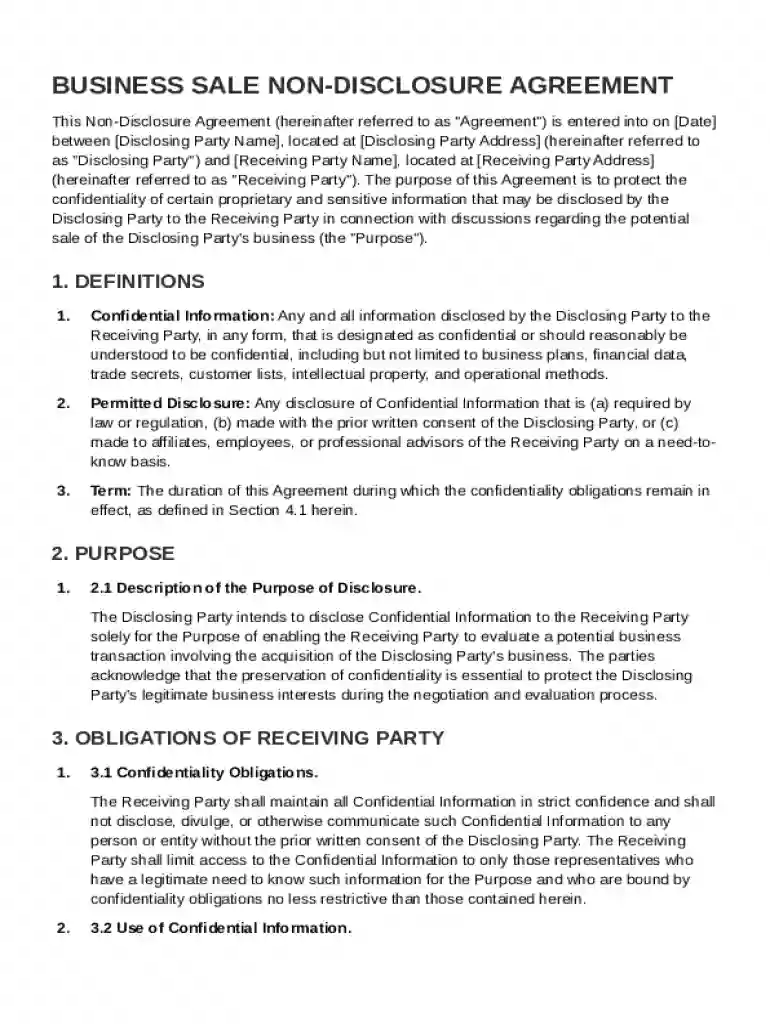
Business Sale Non Disclosure Agreement Template Preview on Page 1

Here's how it works

01. Edit your form online
Type text, add images, blackout confidential details, add comments, highlights and more.

02. Sign it in a few clicks
Draw your signature, type it, upload its image, or use your mobile device as a signature pad.

03. Share your form with others
Send it via email, link, or fax. You can also download it, export it or print it out.

Definition & Meaning

A Business Sale Non-Disclosure Agreement (NDA) is a legal document designed to facilitate the exchange of confidential information between two parties, generally labeled as the Disclosing Party and the Receiving Party. This agreement is crucial during the exploration stages of a business sale, where sensitive data about one party's business operations, financials, and strategic plans are shared. The NDA sets forth the terms and conditions under which confidential information can be disclosed, protecting the disclosing party against unauthorized use or dissemination by emphasizing the responsibilities and limitations of the receiving party.

Key Elements of the Business Sale Non-Disclosure Agreement Template

The template for a Business Sale NDA typically includes several critical components:

  • Definitions: Establishes what constitutes confidential information.
  • Obligations of the Receiving Party: Outlines the duty to maintain confidentiality and limit information usage solely for the evaluation of the business sale.
  • Exclusions from Confidentiality: Specifies information not covered under the NDA, usually information that is public knowledge or independently developed by the receiving party.
  • Term and Termination: Detail the duration of confidentiality obligations and conditions under which the agreement may be terminated.
  • Permitted Disclosures: Lists circumstances in which confidential information can be disclosed, such as to legal or financial advisors.
  • Remedies for Breach: Describes actions in case of an NDA breach, often including legal recourse and damages.

How to Use the Business Sale Non-Disclosure Agreement Template

Using a Business Sale NDA template involves several steps:

  1. Download the Template: Obtain the NDA template from a reputable source, ensuring it's a version that aligns with U.S. legal standards.
  2. Customization: Modify the template to fit the specific details of the transaction, including the names of both parties and a clear description of the confidential information.
  3. Review: Both parties should thoroughly review the document, preferably with the assistance of legal advisors, to ensure mutual understanding and agreement on terms.
  4. Signature: Both parties must sign the document, retaining a copy for their records. Signatures can be applied electronically through platforms like DocHub.

Steps to Complete the Business Sale Non-Disclosure Agreement Template

To complete the Business Sale NDA template effectively:

  1. Enter Party Information: Insert the legal names and contact details of the Disclosing and Receiving Parties.
  2. Define Confidential Information: Clearly describe what constitutes confidential information, tailored to the particularities of the business sale.
  3. Establish Terms and Duration: Specify how long the confidentiality obligations will last and the conditions for any expiration of the agreement.
  4. Detail Exclusions and Permissions: Identify any information excluded from the definition of confidential information and circumstances that allow sharing.
  5. Assign Governing Law: Determine the state law that will govern the agreement, usually matching the location where the business is based.
  6. Finalize and Sign: Once reviewed and agreed upon, both parties should execute the document with signatures.

Legal Use of the Business Sale Non-Disclosure Agreement Template

The Business Sale NDA is legally binding and must adhere to requirements specified under the ESIGN Act for electronic contracts. Its primary legal function is to protect proprietary information during the sale negotiations. This protection enables candid discussions without the risk of sensitive data being leaked, maintaining the integrity and privacy of the business being reviewed.

Who Typically Uses the Business Sale Non-Disclosure Agreement Template

Business Sale NDAs are predominantly used by:

  • Business Owners: Looking to sell their business and need to provide potential buyers with detailed, sensitive business information.
  • Potential Buyers: Evaluating a business opportunity and therefore requiring access to confidential information to make an informed purchase decision.
  • Legal and Financial Advisors: Engaged by either party to assist in the sale process and who may require access to confidential data.
decoration image ratings of Dochub

State-Specific Rules for the Business Sale Non-Disclosure Agreement Template

Some states may impose additional requirements for NDAs. While the basic structure remains the same, legal practitioners advise tailoring the document to comply with jurisdiction-specific rules, such as:

  • Duration Limits: Some states might limit the enforceable duration of NDAs.
  • Trade Secret Protections: Variations in how trade secrets are defined legally.
  • Admissibility in Court: Differences in how breaches are recognized and adjudicated.

Versions or Alternatives to the Business Sale Non-Disclosure Agreement Template

While the NDA for a business sale is specifically structured for buy-sell negotiations, alternatives include:

  • Mutual Non-Disclosure Agreements: Used when confidential information is exchanged both ways, rather than unilaterally.
  • Employment NDAs: Focused on protecting business information from being shared by employees.
  • Partnership NDAs: Designed for situations involving potential partnerships rather than outright sales.

By carefully selecting the appropriate agreement type, parties can ensure their interests are adequately safeguarded based on the nature of the transaction.

be ready to get more

Complete this form in 5 minutes or less

Get form

Got questions?

We have answers to the most popular questions from our customers. If you can't find an answer to your question, please contact us.
Contact us
Protecting sensitive information: Signing an NDA creates a legal obligation to keep sensitive information confidential. Any leak of that information is a bdocHub of contract.
Having a potential buyer sign a confidentiality agreement (or non-disclosure agreement NDA) gives you some protection. If they do bdocHub confidentiality youve a better chance of taking legal action and seeking damages with a signed document from them promising not to bdocHub confidentiality.
Selling Your Business Confidentially Prepare a Non-Disclosure Agreement (NDA) Use Blind Ads. Prequalify Prospective Buyers. Prepare a Selling Memorandum and Number the Copies. Obtain a Signed Letter of Intent. Never Hold Meetings at Your Place of Business. Involve as Few People as Possible.
Before signing an NDA, look out for seven crucial red flags that could limit your freedom or expose you to risks, including broad definitions of confidential information, indefinite duration, lack of mutuality, restrictive non-compete clauses, absence of provisions for legal disclosures, unclear remedies for bdocHub,
NDAs help protect important business information and ideas by clearly stating what must stay private and what can be shared. Usually, NDAs are signed at the start of a business relationship. They can cover any type of confidential information, such as test results, system details, customer lists, or sales numbers.

Security and compliance

At DocHub, your data security is our priority. We follow HIPAA, SOC2, GDPR, and other standards, so you can work on your documents with confidence.

Learn more
ccpa2
pci-dss
gdpr-compliance
hipaa
soc-compliance

People also ask

Yes, either the buyer or the seller can draft a business purchase agreement. However, its crucial that the person writing the agreement has a good understanding of the business and legal implications.

Related links