01. Edit your form online
Type text, add images, blackout confidential details, add comments, highlights and more.

Type text, add images, blackout confidential details, add comments, highlights and more.

Draw your signature, type it, upload its image, or use your mobile device as a signature pad.

Send it via email, link, or fax. You can also download it, export it or print it out.
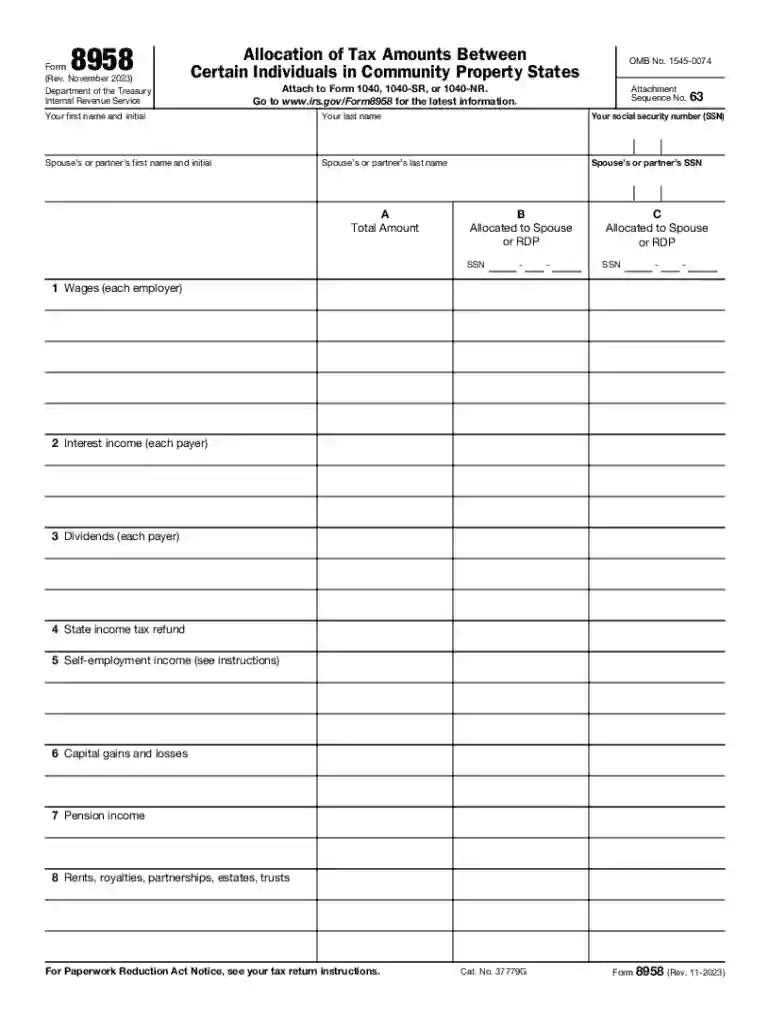
Form 8958 is a tax form primarily used by spouses or registered domestic partners (RDPs) in community property states to allocate and report incomes, deductions, credits, and other tax-related items. This form ensures accurate accounting of community and separate income, which is crucial when filing separate tax returns. Understanding the nuances of Form 8958 is essential for compliance with both federal and state tax laws. Spouses use this form to delineate their financial responsibilities, ensuring that each party's tax obligations are accurately assessed according to community property guidelines.
Determine Filing Status: Identify whether you and your partner are filing separately in a community property state. This step is key in determining eligibility for using Form 8958.
Collect Necessary Information: Gather all relevant financial information, including income, deductions, and credits. This includes wages, salaries, dividends, and any other sources of income.
Complete the Allocation Section: Allocate income and deductions between you and your partner. Ensure that all items are accurately divided per your community property agreement or state laws.
Review State Laws: Familiarize yourself with your specific state's community property rules to ensure accurate compliance when completing the form.
Attach to Form 1040: Once completed, attach Form 8958 to your federal tax return Form 1040. Verify all allocations and data entries before submission to avoid discrepancies.
Form 8958 is typically utilized by married couples or registered domestic partners residing in community property states such as California, Texas, and Washington. These jurisdictions require an accurate division of financial obligations and assets for tax filing purposes. This form proves particularly vital for couples choosing to file separately. It assists in maintaining transparency and equity, aligning with state mandates regarding community versus separate property income.
Community Property: Refers to assets and income acquired during marriage, which are considered jointly owned by both spouses.
Separate Property: Refers to assets owned individually before marriage or acquired by gift or inheritance during marriage.
Allocation: The process of distributing income and deductions between spouses to comply with community property laws.
Filing Separately: A tax filing status where each spouse reports their respective income, deductions, and credits on individual tax returns.
Community property rules can differ significantly between states. For instance:
California: Requires equal division of income and responsibility for tax purposes, but separate property remains distinct.
Texas: Similar to California, emphasizes equitable sharing but has distinct regulations around mixed property.
Washington: Features unique provisions around income from separate property and its treatment upon divorce or separation.
Understanding these differences is critical for accurately using Form 8958.
The IRS provides comprehensive guidelines for completing Form 8958, detailing the necessary steps for proper allocation of community and separate income. Taxpayers must adhere to these guidelines to avoid inaccuracies. Key points include correct identification of community versus separate income, diligent application of state laws, and precise detailing of individual and shared financial responsibilities.
April 15: Traditionally, the deadline to file Form 8958 with your federal tax return. However, if it falls on a holiday or weekend, the deadline may be extended.
Extensions: If an extension is filed using Form 4868, taxpayers must submit Form 8958 by the extended deadline, typically October 15.
Knowing these deadlines helps ensure timely submission, mitigating penalties and interest accrual.
Failing to file Form 8958 or reporting inaccurately can lead to penalties, including fines and interest on unpaid taxes. The IRS may also subject inaccurate filings to audits or reviews. Penalties emphasize the importance of thorough and accurate completion of the form as per IRS guidelines and state laws. Proper filing ensures compliance and prevents financial repercussions.
We've got more versions of the Form 8958 (Rev November 2023) form. Select the right Form 8958 (Rev November 2023) version from the list and start editing it straight away!
At DocHub, your data security is our priority. We follow HIPAA, SOC2, GDPR, and other standards, so you can work on your documents with confidence.