
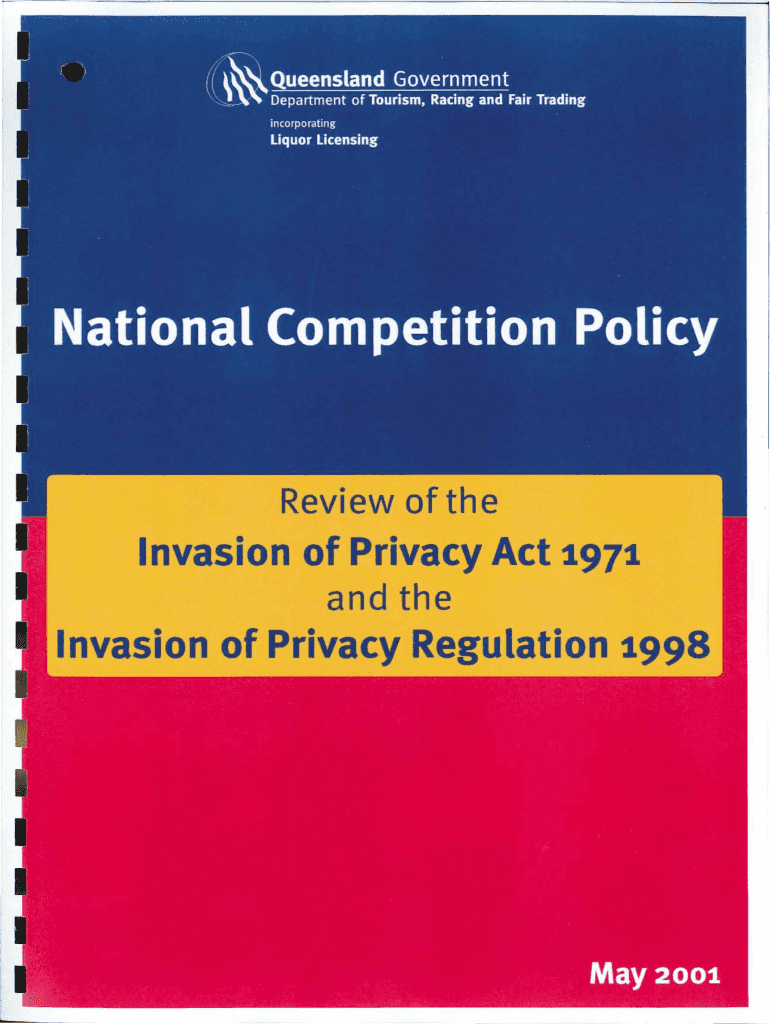







Definition and Meaning
The "Invasion of Privacy Act 1971" and the "Invasion of Privacy Regulation 1998" play crucial roles in establishing and maintaining privacy rights in Queensland, Australia. Primarily, these laws focus on regulating how personal information is handled, ensuring that individuals’ privacy is protected. The Acts’ intent is to provide a structured legal framework to address and mitigate privacy infringements, emphasizing the protection of personal data from misuse or unauthorized access.
Key Elements of the Review
A comprehensive review of both the Invasion of Privacy Act 1971 and the Invasion of Privacy Regulation 1998 entails examining the effectiveness of these laws in safeguarding privacy. Key elements include assessing their impact on consumer protection and competition, as these sectors are heavily influenced by privacy regulations. The review must analyze existing licensing requirements for credit reporting agents, exploring potential deregulation to streamline processes. Evaluating the objectives met by the Commonwealth Privacy Act 1988 is integral, as it forms the backdrop for state-level legislative necessity.
Legal Use of the Review
The review document serves legal purposes by offering insights into the adequacy of the current privacy frameworks. It provides legislators, policymakers, and legal consultants with a detailed analysis of how the state laws correspond with national privacy protection standards. Stakeholders use the document to make informed decisions on whether state regulations should be maintained or repealed in favor of streamlined, nationwide laws.
Steps to Complete the Review
- Data Collection: Gather all relevant information and historical data about both privacy acts.
- Analysis: Critically assess the existing frameworks and their impact on the public and industries.
- Comparison: Compare state privacy laws with the Commonwealth Privacy Act 1988 to identify overlaps.
- Consultation: Engage with stakeholders such as legal experts, consumer advocacy groups, and industry representatives.
- Documentation: Draft the review, incorporating findings and stakeholder feedback.
- Recommendations: Propose potential legal reforms or the deregulation of redundant provisions.
Why You Should Review These Acts
Reviewing these acts is crucial for ensuring they remain relevant and effective in protecting individuals’ privacy rights in the face of technological advancements and societal changes. It’s essential for improving the legal framework to address modern challenges related to data privacy, such as digital information exchange and rising cyber threats. For policymakers, it provides a chance to streamline regulations, thereby enhancing compliance and reducing administrative burdens.
Who Typically Uses This Review
The review is typically utilized by policymakers, regulatory bodies, and legal professionals engaged in privacy law. It’s also of interest to consumer protection agencies and businesses, especially those in the credit reporting and data management sectors. By understanding these laws, these stakeholders can better navigate compliance requirements and contribute to shaping effective privacy protection policies.
State-Specific Rules
Queensland, where these acts are based, may have specific interpretations and applications that differ from other Australian states. The review should highlight any unique provisions or implementations within Queensland’s jurisdiction that impact how the laws are applied locally. Acknowledging these differences ensures that any recommendations for reform are contextually grounded and practical for the state’s environment.
Examples of Using the Review
- Consumer Advocacy: Advocacy groups can use the findings to push for stronger privacy protections or the removal of outdated regulations.
- Legal Reforms: The review can inform debates in legislative assemblies on privacy law modernization.
- Business Compliance: Corporations can assess the need to adjust their data-handling practices in response to potential legal changes following the review.
Versions or Alternatives to the Acts
While reviewing these specific acts, it’s also beneficial to consider other related legislative frameworks at the national or international level. The Commonwealth Privacy Act 1988 serves as a primary alternative, offering broader legislative coverage that may supersede state-specific regulations. Understanding these alternatives allows for a more comprehensive evaluation of privacy law efficacy in Queensland and beyond.




