01. Edit your form online
Type text, add images, blackout confidential details, add comments, highlights and more.

Type text, add images, blackout confidential details, add comments, highlights and more.

Draw your signature, type it, upload its image, or use your mobile device as a signature pad.

Send it via email, link, or fax. You can also download it, export it or print it out.
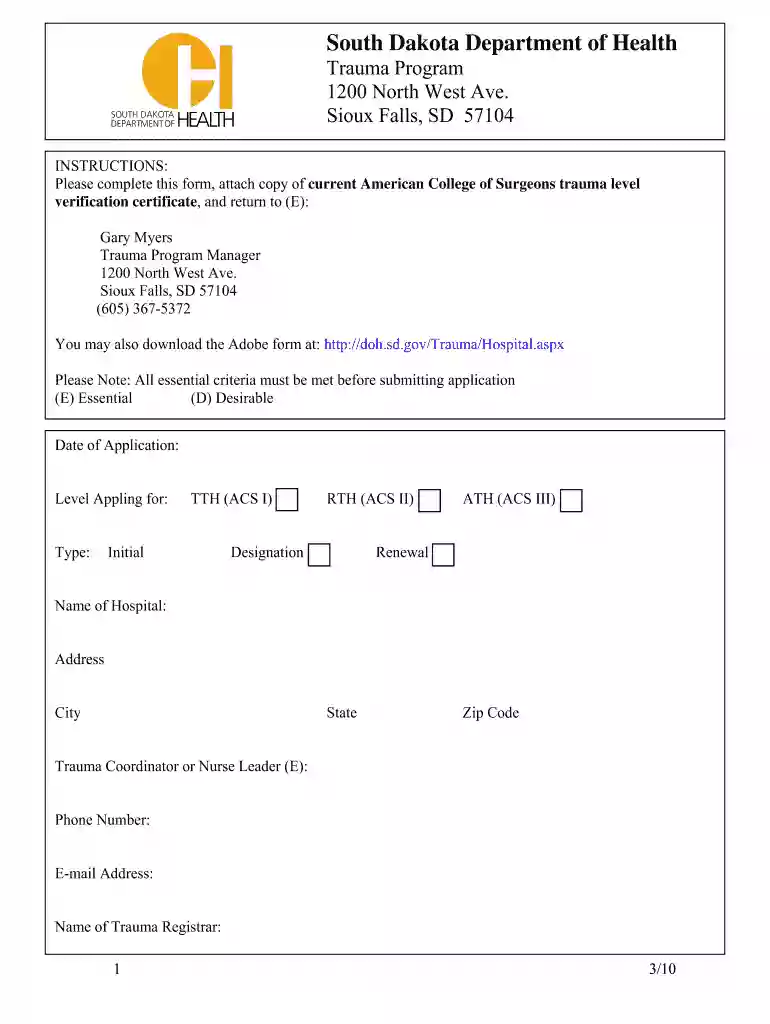
The South Dakota Health Department Trauma Program plays a critical role in designating trauma hospitals across the state. This designation involves an extensive evaluation process to ensure hospitals meet specific standards necessary to handle trauma cases effectively. These designations are vital for public safety, ensuring that trauma victims receive the best possible care in emergencies. Trauma hospital designation verifies a facility's capabilities in trauma care, determining the level of care it can provide.
Securing a trauma hospital designation from the South Dakota Department of Health involves several critical steps.
Initial Assessment: Hospitals must perform a self-assessment to determine readiness for the designation process.
Documentation Submission: Gather required documents, including the current verification certificate, and submit them to the Trauma Program Manager.
Site Visit: An on-site review is conducted by the Department of Health to assess compliance with trauma system standards.
Feedback and Corrections: Facilities may receive feedback and need to make adjustments to meet criteria fully.
Final Approval: Once all requirements are met, the hospital will receive its designation, valid for a specified term, usually two to three years.
Hospitals aiming for a trauma designation must meet established criteria set by the South Dakota Department of Health.


Several key elements define the process and requirements for trauma hospital designation.
Adhering to legal and compliance requirements is critical in obtaining and maintaining a trauma hospital designation.
The Trauma Program Manager acts as a pivotal liaison between hospitals and the South Dakota Department of Health. They provide necessary documentation guidance, support throughout the application, and handle inquiries related to the trauma designation process.
South Dakota has distinctive guidelines pertinent to trauma hospital designation, differing from other states. These guidelines take into consideration regional healthcare needs and population distribution.
Trauma hospital designation enhances community trust by ensuring high-quality emergency care. It solidifies a hospital's commitment to providing exceptional care, fostering confidence among patients and the healthcare community.
Each block provided thorough explanations and examples to ensure a comprehensive understanding of the South Dakota Health Department's Trauma Program and its trauma hospital designation requirements.
We've got more versions of the SD Health Department Trauma Program - trauma hospital designation trauma hospital designation form. Select the right SD Health Department Trauma Program - trauma hospital designation trauma hospital designation version from the list and start editing it straight away!
| Versions | Form popularity | Fillable & printable |
|---|---|---|
| 2010 | 4.8 Satisfied (256 Votes) |
At DocHub, your data security is our priority. We follow HIPAA, SOC2, GDPR, and other standards, so you can work on your documents with confidence.