Indiana Do Not Resuscitate (DNR) Order Form - Free Indiana 2026

Get Form
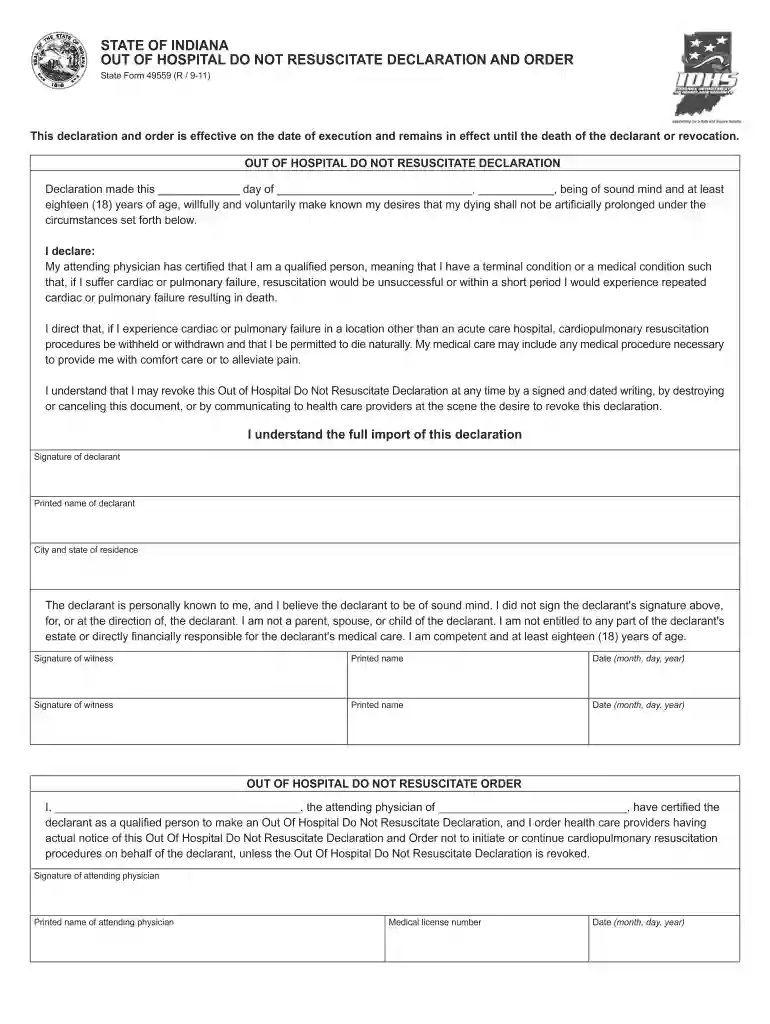
Indiana Do Not Resuscitate (DNR) Order Form - Free Indiana Preview on Page 1

Here's how it works

01. Edit your form online
Type text, add images, blackout confidential details, add comments, highlights and more.

02. Sign it in a few clicks
Draw your signature, type it, upload its image, or use your mobile device as a signature pad.

03. Share your form with others
Send it via email, link, or fax. You can also download it, export it or print it out.

Definition and Purpose of the Indiana Do Not Resuscitate (DNR) Order Form

The Indiana Do Not Resuscitate (DNR) Order Form is a legal document used to communicate an individual's wish not to receive cardiopulmonary resuscitation (CPR) in the event of cardiac or respiratory arrest outside a hospital setting. This form is particularly important for individuals with terminal illnesses or severe health conditions who prefer to avoid aggressive resuscitation efforts. It ensures that both medical professionals and family members are aware of and respect the individual's end-of-life care preferences.

  • It is essential for individuals who want control over their medical treatment at the end of life.
  • Helps avoid unnecessary medical interventions and respect patient's autonomy.
  • Provides clear instructions for emergency medical personnel.

How to Obtain the Indiana Do Not Resuscitate (DNR) Order Form

Acquiring the Indiana DNR Order Form involves several steps to ensure the document is completed correctly:

  1. Consultation with Physician: Start by consulting with a healthcare provider to discuss the decision and its implications.
  2. Secure the Form: Obtain the form through medical facilities or legal service providers. In many cases, it can be downloaded from relevant health department websites.
  3. Verification and Completion: The form must be filled out accurately, validating the patient's decision, and require signatures from the patient and attending physician.
  4. Distribution: Once completed, copies should be given to close family members, healthcare providers, and possibly the local hospital to ensure it is respected.

Steps to Complete the Indiana Do Not Resuscitate (DNR) Order Form

Filling out the Indiana DNR Order Form involves specific steps to ensure that it is valid and enforceable:

  1. Patient Information: Enter the patient's full legal name, date of birth, and contact details.
  2. Declaration of Intent: Clearly state the intent not to undergo CPR in appropriate circumstances outside the hospital.
  3. Physician's Signature: The attending physician must sign, confirming that they have explained the implications and that the patient is of sound mind.
  4. Patient or Representative Signature: Either the patient or their legally authorized representative must sign, indicating acknowledgement and understanding.
  5. Witness Requirements: Depending on state regulations, a witness may also be required to sign the form to confirm its authenticity.

Importance of the Indiana Do Not Resuscitate (DNR) Order Form

The Indiana DNR Order Form holds significant importance for several reasons:

  • Respects Patient Wishes: It empowers patients to make choices about their end-of-life care.
  • Reduces Family Burden: Alleviates pressure on family members by removing the burden of making critical medical decisions during emotional times.
  • Legal Protection: Provides legal protection to healthcare providers who honor the DNR, ensuring compliance with the patient's wishes.

Who Typically Uses the Indiana Do Not Resuscitate (DNR) Order Form

This form is primarily used by individuals facing life-threatening or terminal health conditions. It is also relevant for:


  • Elderly patients preferring comfort care over life-extending measures.
  • Individuals with chronic illnesses that would not benefit from resuscitation.
  • Persons seeking to maintain control over their medical treatment decisions.
decoration image ratings of Dochub

Key Elements of the Indiana Do Not Resuscitate (DNR) Order Form

The form contains several critical components that ensure it is executed properly:

  • Patient Details: Full name, date of birth, and contact information.
  • Statement of Intent: A section declaring the refusal of CPR in specified situations.
  • Medical Provider Endorsement: Signature from an attending physician.
  • Legal Witnesses: Depending on the jurisdiction, a signature from a witness may be necessary.

State-Specific Rules for the Indiana Do Not Resuscitate (DNR) Order Form

Understanding state-specific regulations is essential for the proper use of the DNR form:

  • Indiana law mandates specific language and signatory requirements on the DNR form for it to be legally binding.
  • It must be recognized by emergency medical services across the state to be effectively enforced.
  • The form should be easily accessible, possibly displayed prominently at the patient's place of residence.

Legal Use of the Indiana Do Not Resuscitate (DNR) Order Form

Legal considerations are crucial when deploying a DNR form:

  • Enforceability: The DNR must be correctly executed according to state laws to be enforceable.
  • Revocation: Patients retain the right to revoke the DNR at any time and should communicate any changes to their healthcare provider immediately.
  • Protection for Physicians: Ensures that healthcare providers who comply with the DNR are protected against legal repercussions.

Common Scenarios for Using the Indiana Do Not Resuscitate (DNR) Order Form

Case Study Examples

  • End-Stage Cancer Patients: For individuals with terminal cancer, a DNR form helps avoid invasive procedures that do not improve quality of life.

  • Chronic Heart Conditions: Patients with recurrent heart failure may choose a DNR to focus on pain management and other supportive care.

  • In some cases, individuals who have experienced multiple hospitalizations may decide a DNR aligns with their overall care goals to focus on comfort.

These scenarios underscore the form's importance in upholding individual autonomy and providing clarity during critical medical situations.

be ready to get more

Complete this form in 5 minutes or less

Get form

Got questions?

We have answers to the most popular questions from our customers. If you can't find an answer to your question, please contact us.
Contact us
How To Get a DNR Form Speak with your (or a)physician: For a DNR form to be activated, it requires a doctors signature. Choose possible medical treatments: The main treatment a DNR form covers is CPR treatment. Get formed signed: Different states have different requirements.
An out of hospital DNR declaration must meet the following conditions: Be voluntary. Be in writing. Be signed by the person making the declaration or by another person in the declarants presence and at the declarants express direction.
Your doctor may complete a DNACPR form to indicate this and put it in your medical records. If you wish to make your refusal of CPR legally binding for when in the future you are unable to make this decision, then you should write an Advance Decision to Refuse Treatment (ADRT).
The DNR must be made in conjunction with a physician and the individual or the individuals representative (legal guardian, court appointed representative, formal Healthcare Representative, or Power of Attorney) in order to state that an individual is terminally ill and would not be expected to recover well from

Security and compliance

At DocHub, your data security is our priority. We follow HIPAA, SOC2, GDPR, and other standards, so you can work on your documents with confidence.
Learn more
ccpa2
pci-dss
gdpr-compliance
hipaa
soc-compliance