01. Edit your form online
Type text, add images, blackout confidential details, add comments, highlights and more.

Type text, add images, blackout confidential details, add comments, highlights and more.

Draw your signature, type it, upload its image, or use your mobile device as a signature pad.

Send it via email, link, or fax. You can also download it, export it or print it out.
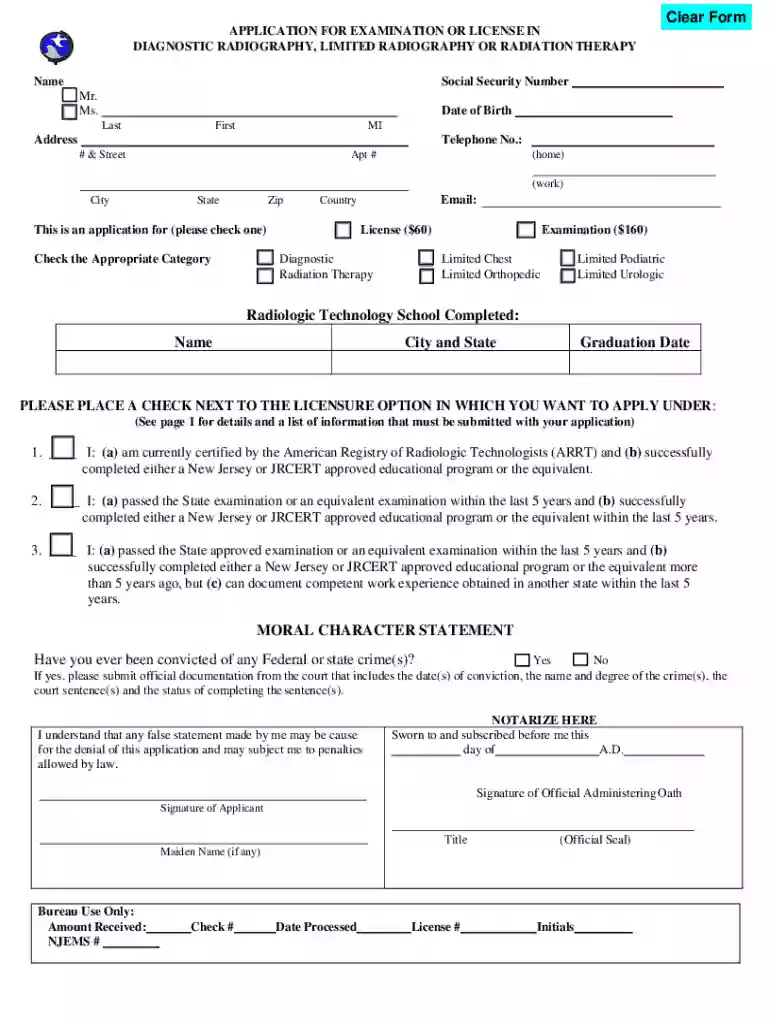
The "2016 NJ Application for Examination or License in Diagnostic Radiography Limited Radiography or Radi" is a formal document used by individuals wishing to obtain a professional license or apply for an examination in the fields of Diagnostic Radiography and Limited Radiography in New Jersey. This application ensures that candidates meet the necessary qualifications to practice or study radiographic procedures, as outlined by New Jersey's regulatory bodies. The document requests a myriad of personal, educational, and professional details to assess the applicant’s eligibility.
Personal Information: Begin by providing accurate personal information such as your full name, date of birth, and social security number. Ensure all details match your official identification documents to avoid delays.
Educational Background: Include detailed information about your educational qualifications. This should encompass the institutions attended, dates of attendance, and degrees or certifications obtained, specifically those related to radiography.
Professional Experience: List your relevant work experiences, highlighting specific roles and responsibilities in diagnostic or limited radiography. Providing this history demonstrates hands-on experience in the field.
Required Documentation: Gather and attach necessary documents such as transcripts, certifications, proof of residency, and any previous licenses if applicable. Make sure that each document is legible and up-to-date.
Application Fees: Calculate and submit the associated application fees. Payment details, including the preferred method (e.g., check, money order), should be followed as per the instructions included in the form.
Notarization and Signature: Obtain notarization for specific sections if required and provide your signature to certify the truthfulness of the information provided.
Submission: Send the completed application either via mail or through an online portal, as specified by the issuing authority. Ensure that all sections are complete before submission. Keep a copy of the completed application for your records.
This form is legally required for anyone seeking to formally engage in the practice of diagnostic or limited radiography within the state of New Jersey. Utilizing this form ensures that a practitioner has met all educational, professional, and ethical standards mandated by state regulations.
New Jersey has particular guidelines that applicants must adhere to, which include providing proof of both theoretical knowledge and practical experience in radiography. It's crucial to adhere to these specific standards to ensure the application is processed without issue. Failing to comply with state-specific rules might lead to application denial or other consequences.
To qualify for submission, applicants must possess a recognized education in radiology with supplemental certifications where necessary. Experience in the field may also be a prerequisite, alongside a clear background check and professional recommendations if needed.


The time taken to process and approve applications varies. Typically, expect a period for verification and validation of the submitted details, which could range from several weeks to a few months. Applicants will be notified of the decision via the contact information provided in their application.
We've got more versions of the 2016 NJ Application for Examination or License in Diagnostic Radiography Limited Radiography or Radi form. Select the right 2016 NJ Application for Examination or License in Diagnostic Radiography Limited Radiography or Radi version from the list and start editing it straight away!
| Versions | Form popularity | Fillable & printable |
|---|---|---|
| 2016 | 4.8 Satisfied (132 Votes) |
At DocHub, your data security is our priority. We follow HIPAA, SOC2, GDPR, and other standards, so you can work on your documents with confidence.