01. Edit your form online
Type text, add images, blackout confidential details, add comments, highlights and more.

Type text, add images, blackout confidential details, add comments, highlights and more.

Draw your signature, type it, upload its image, or use your mobile device as a signature pad.

Send it via email, link, or fax. You can also download it, export it or print it out.
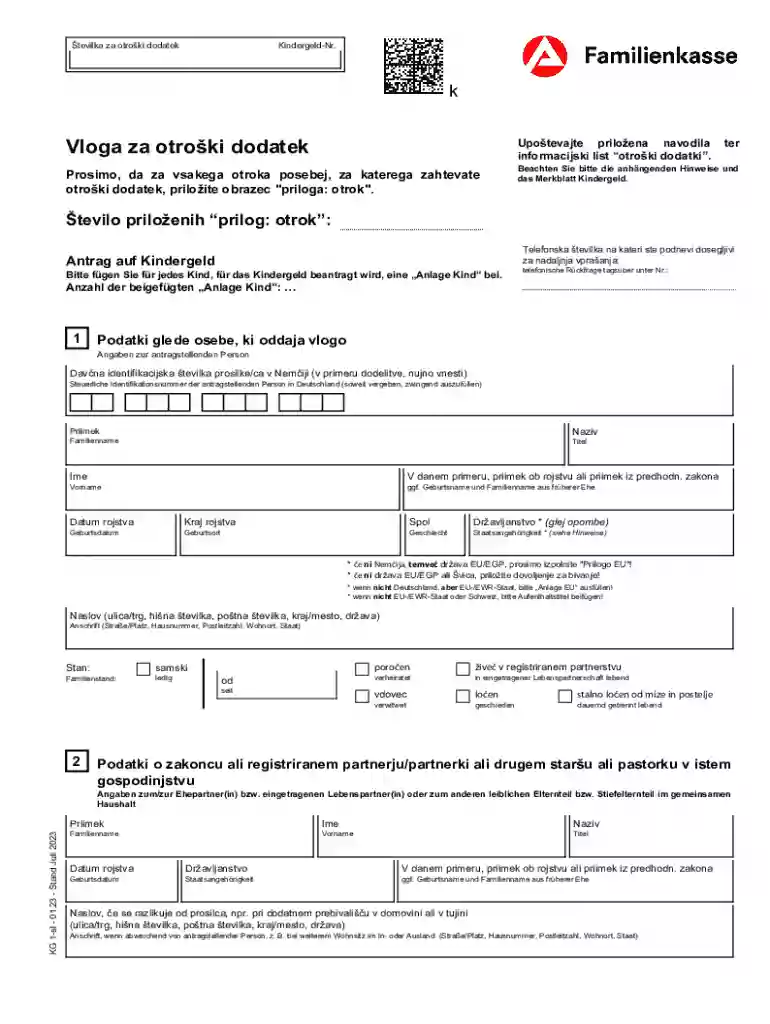
The "Anlage EU" is an integral component of the application process for German child benefits, known as Kindergeld. It serves to supplement the primary application form by gathering specific information about applicants from EU member states who reside in Germany. The form ensures that child benefits are distributed to eligible recipients in alignment with EU regulations, facilitating cross-border recognition of entitlements. This document is vital for ensuring that non-German EU citizens can claim benefits efficiently, as it captures necessary data to establish lawful residence and eligibility within the EU framework.
Acquiring the Anlage EU form is straightforward and can be done through several avenues. Prospective applicants can download the form from the official website of the Familienkasse (Family Benefits Office) or request a physical copy through a local office. For those who prefer online methods, government portals such as "Bundesagentur für Arbeit" often provide digital versions for ease of access. It's crucial to ensure that you obtain the most current version of the form to avoid processing delays. Additionally, some applicants may receive the form directly from the Familienkasse if they are already in communication or have previously submitted inquiries regarding Kindergeld.
Personal Information: Begin by filling out your personal details, including full name, address, and contact information. Ensure that these match your official identification documents to prevent discrepancies.
Details of Children: Include information for each child for whom you are claiming benefits. This section requires names, birth dates, and any relevant identification numbers.
Residency Information: Provide proof of residency within Germany. This may include a registration certificate (Anmeldung) or equivalent documentation that verifies your lawful presence in the country.
Employment Status: Outline your current employment status and any relevant income. This can affect eligibility and the amount of benefit received.
Additional Documentation: Gather required supporting documents such as birth certificates, and any legal agreements if separated or divorced, relevant to child custody or support.
Review and Submit: Double-check all entered details for accuracy and completeness, then submit the form either online through government portals or via mail to the local Familienkasse office.
Eligibility for completing the Anlage EU form primarily revolves around residency and familial connections. Applicants must:
Specific exceptions and considerations may apply for unique family situations, such as joint custody across borders or one parent living outside Germany.


Several critical sections of the Anlage EU form must be carefully completed to ensure successful processing:
By ensuring these sections are thoroughly and correctly filled out, applicants reduce the risk of administrative errors and expedite the processing of their application.
The legal framework surrounding the use of the Anlage EU form is vital to its integrity and effective function. Applicants are obliged to submit truthful information under penalty of law, as misinformation can lead to penalties, including fines and benefits suspension. Compliance also involves notifying the Familienkasse of any changes in circumstances, such as address changes or employment status updates, to prevent fraud and ensure continued benefit eligibility.
To complement the Anlage EU form, applicants must supply a range of supplementary documents:
These documents substantiate the information provided in the application, ensuring all claims meet the stringent criteria set by the Familienkasse.
Applicants can choose between several submission techniques to file their completed Anlage EU form:
Choosing the most convenient method, considering personal circumstances and available resources, can significantly impact the processing time and overall experience.
Understanding specific terminology associated with the Anlage EU form ensures clarity during the application:
By familiarizing yourself with these and other related terms, the application process will be more efficient and less prone to errors.
At DocHub, your data security is our priority. We follow HIPAA, SOC2, GDPR, and other standards, so you can work on your documents with confidence.