






Definition & Meaning
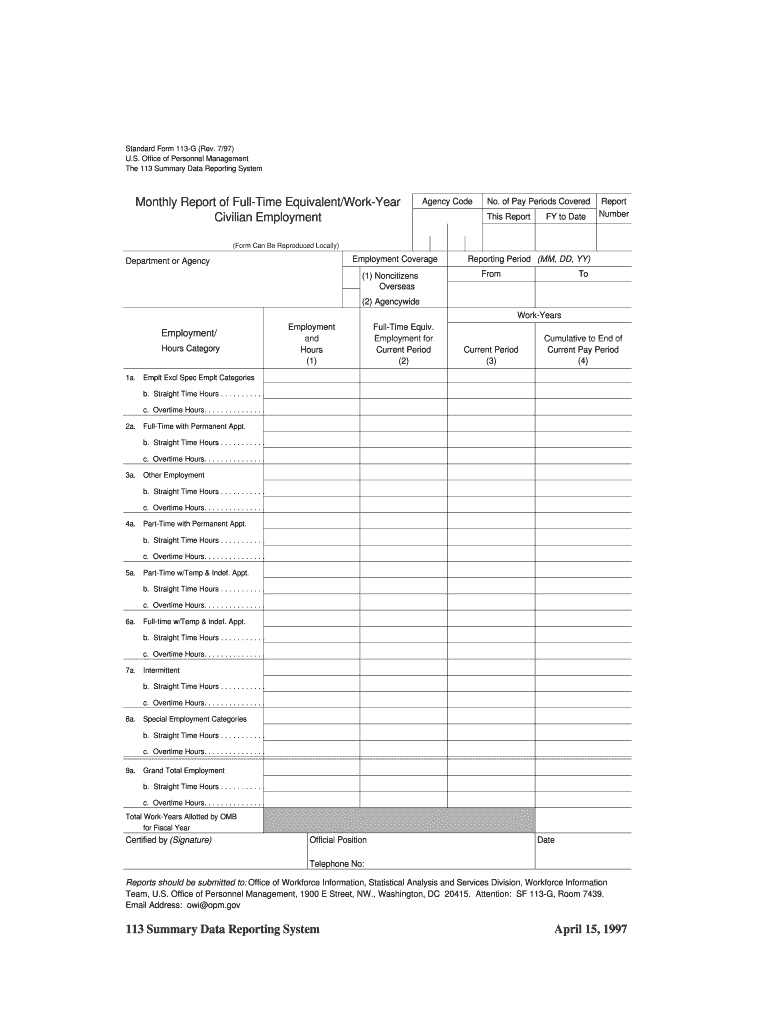
The "Monthly Report of Federal Civilian Employment - OPM" is an essential document that provides detailed data on the Full-Time Equivalent (FTE) and Work-Year Civilian Employment across various federal agencies. Issued by the U.S. Office of Personnel Management, this report compiles statistics related to employment categories, hours worked, and overtime. It's a critical tool for analyzing employment trends within the federal government, offering insights into workforce distribution and staffing levels.
Purpose of the Report
- Tracks Federal Employment: The report captures data on civilian employment, offering a clear snapshot of federal workforce size and composition.
- Supports Decision Making: It aids policymakers and government officials in making informed decisions about workforce planning and resource allocation.
- Monitors Trends: By comparing monthly data, the report helps in identifying employment trends over time within federal agencies.
How to Use the Monthly Report of Federal Civilian Employment - OPM
For effective use, understanding the structure and data presentation in the report is crucial. Here’s how different stakeholders can utilize it:
Analysts and Policymakers
- Trend Analysis: Examine historical data to track employment trends and make predictions about future staffing needs.
- Budgeting: Use the FTE counts to estimate payroll budgets and allocate resources efficiently.
Federal Agency Management
- Workforce Planning: Assess workforce distribution to align with organizational goals and improve efficiency.
- Performance Evaluation: Evaluate staffing levels against agency objectives to identify areas needing attention or adjustment.
How to Obtain the Monthly Report of Federal Civilian Employment - OPM
Acquiring the report involves straightforward steps, accessible to federal employees and researchers.
Access Methods
- OPM Website: Visit the official OPM website, where reports are published regularly for public access.
- Federal Agencies: Employees can request access through their agency’s human resources or administrative offices.
- Libraries: Some public or university libraries maintain archives of these reports.
Requirements for Access
- Authorization: While public access is allowed, federal employees may need agency credentials for internal reporting versions.
- Data Requests: Customized data requests can often be made to OPM for specific studies or analyses.
Steps to Complete the Monthly Report of Federal Civilian Employment - OPM
Completing this report involves several key steps to ensure accuracy and compliance.
Step-by-Step Process
- Data Collection: Gather employment and payroll data from relevant departments within the agency.
- Data Entry: Input the required information into the report template, ensuring all categories and data fields are complete.
- Verification: Cross-check entered data with source documents to verify accuracy and consistency.
- Submission: Submit the completed report to OPM electronically, adhering to the specified submission guidelines and deadlines.
Common Challenges
- Data Accuracy: Ensuring all data is current and accurate can be challenging when dealing with large datasets.
- Timeliness: Meeting submission deadlines is crucial to comply with OPM requirements and avoid penalties.
Who Typically Uses the Monthly Report of Federal Civilian Employment - OPM
Various stakeholders rely on this report to inform their work and decisions.


Primary Users
- Federal Agencies: Use the report to track workforce changes and manage human resource needs.
- Policymakers: Analyze employment data to develop policies that support efficient government operation.
- Research Institutions: Employ the data for studies on federal employment trends and workplace policies.
Secondary Users
- Public and Media: Individuals and journalists may reference the report for insights into government employment practices.
- Consultants: Utilize data to advise clients on federal employment and staffing strategies.
Key Elements of the Monthly Report of Federal Civilian Employment - OPM
Understanding the components of the report is crucial for effective analysis.
Major Sections
- Employment Categories: Breakdowns by job types, full-time versus part-time status, and employment levels.
- Hours Worked: Detailed data on total hours, including regular and overtime hours for each category.
- Overtime Reporting: Provides insight into additional workforce demands and fiscal impact through overtime metrics.
Important Fields
- Agency Codes: Identifiers for each reporting agency to ensure proper categorization in the employment database.
- FTE Counts: Central to understanding staffing levels, representing total work time equivalent to a full-time employee.
Examples of Using the Monthly Report of Federal Civilian Employment - OPM
Practical examples showcase how different entities utilize this report.
Case Studies
- Federal Agency Analysis: An agency uses the report to assess the impact of budget cuts on staffing levels and makes adjustments to hiring practices.
- Policy Development: A congressional committee reviews the report to propose legislation aimed at optimizing federal workforce efficiency.
- Academic Research: Researchers analyze long-term data trends from the report to publish studies on public sector employment shifts.
Real-world Scenarios
- Workforce Reductions: Analyzing effects of government shutdowns on employee hours and payroll through historical report data.
- Hiring Freezes: Evaluating the impact of hiring freezes on service delivery and employee workload within agencies.