






Definition and Relevance of Forces and Their Measurement
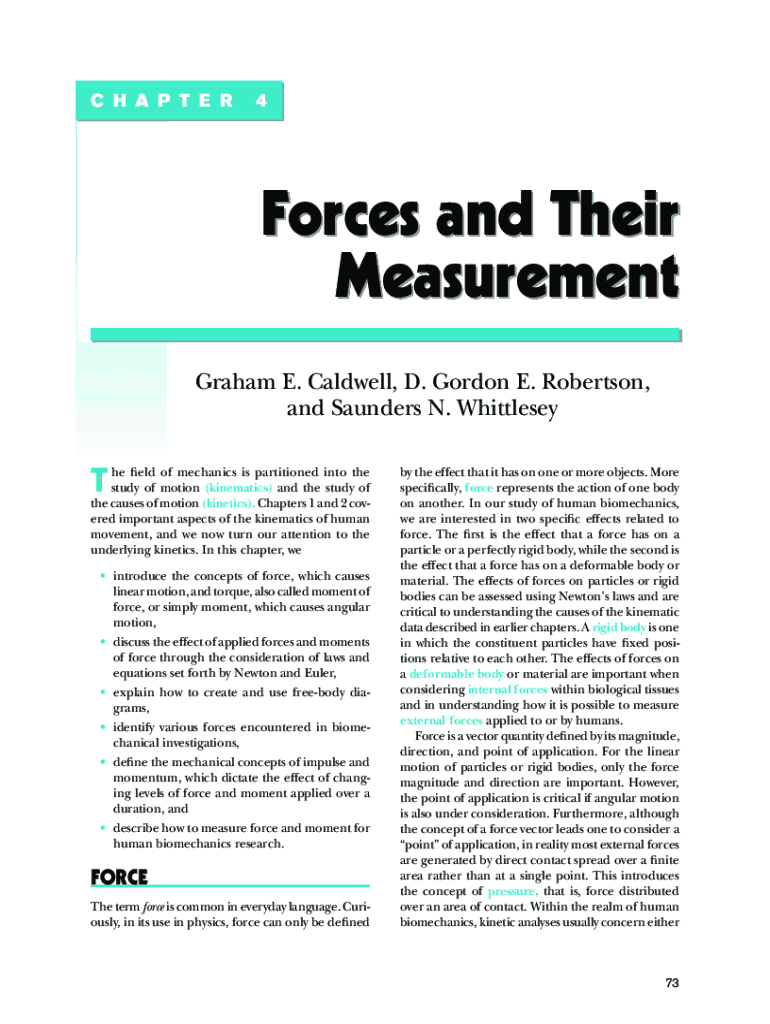
Understanding forces and their measurement is crucial in the field of biomechanics. A force is any interaction that, when unopposed, changes the motion of an object. It can be a push or a pull resulting from the object's interaction with another object. In biomechanics, studying forces allows us to analyze human movement, evaluate performance, and prevent injuries. The measurement of forces provides quantified data to support research, development, and application in fields such as sports science, rehabilitation, and ergonomics.
Key Elements of the PDF on Forces and Their Measurement
The PDF on forces and their measurement explores significant concepts such as force, torque, Newton's laws of motion, and free-body diagrams. Each element plays a vital role in understanding the dynamics of human movement:
- Force: Defined as a push or pull action that can cause an object with mass to change its velocity.
- Torque: A force that causes rotation, essential for studying angular movements.
- Newton’s Laws: Provide the foundational principles explaining motion's causes and effects.
- Free-Body Diagrams: Used to visualize the forces acting on a body, aiding in the analysis of equilibrium and motion.
Techniques for Measuring Forces in Biomechanics
Accurately measuring forces in biomechanics involves several techniques. Commonly used methods include:
- Force Platforms: Devices that measure ground reaction forces during activities such as walking or jumping. They're essential for gait analysis and sports science.
- Pressure Distribution Sensors: Capture the distribution of force across surfaces, helpful in studies of foot mechanics and postural control.
- Internal Force Measurement: Methods like electromyography (EMG) are used to measure muscle forces indirectly by assessing electrical activity within muscles.
Practical Applications and Examples
This document offers extensive examples of forces applied in various practical contexts:
- Sports Science: Analyzing athletes' movements, optimizing training techniques, and preventing injuries through precise force measurements.
- Rehabilitation: Tailoring physical therapy exercises to individual needs by understanding the forces exerted by and on different body parts.
- Ergonomics: Designing workspaces and tools to minimize unsafe force exertion, reducing strain and injury risks.
Legal and Ethical Use of Force Measurement Data
The application of force measurement data in biomechanics must comply with ethical and legal standards:
- Data Protection: Ensure all information gathered is protected and used according to policies such as HIPAA regulations in the U.S.
- Research Ethics: Consent from participants should be obtained before conducting any force measurement tests.
- Standardization: Following standardized methods ensures results are valid, reliable, and comparable across studies.
Who Commonly Utilizes Forces and Their Measurement
Various professionals and researchers rely on measuring forces for insights and applications:
- Biomechanists: To understand the mechanical behavior of body systems during movement.
- Sports Coaches: For performance enhancement and injury prevention strategies.
- Physical Therapists: To assess progress and customize rehabilitation programs.
- Occupational Therapists: To improve the ergonomic conditions of workplaces.
Steps to Utilize the PDF Effectively
Engaging effectively with the PDF on forces and their measurement requires a structured approach:
- Familiarization: Begin by reviewing basic mechanical principles such as motion and force.
- Understanding Context: Study the practical examples provided to see real-world applications.
- In-depth Study: Focus on sections related to your field of interest or work.
- Application Preparation: Use the measurement guides to plan your experimental or practical applications.
- Ethical Consideration: Review the legal guidelines and ensure all practices adhere to ethical standards.
Importance of Forces and Their Measurement in Research
In biomechanical research, measuring forces accurately can lead to significant findings and innovations:
- Dynamic Analysis: Understanding how forces affect human movement over time and in different conditions.
- Innovation in Prosthetics: Designing better prosthetic devices by analyzing forces applied to these devices during use.
- Health Evaluations: Developing more precise health assessments by integrating force measurement data.
Software Compatibility and Tools for Data Analysis
Various software solutions and technological tools support the analysis of biomechanical force data:
- Analysis Software: Tools like MATLAB or LabVIEW can be employed to process and analyze data collected from force platforms and sensors.
- Simulation Programs: Software such as OpenSim allows for the visualization and simulation of musculoskeletal dynamics.
- Data Management: Ensure compatibility between measuring devices and data analysis platforms for seamless workflow integration.