






Definition & Meaning
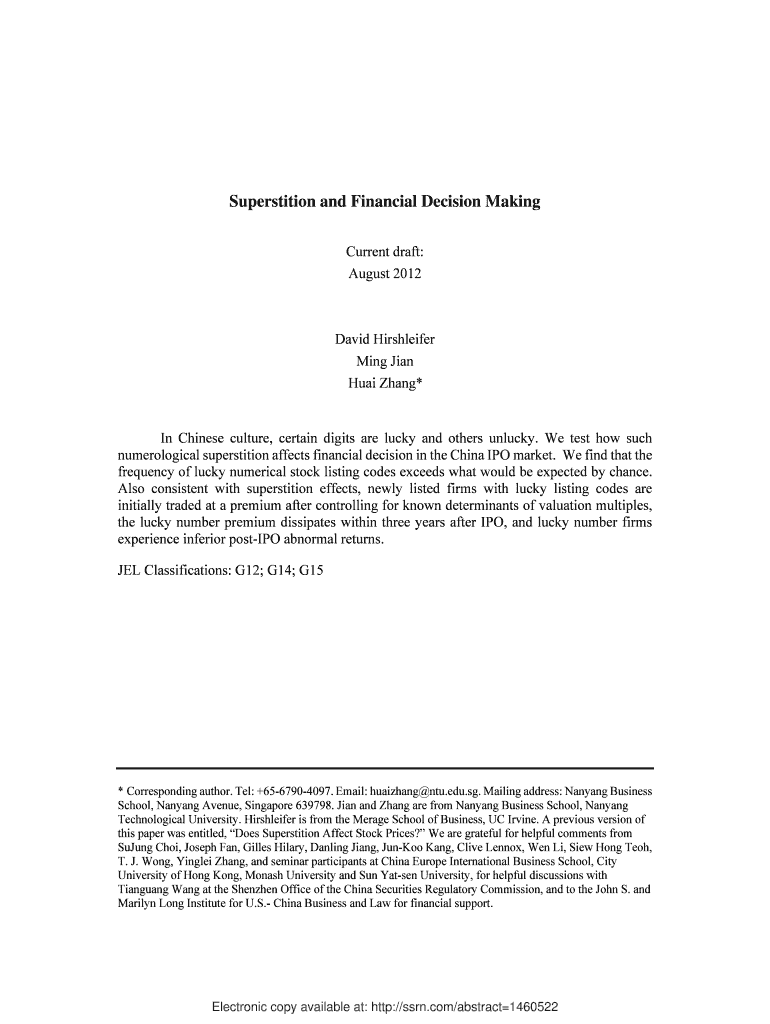
The concept of "Superstition and Financial Decision Making" refers to how individuals and organizations might allow superstitious beliefs to influence their financial choices. This can include reliance on numerology, astrology, or other belief systems when making significant financial decisions, such as investing, issuing public offerings, or selecting financial instruments. The field explores the psychological and cultural factors that may drive such behaviors and their impact on financial markets.
Key Elements of Superstition and Financial Decision Making
Several fundamental aspects are critical to understanding the role of superstition in financial decision-making:
-
Numerical Superstitions: Certain cultures have specific associations with numbers, such as unlucky or lucky numbers which can influence investor behavior in stock markets, particularly in the context of IPOs.
-
Cultural Beliefs: Cultural norms and long-standing beliefs can heavily impact how financial decisions are made, often leading to biased or non-rational decision-making processes.
-
Investor Behavior: Superstitious beliefs can manifest in hyperbolic discounting, overconfidence, or herd behavior among investors, all of which alter market dynamics.
Steps to Complete the Superstition and Financial Decision Making
In exploring this topic, it is helpful to follow a structured approach:
-
Identify Superstitions: Understand the specific superstitions prevalent in the target demographic or cultural cohort, such as the attachment to specific numbers.
-
Analyze Impact: Research how these superstitions influence financial decisions, market trends, and the performance of financial instruments.
-
Quantitative Analysis: Utilize statistical methods to quantify the effect of superstitions on financial outcomes, comparing data points across time and regions.
-
Comparison with Rational Models: Evaluate financial decisions against established economic models that do not account for superstitions to fully assess their impact.
Important Terms Related to Superstition and Financial Decision Making
Understanding this topic requires familiarity with several specific terms:
-
Behavioral Finance: A field that combines psychology and economics to study market inefficiencies.
-
IPO (Initial Public Offering): The process of a company offering shares to the public for the first time, a key setting for superstitious influences.
-
Market Anomalies: Patterns in stock markets or financial data that cannot be explained by traditional financial theories.
Examples of Using Superstition in Financial Decision Making
There are numerous real-world applications of superstitions influencing financial decisions:
-
Chinese IPOs: Companies listed during periods considered lucky, such as certain lunar phases or with auspicious numbers, often see initial trading premiums.
-
Astrological Influences: Investment strategies based on astrological signs that purportedly predict market conditions can lead to collective shifts in market sentiment.
-
Feng Shui in Real Estate: Consideration of feng shui principles can impact property valuations and transaction timings in markets like Hong Kong.
Legal Use of Superstition and Financial Decision Making
While superstition can play a role in financial decisions, its influence must be compliant with legal and regulatory standards. Firms and financial advisors should ensure that:
-
Disclosure Requirements: All material information, including any non-traditional factors affecting financial products, must be fully disclosed.
-
Regulatory Framework: Practices incorporating superstitions do not contravene existing financial regulations and laws, ensuring investor protection is maintained.
Versions or Alternatives to Superstition and Financial Decision Making
A variety of models and alternative frameworks can be employed alongside or in contrast to superstitious approaches:
-
Rational Economic Models: Based on the assumption of rational actors seeking to maximize utility, these models often exclude psychological influences.
-
Behavioral Economic Theories: Incorporating psychological insights, these theories offer alternative explanations for market behavior influenced by superstition.
State-by-State Differences
In the United States, regional variations can influence how superstition impacts financial decision-making:
-
Cultural Diversity: States with significant cultural enclaves, such as California or New York, may exhibit more pronounced effects due to cultural superstitions.
-
Regulatory Differences: Financial regulations may vary by state, influencing how superstitions integrate into financial practice legally and ethically.
Software Compatibility
Financial software can facilitate the analysis of superstitions in decision-making:
-
Data Analytical Tools: Platforms like QuickBooks or R can aid in the quantitative analysis of superstition's impact on financial performance.
-
Compatibility with Financial Models: Ensures superstitions-related data can be integrated with broader financial modeling software to provide comprehensive analysis.