01. Edit your form online
Type text, add images, blackout confidential details, add comments, highlights and more.

Type text, add images, blackout confidential details, add comments, highlights and more.

Draw your signature, type it, upload its image, or use your mobile device as a signature pad.

Send it via email, link, or fax. You can also download it, export it or print it out.
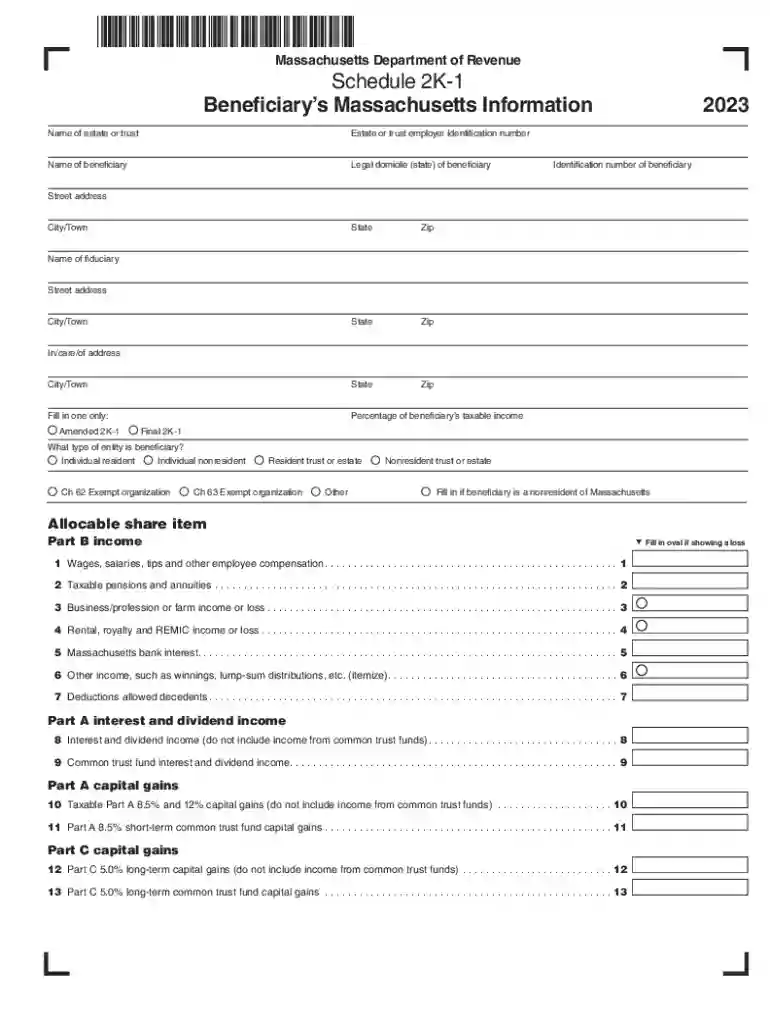
The Schedule 2K-1, a document issued by the Massachusetts Department of Revenue, details a beneficiary's share of income, deductions, and credits from an estate or trust. It is used for the 2023 tax year. The purpose of this form is to report information that affects the beneficiary’s tax obligations, ensuring that individuals are accurately documenting their fiscal interests in an estate or trust. As official tax documentation, it plays a vital role in the transparent reporting of financial distributions.
Completing the Schedule 2K-1 requires attention to detail to ensure all required information is accurately represented.
Consider a beneficiary receiving dividend income from a trust. They must report this income precisely as documented on the Schedule 2K-1 to align with state and federal tax guidelines.
This form ensures legal compliance with Massachusetts state tax laws by accurately reporting the income received through trusts or estates.
For example, heirs to an estate would use this form to report their share of income from estate assets, ensuring that all income is taxed according to state guidelines.
The Massachusetts Schedule 2K-1 is typically required to be submitted along with individual state tax returns, aligning with the April 15th filing deadline. Extensions may alter the deadline, but adherence to the original date ensures compliance and reduces penalty risks.
Beneficiaries should be aware that filing for an extension at the federal level might necessitate separate consideration for state-level extensions, which might not align precisely.
To complete this form accurately, gather the following:
Failure to accurately file the Schedule 2K-1 can result in penalties, including fines and interest on unpaid taxes. Additionally, significant discrepancies or omitted income could prompt an audit from tax authorities.
We've got more versions of the Schedule 2K-1 Beneficiary's Massachusetts Information form. Select the right Schedule 2K-1 Beneficiary's Massachusetts Information version from the list and start editing it straight away!
At DocHub, your data security is our priority. We follow HIPAA, SOC2, GDPR, and other standards, so you can work on your documents with confidence.