






Definition and Meaning
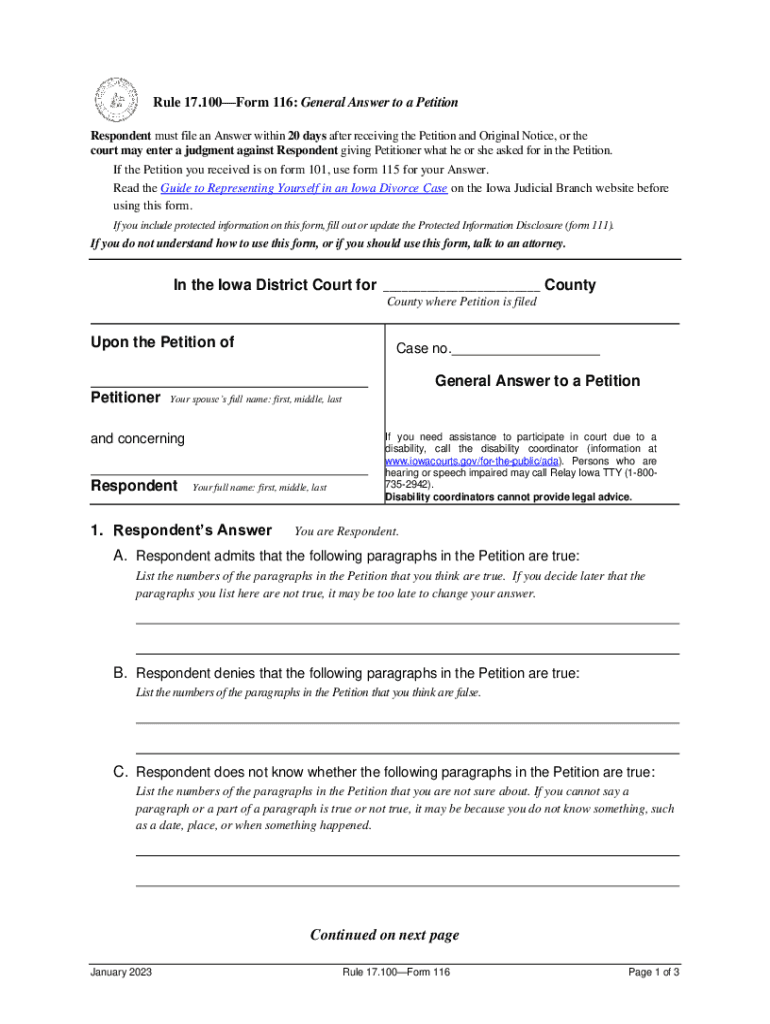
The "17 116 General Answer to a Petition" is a legal form used in Iowa, primarily concerning family law, specifically for responding to a Petition for Dissolution of Marriage. The document outlines how respondents should address the claims made in a petition, either admitting or denying each element. This response is formal, serving as the respondent's statement on what aspects of the petition they agree or disagree with, thus setting the stage for the subsequent legal process.
How to Use the 17 116 General Answer to a Petition
To effectively use the 17 116 form, respondents must understand each claim presented in the initial Petition for Dissolution of Marriage. Here's how it works:
- Review the Petition: Carefully read the initial petition to comprehend all allegations and statements.
- Draft Responses: Use the form to specifically admit or deny each point or statement made in the petition.
- Provide Additional Information: Where applicable, offer additional context or details that support your position.
- Submit on Time: Ensure the form is submitted within the required time frame, usually 20 days from receiving the petition, to avoid default judgments.
Steps to Complete the 17 116 General Answer to a Petition
Filling out the 17 116 involves a systematic approach:
- Personal Information: Begin by filling in your personal details, including name, address, and contact information.
- Respond to Claims: Go through each numbered paragraph of the petition and specify whether you admit, deny, or partly agree with the statements.
- Include Requests: Clearly write any requests to the court, like for a protective order or resolution terms different from those requested by the petitioner.
- Certification of Service: Complete this section to prove that a copy of your response was delivered to the petitioner or their attorney, outlining the method of delivery.
Who Typically Uses the 17 116 General Answer to a Petition
This form is principally used by respondents in divorce proceedings within Iowa. Respondents might include individuals undergoing marital separation who have been served with a Petition for Dissolution of Marriage and need to formally respond to initiate their defense or negotiations. Often, legal professionals also use this form to ensure their clients' responses are legally sound.


Legal Use of the 17 116 General Answer to a Petition
The legal framework surrounding this form is specific to family law proceedings. By submitting the 17 116, respondents convey their official stance regarding the petition, enabling the legal process to proceed towards settlement or court adjudication. The form serves as a critical legal document ensuring respondents' rights and perspectives are formally presented within the judicial system.
Key Elements of the 17 116 General Answer to a Petition
Several key components define this legal form:
- Identification Information: Basic personal details of the respondent.
- Response to Allegations: Specific admissions or denials related to each point in the petition.
- Additional Context: Any supplementary information that can influence the court's understanding.
- Request for Relief: Articulation of any court orders or judgments the respondent seeks.
- Proof of Service: Documentation confirming the petitioner has received a copy of the response.
State-Specific Rules for the 17 116 General Answer to a Petition
As this form is used within Iowa, it must adhere to state-specific regulations about family law and court procedures:
- Filing Deadlines: The respondent must file the form within 20 days of receiving the petition.
- Court Jurisdiction: The form is specific to Iowa's family law courts, requiring knowledge of local court rules.
- Required Formats: Must comply with state-prescribed formats for legal documents and their delivery.
Examples of Using the 17 116 General Answer to a Petition
Consider two different scenarios:
- Admission: A respondent might agree with the petitioner’s statement about residency requirements, thereby affirming the court’s jurisdiction.
- Denial: Conversely, disputes over shared property could lead to denying statements regarding asset distribution as outlined in the petition, prompting negotiation or mediation.
These examples illustrate the form's role in customizing a defensive or concurring response to a marriage dissolution case.