




01. Edit your form online
Type text, add images, blackout confidential details, add comments, highlights and more.

Type text, add images, blackout confidential details, add comments, highlights and more.

Draw your signature, type it, upload its image, or use your mobile device as a signature pad.

Send it via email, link, or fax. You can also download it, export it or print it out.
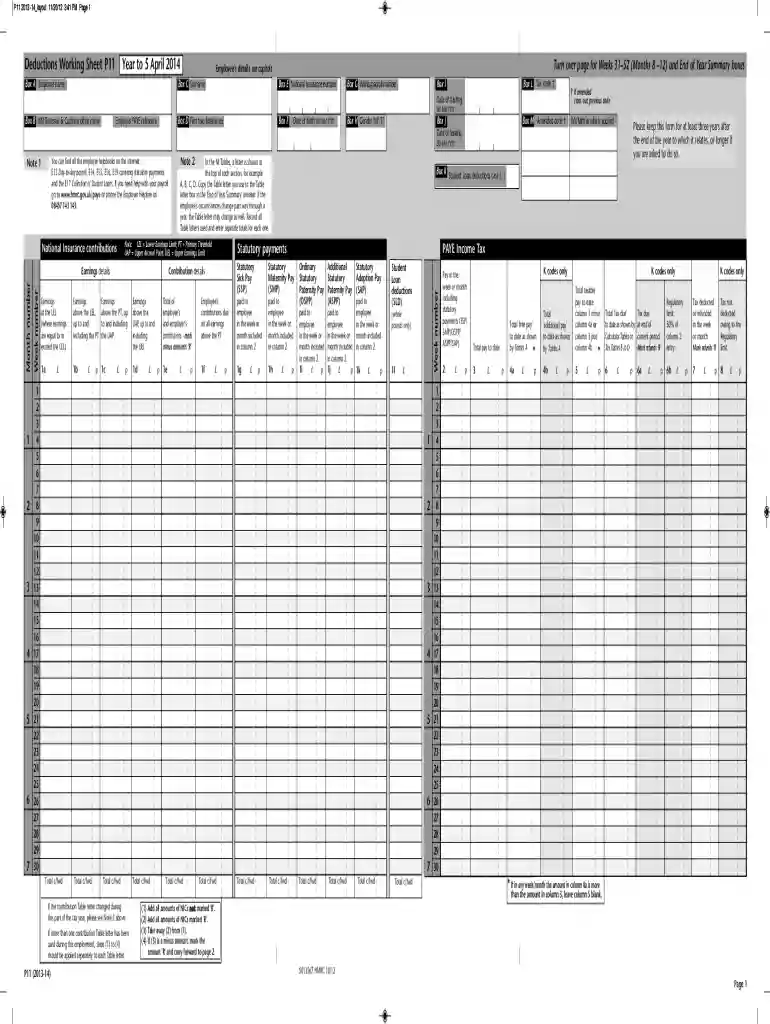
The P11 Deductions Working Sheet serves as a comprehensive tool for employers to accurately record and manage employee earnings and tax-related data. It is specifically designed to capture information about employee earnings, National Insurance contributions, statutory payments like Sick Pay and Maternity Pay, and any other deductions applicable for the tax year ending April 5, 2014. This document is essential for maintaining accurate payroll records and ensuring compliance with tax regulations.
Accurate completion of the P11 is vital for compliance and payroll accuracy. Here is a step-by-step guide to using the P11 Deductions Working Sheet:
Enter Employee Information: Begin by filling in the employee's personal details and National Insurance number.
Record Earnings: Input the gross pay for each pay period. For precise records, maintain consistency in documenting weekly or monthly earnings.
Statutory Payment Logging: Include any paid statutory entitlements like Sick Pay or Maternity Pay. This ensures all such payments are accurately logged.
Deduction Calculations: Sum all deductions, including tax withheld and National Insurance contributions.
Review & Verify: It is crucial to regularly verify all entries for accuracy and completeness. Mistakes in recording could lead to compliance issues or payroll errors.
Follow these steps to ensure the P11 sheet is filled out correctly:
Prepare Required Details: Gather all necessary employee details and any previous payroll data relevant for the current fiscal year.
Calculate Earnings and Deductions: Use precise calculations to determine the accurate deductions and contributions.
Detail Entries Accordingly: Make sure each section of the form is filled out; missing data can lead to inaccuracies.
End-of-Year Adjustments: At the fiscal year-end, revisit all entries to finalize and prepare for submission to relevant authorities.
Adhering to legal standards is crucial in payroll processing:
The P11 document is structured around several key components:


Deadlines ensure compliance and timely submission:
Failure to maintain or submit the P11 properly can lead to:
Understanding these core elements will ensure effective use of the P11 Deductions Working Sheet and compliance with U.S. tax laws.
We've got more versions of the P11 (2013) deduction Working sheet P11 Deductions Working Sheet P11 form. Select the right P11 (2013) deduction Working sheet P11 Deductions Working Sheet P11 version from the list and start editing it straight away!
| Versions | Form popularity | Fillable & printable |
|---|---|---|
| 2012 | 4.5 Satisfied (34 Votes) |
At DocHub, your data security is our priority. We follow HIPAA, SOC2, GDPR, and other standards, so you can work on your documents with confidence.


