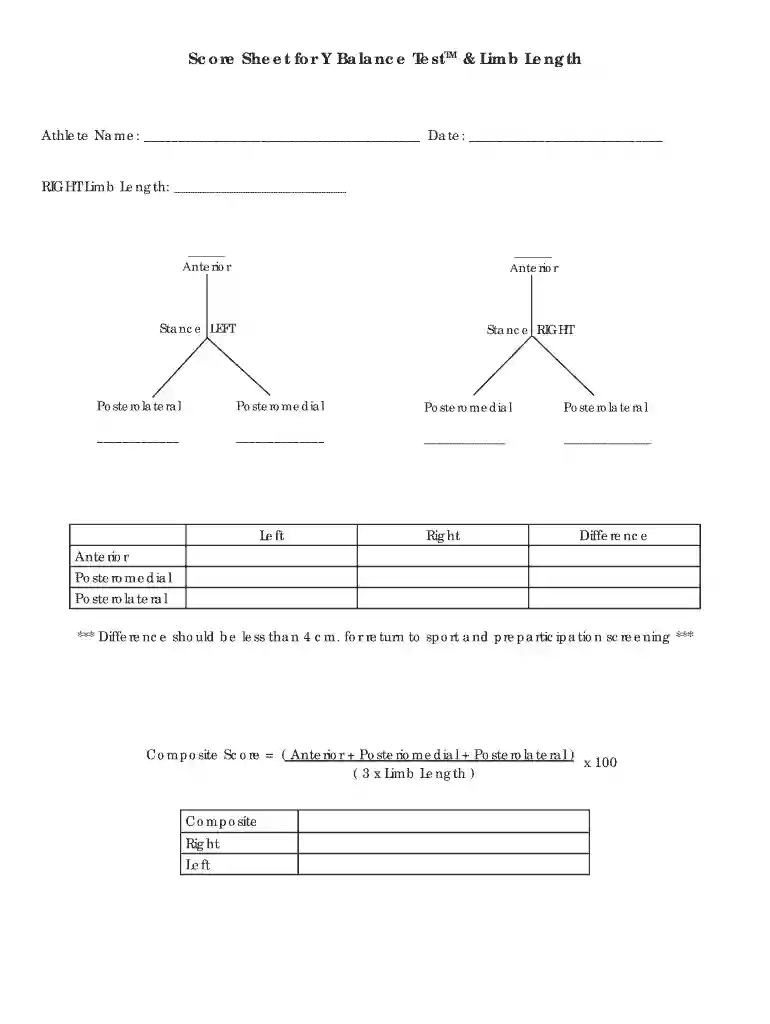
Y Balance Score Sheet without consent section Modifiedindd - usbcongress internapcdn 2026

Get Form
Y Balance Score Sheet without consent section Modifiedindd - usbcongress internapcdn Preview on Page 1

Here's how it works

01. Edit your form online
Type text, add images, blackout confidential details, add comments, highlights and more.

02. Sign it in a few clicks
Draw your signature, type it, upload its image, or use your mobile device as a signature pad.

03. Share your form with others
Send it via email, link, or fax. You can also download it, export it or print it out.

Definition and Purpose of the Y Balance Score Sheet

The Y Balance Score Sheet is a specialized tool used for assessing an athlete’s balance and limb length. It is integral for determining an athlete’s readiness to return to sport or participate in pre-screening activities. The score sheet records critical measurements such as limb lengths and test scores for various stances, including anterior, posteromedial, and posterolateral. These measures are crucial for identifying any significant disparities that may affect performance, with the expectation that any difference in scores should be less than four centimeters.

How to Use the Y Balance Score Sheet

To effectively use the Y Balance Score Sheet, familiarity with its components and required procedures is essential. Begin by setting up the testing environment to ensure safety and accuracy. The athlete should be positioned correctly for the various stance tests. Each stance (anterior, posteromedial, and posterolateral) is measured a minimum of three times per limb, with the best score recorded. Consistency in measurement techniques across testing sessions is vital for reliable results.

  • Positioning: Ensure the athlete’s foot is properly aligned in the starting position.
  • Measurement Consistency: Use the same measuring tools and units to track progress accurately.
  • Recording Scores: Document the best score out of three attempts for each stance.

How to Obtain the Y Balance Score Sheet

Obtaining a Y Balance Score Sheet is straightforward. It is typically supplied by sports medicine professionals, physical therapists, or certified trainers. These professionals often have access to the latest versions for specific use cases. Alternatively, digital versions may be available for download through relevant sports medicine websites or training platforms.

  • Physical Therapists and Trainers: Often provide hard copies during consultations.
  • Online Resources: Check reputable sports science or physical therapy sites for downloadable forms.
  • Sports Medicine Clinics: May offer the score sheet as part of their evaluation toolkit.

Steps to Complete the Y Balance Score Sheet

Completing the Y Balance Score Sheet involves several structured steps designed to capture comprehensive balance metrics:

  1. Set Up Equipment: Align the measuring apparatus accurately according to instructions.
  2. Initial Limb Measurement: Measure the athlete’s limb length to establish a baseline.
  3. Conduct Tests: Perform and record three tries per limb in each stance.
  4. Score Calculation: Determine the composite score by calculating the average of the best scores.
  5. Analysis: Compare against standard benchmark scores to assess the need for further intervention or training.

Key Elements of the Y Balance Score Sheet

The Y Balance Score Sheet comprises several crucial sections, each designed to capture specific data related to an athlete’s balance capabilities:

  • Limb Length Record: Baseline measure for accurate score adjustment.
  • Balance Test Scores: Separate sections for anterior, posteromedial, and posterolateral scores.
  • Comparison Metrics: Allows for detection of asymmetries.
  • Aggregate Score Calculation: Provides a collective view of balance proficiency.

Important Terms Related to the Y Balance Score Sheet

Understanding the terminology associated with the Y Balance Score Sheet is beneficial for accurate completion and interpretation:

  • Anterior Reach: Forward balancing motion.
  • Posteromedial Reach: Balancing towards the rear and toward the midline.
  • Posterolateral Reach: Balancing towards the rear and away from the midline.
  • Composite Score: An average score derived from all reach directions.

Legal Use and Compliance

The Y Balance Score Sheet is widely recognized for its role in athletic assessments but must be used in compliance with certain standards, especially in professional settings:

  • Usage: Ensure usage aligns with guidelines provided by sports authorities.
  • Athlete Consent: Typically required prior to administration, although the modified version discussed does not include a consent section.
  • Data Privacy: Maintain confidentiality consistent with health data regulations.

Examples of Using the Y Balance Score Sheet

The Y Balance Score Sheet is applied in various settings, from sports rehabilitation to fitness assessments:

  • Rehabilitation: Used by physiotherapists to track recovery progress.
  • Pre-Season Screening: Helps teams identify potential injury risks in athletes.
  • Performance Enhancements: Utilized by trainers to develop personalized training plans.

Versions or Alternatives to the Y Balance Score Sheet

While the Y Balance Score Sheet is a widely used tool, alternatives or updated versions may exist:

  • Modified Score Sheets: May exclude certain sections, such as consent, while focusing on core balance measures.
  • Digital Tools: Offer automated data capture and analysis for enhanced accuracy and efficiency.

By understanding the specific nuances and applications of the Y Balance Score Sheet, users can employ it effectively within their athletic and rehabilitative practices.

be ready to get more

Complete this form in 5 minutes or less

Get form

Security and compliance

At DocHub, your data security is our priority. We follow HIPAA, SOC2, GDPR, and other standards, so you can work on your documents with confidence.
Learn more
ccpa2
pci-dss
gdpr-compliance
hipaa
soc-compliance
be ready to get more

Complete this form in 5 minutes or less

Get form