01. Edit your form online
Type text, add images, blackout confidential details, add comments, highlights and more.

Type text, add images, blackout confidential details, add comments, highlights and more.

Draw your signature, type it, upload its image, or use your mobile device as a signature pad.

Send it via email, link, or fax. You can also download it, export it or print it out.
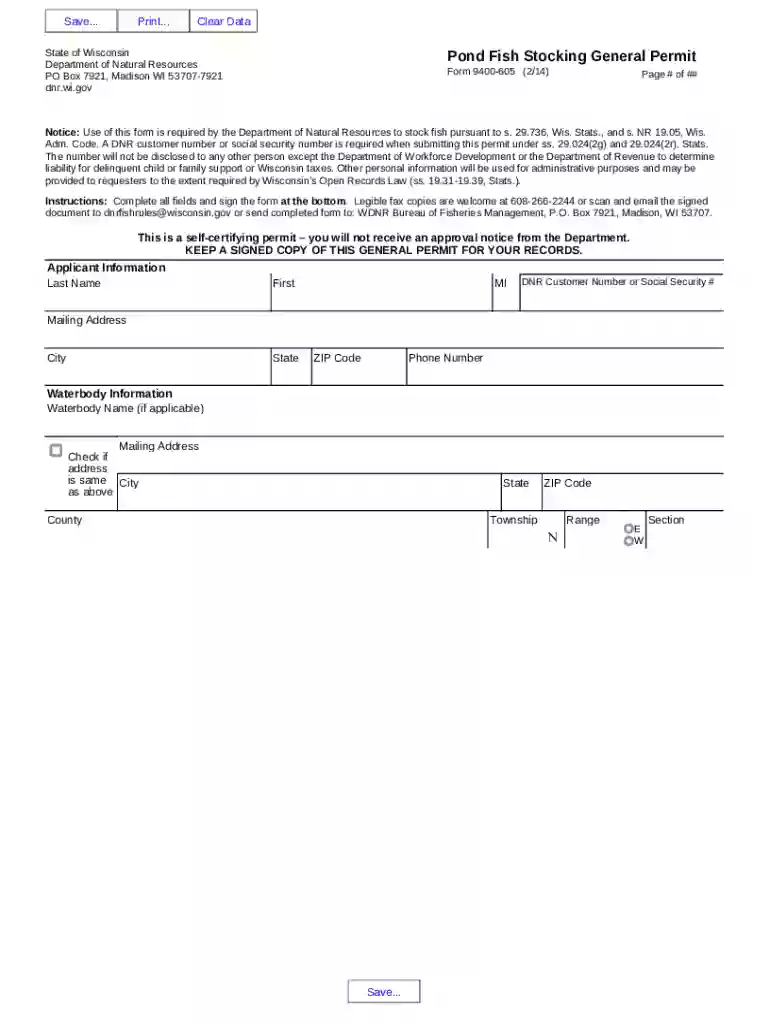
Form 9400-605 Pond Fish Stocking General Permit is an official document issued by the Wisconsin Department of Natural Resources. This form is crucial for individuals or businesses wishing to stock Wisconsin-native fish in enclosed private water bodies. It outlines essential guidelines and restrictions that must be adhered to, ensuring both the sustainability of the fish populations and the ecological balance within the state’s natural waters. Key aspects include sourcing fish from registered suppliers, maintaining proper health standards, and ensuring accurate record-keeping of all stocking activities.
Using the Form 9400-605 involves several critical steps aimed at ensuring compliance with environmental regulations. The form must be filled out accurately, capturing all required information regarding the species and quantity of fish being stocked and the permit holder's details. It serves as a self-certifying document, meaning that once it is completed, no further approval is needed before stocking occurs. However, individuals must ensure they follow all guidelines laid out in the form to avoid any legal issues.
To obtain the Form 9400-605, individuals must contact the Wisconsin Department of Natural Resources. The form can typically be downloaded directly from their official website or requested via mail. It is important to ensure that the form is the latest version to comply with any recent regulatory changes.
Utilizing the Form 9400-605 legally requires strict adherence to the guidelines laid out in the permit. Stocking fish without complying with these guidelines can result in fines and other penalties. Importantly, the permit is restricted to self-contained ponds on private property and must not be used for public waters or interconnected systems.
The Form 9400-605 is crucial in maintaining ecological balance by controlling fish stocking activities. It ensures prescribed species are introduced into environments that can support them without adverse effects. This regulation helps in safeguarding Wisconsin’s diverse aquatic ecosystems and supports the effort to maintain biodiversity.
All activities under this permit are governed by Wisconsin state law, which has specific requirements compared to other states. For instance, only Wisconsin-native fish species are permitted to be stocked. Additionally, the form outlines that every stocked fish must be obtained from a certified hatchery to prevent the spread of diseases.
A practical example involves a landowner wishing to enhance the recreational fishing potential of a private pond. By securing the Form 9400-605, they can legally introduce native species like largemouth bass, according to the stipulations provided, fostering a balanced aquatic environment without risking regulatory noncompliance.
At DocHub, your data security is our priority. We follow HIPAA, SOC2, GDPR, and other standards, so you can work on your documents with confidence.