
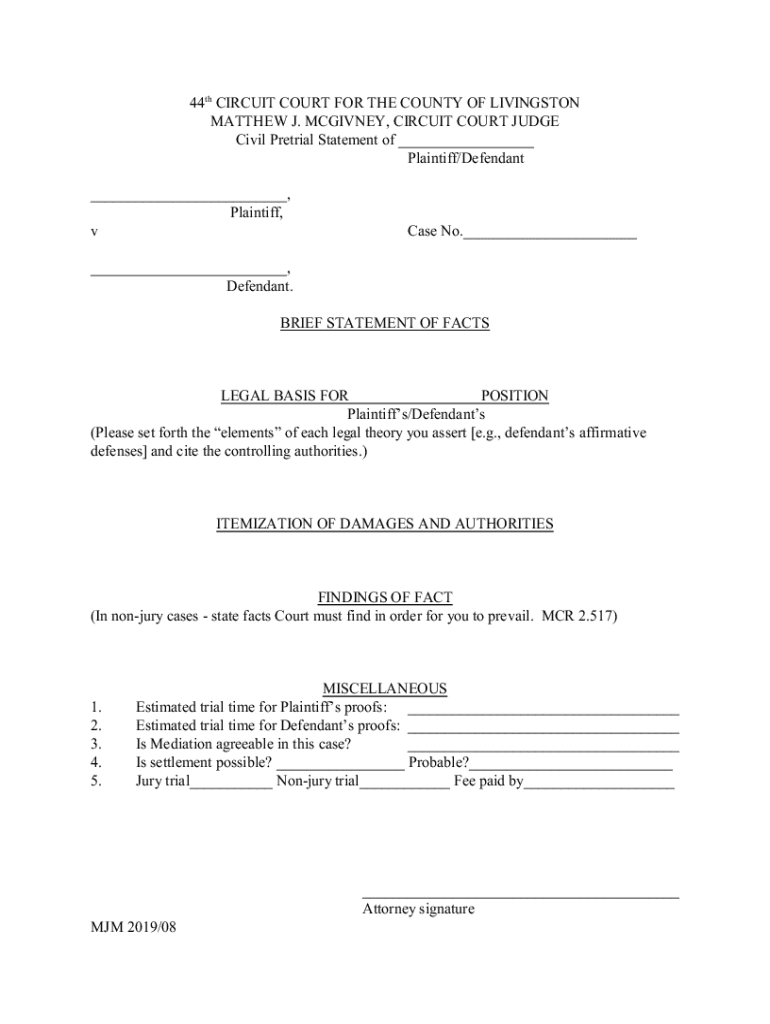







Definition and Purpose of the MJM-Civil-Pretrial-Statement
The MJM-Civil-Pretrial-Statement is a legal document used primarily within the 44th Circuit Court of Livingston County. It serves as a structured outline for parties involved in a civil case to present critical information before the trial begins. This document includes details about the parties involved, a summary of the facts, and the legal principles that both parties rely on. Additionally, it itemizes any damages being claimed and identifies findings of fact required in non-jury cases. The pretrial statement is crucial for outlining the structure of the case, estimated trial times, and discussions regarding mediation and settlement possibilities. Properly completing this form ensures that all parties are prepared for efficient and effective court proceedings.
How to Use the MJM-Civil-Pretrial-Statement
Using the MJM-Civil-Pretrial-Statement requires careful attention to detail and adherence to specified guidelines. You should begin by accurately filling out sections with the case number and parties involved. Next, provide a brief but comprehensive statement of facts pertinent to the case. It is essential to clearly articulate the legal basis for your position, supported by relevant laws and precedents. Be meticulous when itemizing damages, detailing both the type and amount expected for compensation. Ensure all findings of fact, especially in non-jury trials, are well-documented. Lastly, include information regarding potential mediation and settlement, which can be crucial for resolution without a full trial. Consider each section as a critical piece of your case, reflecting thorough preparation and understanding of your legal standing.
Steps to Complete the MJM-Civil-Pretrial-Statement
- Case Information: Start by recording the case number and names of all parties involved in the litigation.
- Statement of Facts: Provide a concise, factual summary that lays the groundwork for the case issues, focusing on events leading to the trial.
- Legal Basis: Clearly outline the legal arguments and statutes that support your case, including any relevant precedents.
- Itemization of Damages: List all damages sought in precise monetary terms, along with supporting evidence or documentation.
- Findings of Fact: Identify necessary findings for non-jury cases to guide the court’s decision-making process.
- Estimated Trial Times: Offer reasonable estimates for how long you expect the trial to last from both plaintiff and defendant perspectives.
- Mediation and Settlement Prospects: Discuss whether mediation is viable and what settlement options have been considered.
Key Elements of the MJM-Civil-Pretrial-Statement
- Accurate Party Identification: Ensure all parties to the case are correctly identified by name, address, and role (e.g., plaintiff or defendant).
- Detailed Factual Summary: Present facts logically and transparently to enable the judge to understand the core issues quickly.
- Legal Justifications: Support your arguments with applicable legal standards and previously adjudicated cases, reinforcing your position.
- Comprehensive Damages: Break down the damages being claimed into categories such as economic, non-economic, and punitive damages.
- Findings for Non-Jury Trials: Specify critical factual determinations the judge needs to make, particularly important when no jury is involved.
- Trial Timeline: Propose realistic timing for court proceedings to aid in scheduling and case management.
- Resolution Options: Acknowledge any negotiations or mediation attempts, highlighting a willingness to resolve disputes efficiently.
Legal Use of the MJM-Civil-Pretrial-Statement
The MJM-Civil-Pretrial-Statement serves an official purpose in preparing for civil court proceedings within Livingston County’s 44th Circuit Court. Its legal use involves providing the court with a definitive record of the anticipated trial structure, assets in dispute, and the overarching legal arguments from both sides. It effectively functions as a roadmap for the trial, helping judges anticipate questions, motions, and the need for specific evidence. Lawyers utilize this form to strategize their approach and anticipate the opposing party's arguments. By outlining settlement opportunities, it also encourages the resolution of disputes prior to trial, serving as a practical tool for both legal practitioners and clients seeking expedited justice.
Important Terms Related to MJM-Civil-Pretrial-Statement
- Plaintiff: The party initiating the lawsuit and claiming damages or legal relief.
- Defendant: The party against whom the lawsuit is filed and who is responding to the claims.
- Legal Basis: The foundational legal principles or statutes supporting a party’s case.
- Mediation: A facilitated negotiation process intended to reach a voluntary settlement.
- Settlement: An agreement reached between parties to resolve the dispute without continuing court proceedings.
- Findings of Fact: Judicial determinations on contested factual issues that inform the final judgment.
- Economic Damages: Quantifiable monetary losses, such as medical bills or lost wages.
- Non-Economic Damages: Compensation for intangible losses, such as pain and suffering.
Who Typically Uses the MJM-Civil-Pretrial-Statement
The MJM-Civil-Pretrial-Statement is typically completed by attorneys representing either plaintiffs or defendants in civil litigation before Livingston County’s 44th Circuit Court. It is critical for lawyers to strategically develop the information presented in this form to ensure the best outcomes for their clients. Judges use the completed forms to gain insight into the scope and specifics of the case, while court clerks might reference them to organize and schedule trials effectively. Additionally, parties involved in the litigation, such as individuals or corporations, may review the form to understand the opposing party’s case structure and prepare for court proceedings.


Examples of Using the MJM-Civil-Pretrial-Statement
For example, in a personal injury case where the plaintiff claims damages for lost wages due to an auto accident, the MJM-Civil-Pretrial-Statement will detail the accident details, the injuries sustained, and the economic impact on the plaintiff. The legal basis might cite negligence laws applicable in Michigan, and the itemization of damages will include medical expenses, lost income, and future earning capacity considerations. Another case might involve a contractual dispute where the plaintiff alleges breach by the defendant. Here, legal arguments will hinge on contract law, with specific clauses cited, and damages might include lost profits and cost of enforcement. In both instances, mediation possibilities will be discussed as part of the statement to explore settlement potential and save court resources.




