




01. Edit your form online
Type text, add images, blackout confidential details, add comments, highlights and more.

Type text, add images, blackout confidential details, add comments, highlights and more.

Draw your signature, type it, upload its image, or use your mobile device as a signature pad.

Send it via email, link, or fax. You can also download it, export it or print it out.
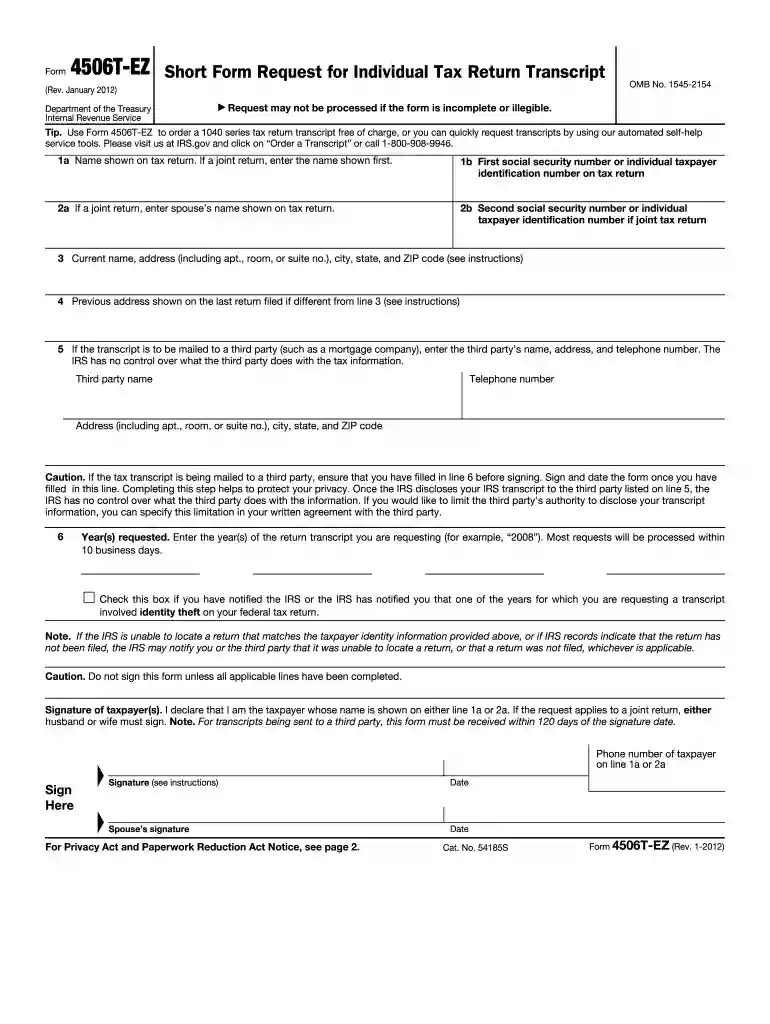
The 2012 tax transcript form, known officially as Form 4506T-EZ, is instrumental for taxpayers wanting to request a transcript of their federal tax return. This document simplifies the process of obtaining a summary of information from their 1040 series tax returns. Useful for individuals who need to verify income or adjust previous filings, the form offers a concise reflection of originally filed return data, such as AGI and taxable income. Utilizing this form can be particularly beneficial when applying for loans or financial aid, as institutions often require verifiable income documentation. For the 2012 tax year, the transcript is crucial for examining past financial actions and ensuring compliance with IRS mandates.
To utilize the 2012 tax transcript form, the taxpayer must first obtain a blank Form 4506T-EZ. By following the structured layout of the form, one can efficiently provide the necessary information for the IRS to process the transcript request. Each section demands specific details such as personal identification information and address. Users must also specify the tax year for which the transcript is needed, ensuring clarity for the processing IRS agents. Individuals seeking third-party assistance during this process can authorize the IRS to send the transcript directly to another entity, which can be beneficial for tax preparers or legal advisers. Ensuring each section is filled without omissions is vital for avoiding delays.
Completion of the 2012 tax transcript form involves several precise steps.
Enter Personal Details: Begin by filling in your name, Social Security number, and mailing address. Double-check this information for accuracy.
Specify Transcript Type and Year: Identify the type of transcript needed (such as an account transcript) and explicitly state '2012' in the tax year field.
Third-Party Authorization: If needed, enter the name and contact details of the recipient where the transcript should be sent. Ensure that proper authorization is provided.
Provide Contact Information: Include a telephone number for any follow-up questions from the IRS.
Signature and Date: Ensure the form is signed and dated. Unsigned forms will be rejected.
Review and Submit: Before submission, review all fields for complete and accurate information to prevent rejection.
Following these steps ensures a smooth submission process and timely receipt of your requested document.
The 2012 tax transcript form is primarily used by individual taxpayers who need to verify their past income with a third party or check their records. It is especially useful for those applying for mortgages, student loans, or financial aid, as the lender or institution often requires verified income from previous tax returns. Additionally, taxpayers who have misplaced their 2012 tax records might use this form to reconstruct their financial documentation. Tax professionals also frequently utilize these transcripts to assist clients in financial planning or audits.


When handling the 2012 tax transcript form, it's crucial to focus on key elements that ensure successful completion and submission:
Each component plays a critical role in the acceptance and processing of a transcript request.
The IRS provides specific guidance on how to appropriately request a tax transcript. These guidelines emphasize the need for correct and completed information to prevent processing delays. Taxpayers are instructed to use the form exclusively for individual tax return transcripts and adhere strictly to the provided instructions for each form section. This ensures compliance with IRS requirements and guards against misfiling. By following the IRS guidelines, taxpayers can efficiently obtain their 2012 tax year information without complications.
The 2012 tax transcript form, Form 4506T-EZ, can be obtained directly from the IRS website, where it is available as a downloadable PDF for ease of access. Taxpayers can also request a copy via phone through the IRS automated service or by visiting an IRS Taxpayer Assistance Center. Once downloaded, you can print the form, fill it out manually, or complete it digitally before printing. Keeping a copy of the completed request for personal records is advisable.
While no specific annual deadline exists for requesting a tax transcript, taxpayers should be aware that processing times can vary, particularly during peak IRS processing seasons. Typically, transcripts for returns filed electronically are accessible within three weeks, while those for paper-filed returns may take up to six weeks. Planning is critical, especially for those who need transcripts for time-sensitive purposes such as loan applications or educational grants. Thus, it is recommended to file requests well in advance of any external deadlines.
We've got more versions of the 2012 tax transcript form form. Select the right 2012 tax transcript form version from the list and start editing it straight away!
At DocHub, your data security is our priority. We follow HIPAA, SOC2, GDPR, and other standards, so you can work on your documents with confidence.





Do not sign this form unless all applicable lines have been completed. Purpose of form. Individuals can use Form. 4506T-EZ to request a tax return transcript
Please visit us at IRS.gov and click on Order a Transcript or call 1-800-908-9946. If you need a copy of your return, use. Form 4506, Request for Copy of TaxRead more
Apr 15, 2015 during tax preparation. To get a free transcript: Visit IRS.gov and click on Get. Transcript of Your Tax Records under Tools,. Use FormRead more


