







Definition & Meaning
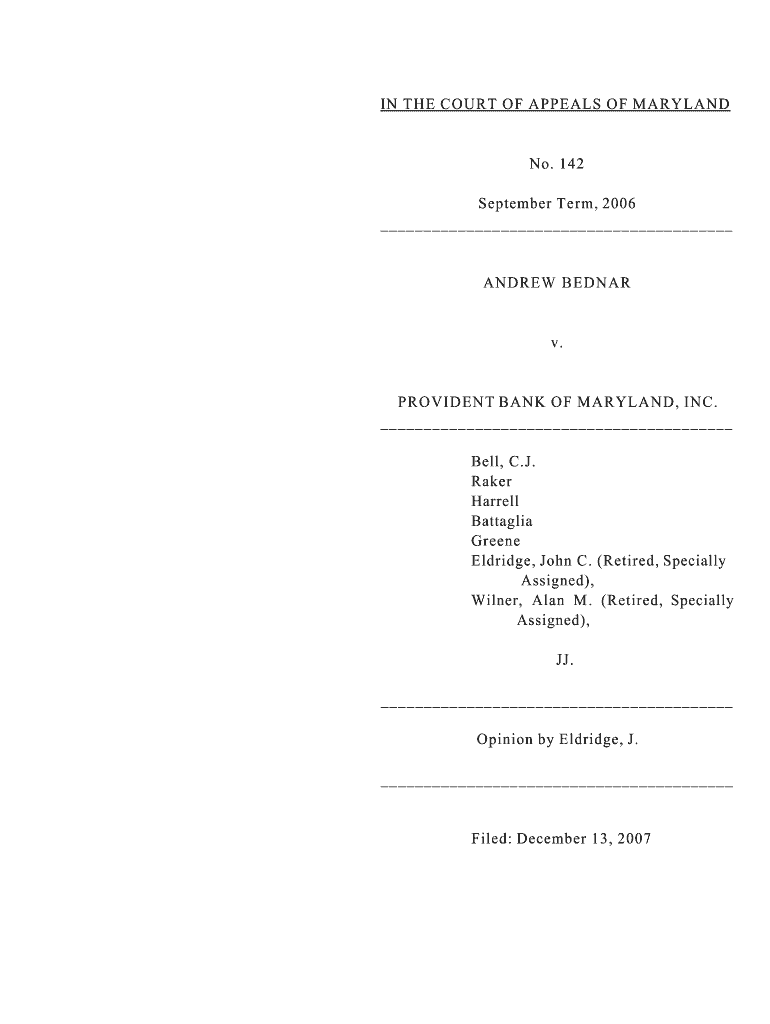
The case of "Bednar v. Provident Bank of Maryland" involves a legal dispute within the Maryland state court system, specifically addressing the rights of a borrower in relation to prepayment charges under Maryland's Credit Grantor Closed End Credit Provisions (CLEC). This court opinion from the Court of Appeals of Maryland highlights the critical interpretation of the conditions under which a borrower can prepay a loan without incurring additional charges. The case is a significant legal precedent in Maryland's credit law landscape, as it clarifies the limitations on how financial institutions can impose fees, emphasizing the protection of consumer rights against undisclosed financial charges.
Contextual Importance
Understanding the implications of this case requires knowledge of the Maryland state court system's hierarchy. The ruling originated from the Circuit Court, was challenged, and subsequently reversed by the Court of Appeals, the state’s highest court. This case sets a binding precedent for similar disputes involving prepayment penalties across Maryland, ensuring that borrowers are not unjustly charged beyond what is explicitly stated in their loan agreements.
Key Elements of the Bednar Case
The core issue in "Bednar v. Provident Bank of Maryland" revolves around whether the imposition of a $681 fee was permissible under the terms agreed upon with Provident Bank. The Court of Appeals determined that this fee constituted an illegal prepayment penalty, contravening the CLEC, which governs closed-end credit agreements in Maryland.
Legal Findings
- Interpretation of CLEC: The court analyzed the applicability of CLEC to assess whether Provident Bank's charge fell under prohibited prepayment penalties.
- Consumer Rights: The decision underscored a borrower’s right to clarity on prepayment terms and protections against unexpected fees.
Steps to Complete Document Requirements
For those involved in similar cases or legal reviews, it is essential to capture all critical evidence regarding loan agreements and any additional charges imposed when prepaying.
- Gather Documentation: Begin by compiling all relevant loan documentation, including the original loan agreement, any amendments, and correspondence with the financial institution.
- Analyze Legal Precedents: Review case law, particularly focusing on the "Bednar v. Provident Bank of Maryland," to understand the judicial interpretation of relevant credit laws.
- Engage with Legal Counsel: Consult with a legal expert familiar with Maryland’s credit laws to ensure comprehensive understanding and application of legal principles.
Why the Bednar Case Matters
This court decision is pivotal for borrowers in Maryland, setting a precedent that ensures financial institutions cannot impose undisclosed charges for loan prepayment, which secures consumer protection under statutory lending laws.
Impact on Lending Practices
- Consumer Protection: Ensures transparency and fairness in lending terms and conditions.
- Regulatory Compliance: Financial institutions must align their practices with legal standards, further safeguarding consumer interest.
Legal Use and Application
Professionals dealing with closed-end credit agreements must ensure that all charges comply with the Maryland Credit Grantor laws to avoid unlawful penalties.
Essential Compliance Steps
- Legal Review: Conduct regular audits of credit agreements to verify legal compliance.
- Disclosure: Clearly disclose all applicable fees to borrowers at the outset of the loan agreement.
Important Terms in the Case
- Closed-End Credit: Loan agreements with a set term and repayment schedule.
- Prepayment Penalty: Charges that may be imposed when a borrower pays off a loan before its scheduled completion.
Glossary of Terms
- CLEC: Maryland’s statute governing closed-end credit agreements to protect consumers from unfair lending practices.
- Summary Judgment: A court decision made without a full trial, based on statements and evidence presented in written form.
State-Specific Rules for Similar Cases
The Maryland Credit Grantor laws uniquely apply to cases such as "Bednar v. Provident Bank of Maryland" within the state, requiring adherence to specific statutory provisions.
Regional Legal Practices
- Judicial Precedents: Understand the precedential impact within the Maryland court system.
- Statutory Interpretation: Engage deeply with state statutes to navigate complex credit disputes effectively.
Examples of Using the Bednar Case
Legal professionals often reference the Bednar case when arguing about improper imposition of prepayment fees in Maryland.
Case-Based Scenarios
- Legal Disputes: Use as a precedent when contesting unexpected fees from financial institutions.
- Educational Purposes: Serve as a case study in understanding consumer rights in credit agreements.
Penalties for Non-Compliance
Failing to adhere to Maryland's credit laws can result in legal challenges or financial penalties for lending institutions.
Consequences for Lenders
- Legal Repercussions: Cases may be brought to court, potentially leading to costly penalties and reversals.
- Consumer Reparations: Institutions may be required to refund unjustly collected fees to borrowers.




