Definition & Meaning
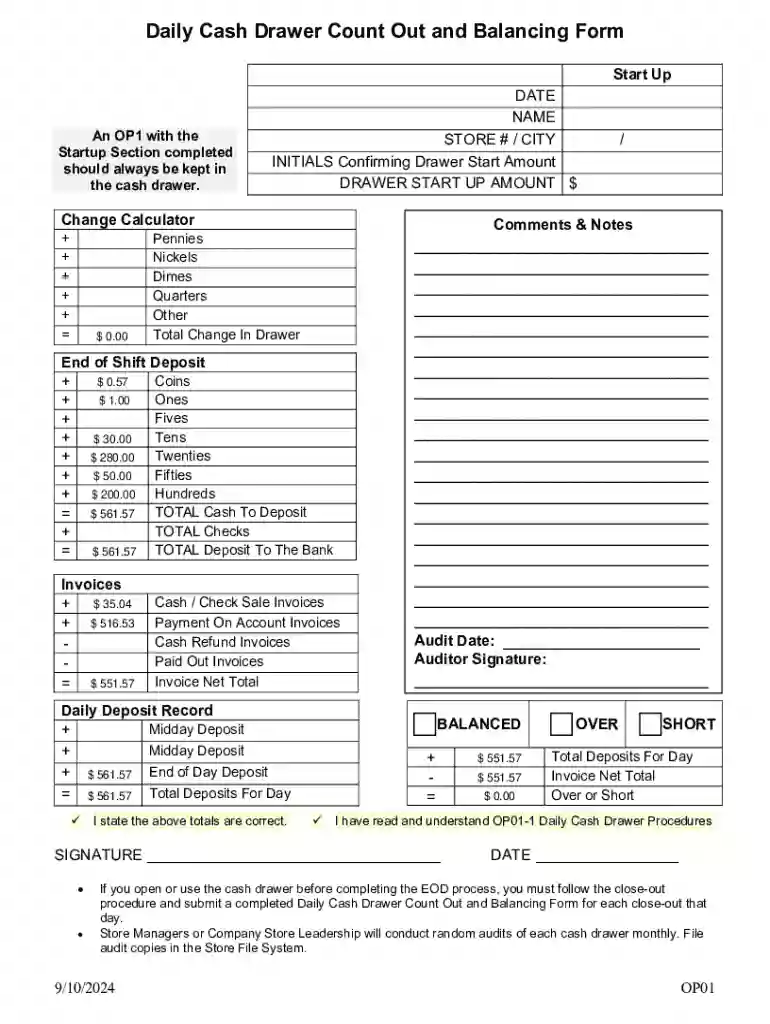
The Daily Cash Drawer Count Out and Balancing Form is a crucial document used primarily in retail and service businesses to accurately record and verify cash transactions at the end of each business day. This form helps in managing and auditing cash drawers, ensuring that all financial transactions are accurately captured and any discrepancies are immediately identified. It is typically divided into sections that document the starting cash amount, sales invoices, deposits, and any discrepancies such as overages or shortages. This form requires employee and management signatures to confirm its accuracy, serving as a vital report for daily financial accountability.
Key Elements of the Daily Cash Drawer Count Out and Balancing Form
The form is structured to provide a comprehensive record of daily cash activity. Key elements include:
- Starting Cash Amount: Captures the initial cash available in the drawer at the start of the shift.
- Sales and Transactions: Records all cash sales, credit transactions, and any other form of payments received.
- Deposits and Withdrawals: Details any cash deposited into the bank or withdrawn for business purposes.
- Discrepancies: Notes any overages or shortages detected during the cash count out process.
- Signatures: Requires both employee and management signatures to verify the count's accuracy and finalize the documentation.
How to Use the Daily Cash Drawer Count Out and Balancing Form
To effectively use this form, follow these steps:
- Record Starting Cash: At the beginning of the shift, note the cash float or starting amount using the form's designated section.
- Track Transactions: Throughout the day, consistently record each sale and transaction on the form.
- Perform Cash Count: At the end of the day, count the cash in the drawer and compare it with the recorded transactions.
- Document Discrepancies: Note any differences between the recorded amount and actual cash, then investigate potential causes.
- Secure Signatures: Both the cashier and a manager must sign off on the form to confirm its accuracy.
Steps to Complete the Daily Cash Drawer Count Out and Balancing Form
Step 1: Set Up the Starting Cash Balance
- Enter the cash amount present at the beginning of the day.
- Ensure that the initial amount matches the records from the previous day’s closing balance.
Step 2: Record Daily Transactions
- Log each cash transaction throughout the day.
- Keep track of credit card sales and any checks received for comprehensive accounting.
Step 3: Count and Balance
- At the close of business, count the cash in the drawer.
- Compare this with the total cash sales as per the form's transaction records.
- Mark any discrepancies for review.
Step 4: Reconcile and Finalize
- Investigate and comment on any variance between recorded and actual cash.
- Secure signatures from involved personnel to certify that the documented information is accurate.
Examples of Using the Daily Cash Drawer Count Out and Balancing Form
- Retail Store: A retail cashier uses the form to document daily sales and verify the ending cash balance.
- Restaurant: At the end of a shift, the restaurant manager checks the form filled by staff to ensure all transactions were logged correctly.
- Service Provider: A salon uses the form to confirm cash, credit, and diverse forms of payments collected each day are accurately noted and signed off.
Why Should You Use the Daily Cash Drawer Count Out and Balancing Form
Utilizing this form ensures:
- Accuracy: Reduces errors in cash handling by maintaining detailed transaction records.
- Security: Deters theft and fraud by requiring detailed accountability through signatures.
- Financial Management: Facilitates clear audit trails and financial reporting for management review.
- Discrepancy Resolution: Provides a systematic approach to handling and rectifying cash shortages or overages.
Who Typically Uses the Daily Cash Drawer Count Out and Balancing Form
This form is predominantly used by:
- Retail Employees: Cashiers and store clerks who handle transactions and close-out procedures.
- Managers: Individuals tasked with verifying cash records and approving daily closing balances.
- Auditors and Financial Officers: Personnel responsible for ensuring compliance with financial practices and accuracy in financial reporting.
Software Compatibility and Digital Usage
The form can be integrated with various software like QuickBooks or utilized in a digital format through platforms like DocHub. This digital integration allows for:
- Ease of Access: Employees can complete and sign forms digitally, ensuring quick processing.
- Real-Time Updates: Information can be updated regularly, allowing for immediate detection and reconciliation of discrepancies.
Digital management of the form enhances security and efficiency, providing a reliable method of document control and storage within business operations.