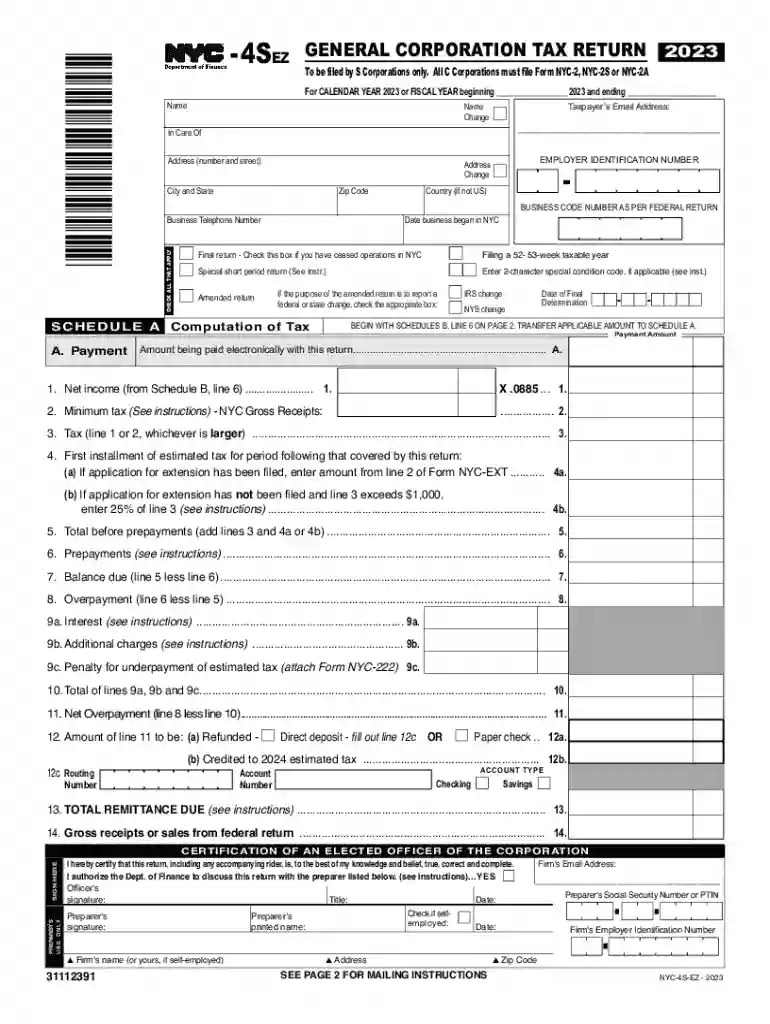
New York City General Corporate Tax Return (1120)-2026

Get Form
New York City General Corporate Tax Return (1120) Preview on Page 1

Here's how it works

01. Edit your form online
Type text, add images, blackout confidential details, add comments, highlights and more.

02. Sign it in a few clicks
Draw your signature, type it, upload its image, or use your mobile device as a signature pad.

03. Share your form with others
Send it via email, link, or fax. You can also download it, export it or print it out.

Definition and Meaning

The New York City General Corporate Tax Return (1120) serves as a crucial document for corporations operating within New York City. It is required for filing and reporting a company’s financial details, such as income, deductions, and overall tax liability. Specifically designed for S Corporations, this form includes sections for reporting elements like net income, minimum tax, prepayments, and any overpayments.

Examples of Form Utilization

  • Corporations use this document to calculate payable taxes based on net income and other fiscal parameters.
  • Businesses must report prepayments from previous tax periods, adjusting their current tax liabilities accordingly.

Key Elements of the Form

Understanding the elements of the New York City General Corporate Tax Return (1120) is vital for accurate completion.

Sections Breakdown

  • Taxpayer Identification: Requires the inclusion of the corporation's legal and taxpayer identification details.
  • Income Computation: Reports net income, factoring in deductions and allowable credits, ensuring adherence to applicable tax laws.
  • Tax Calculations and Due Amounts: This section outlines the exact method for computing income tax liabilities and any additional charges.

Real-World Application

For instance, a corporation operating multiple subsidiaries within New York City will need to consolidate these income reports to accurately fill out this form. Compliance here ensures that all income is reported, avoiding potential audits.

Steps to Complete the Form

Filing the New York City General Corporate Tax Return (1120) requires precision. Here’s a step-by-step guide.

  1. Gather Required Documents: Assemble all necessary financial records, including year-end balance sheets and profit-loss statements.
  2. Fill in Identification Information: Accurately input the corporation’s name, address, and identification number.
  3. Enter Income and Deduction Details: Input precise figures of income, deductions, and credits.
  4. Calculate Tax Liability: Use the provided formula to compute payable taxes, taking into account any prepayments.
  5. Certify and Submit: Ensure the form is signed by an elected officer of the corporation before submission.

Practical Tip:

In case of amendments or errors, prepare to revise the document and re-submit before the deadline to avoid penalties.

Important Terms Related to the Form

Familiarity with terminology pertinent to the New York City General Corporate Tax Return (1120) aids in accurate filing.

Glossary

  • Net Income: Total earnings after deductions and expenses.
  • Prepayments: Previously paid tax amounts that may offset current liabilities.
  • Minimum Tax: The lowest amount payable by the corporation, regardless of other computations.

Use in Context

A scenario where a corporation expects significant deductions due to startup costs might lead to a situation where understanding the "net income" term is crucial for lowering the tax burden.

Filing Deadlines / Important Dates

Knowing when to file the New York City General Corporate Tax Return (1120) is essential to maintaining compliance.

Annual Submission Timeline

  • The form is typically due by the 15th day of the third month following the end of the corporation's fiscal year. For a calendar year corporation ending on December 31, the due date is March 15.

Penalties for Late Submission

Failure to file or incorrect filing can result in financial penalties, interest charges, or other legal consequences.

Required Documents

Proper documentation is vital for completing the New York City General Corporate Tax Return (1120).

Essential Documents Checklist

  • Financial statements, including income statements and balance sheets.
  • Records of any tax prepayments or overpayments from previous periods.
  • Documentation supporting any deductions or credits claimed.

Example Scenario

A corporation claiming research and development credits needs thorough documentation to substantiate these claims effectively when filing.

Form Submission Methods (Online / Mail / In-Person)

Submitting the New York City General Corporate Tax Return (1120) can be done through various methods.

Options for Filing

  • Online: Use New York City's official eFile system for quick and efficient submission.
  • Mail: Traditional paper filing can be done by sending the document to the designated city tax office.
  • In-Person: Direct submission at a local tax office is also available for those preferring manual processes.

Digital vs. Paper Version

Digital submissions can be more efficient and offer instant confirmation. Ensure compatibility with software like TurboTax for simplified completion.

Legal Use and Compliance

Ensuring that the New York City General Corporate Tax Return (1120) is used and filed legally is paramount for all corporations.

Adherence to Legal Standards

Compliance with the ESIGN Act when submitting electronically signed documents ensures legality and binding agreements.

Avoiding Legal Pitfalls

Corporations should regularly consult tax professionals or legal advisors to ensure that they meet New York City's taxation obligations and remain informed of regulatory updates or changes.

be ready to get more

Complete this form in 5 minutes or less

Get form

Got questions?

We have answers to the most popular questions from our customers. If you can't find an answer to your question, please contact us.
Contact us
Form CT-1120, Corporation Business Tax Return, must be filed by every corporation (or association taxable as a corporation) that carries on business or has the right to carry on business in Connecticut.
A corporation that is a component member of a controlled group must use Schedule O (Form 1120) to report the apportionment of taxable income, income tax, and certain tax benefits between all component members of the group.
Sole proprietors, partnerships, LLCs, and other unincorporated businesses conducting business in New York City are generally subject to the Unincorporated Business Tax (UBT). This includes income earned from activities such as selling goods or services within the city.
Who has to pay this tax? Corporations that do business, employ capital, or own or lease property, or maintain an office in the city in a corporate or organized capacity must pay this tax.
As a resident, you pay state tax (and city tax if a New York City or Yonkers resident) on all your income no matter where it is earned. As a nonresident, you only pay tax on New York source income, which includes earnings from work performed in New York State, and income from real property located in the state.

Security and compliance

At DocHub, your data security is our priority. We follow HIPAA, SOC2, GDPR, and other standards, so you can work on your documents with confidence.
Learn more
ccpa2
pci-dss
gdpr-compliance
hipaa
soc-compliance
be ready to get more

Complete this form in 5 minutes or less

Get form

People also ask

What activities are subject to this tax? Unincorporated businesses include trades, professions, and certain occupations of an individual, partnership, limited liability company, fiduciary, association, estate, or trust.
A minimum tax based on the S corporations NYC gross receipts which is determined as follows: $100,000 or less = $25 minimum tax. More than $100,000 but not more than $250,000 = $75. More than $250,000 but not more than $500,000 = $175.
All domestic and foreign S corporations and qualified S subsidiaries in New York City that are: Doing business; Employing capital; Owning or leasing property, in a corporate or organized capacity; or.

Related links