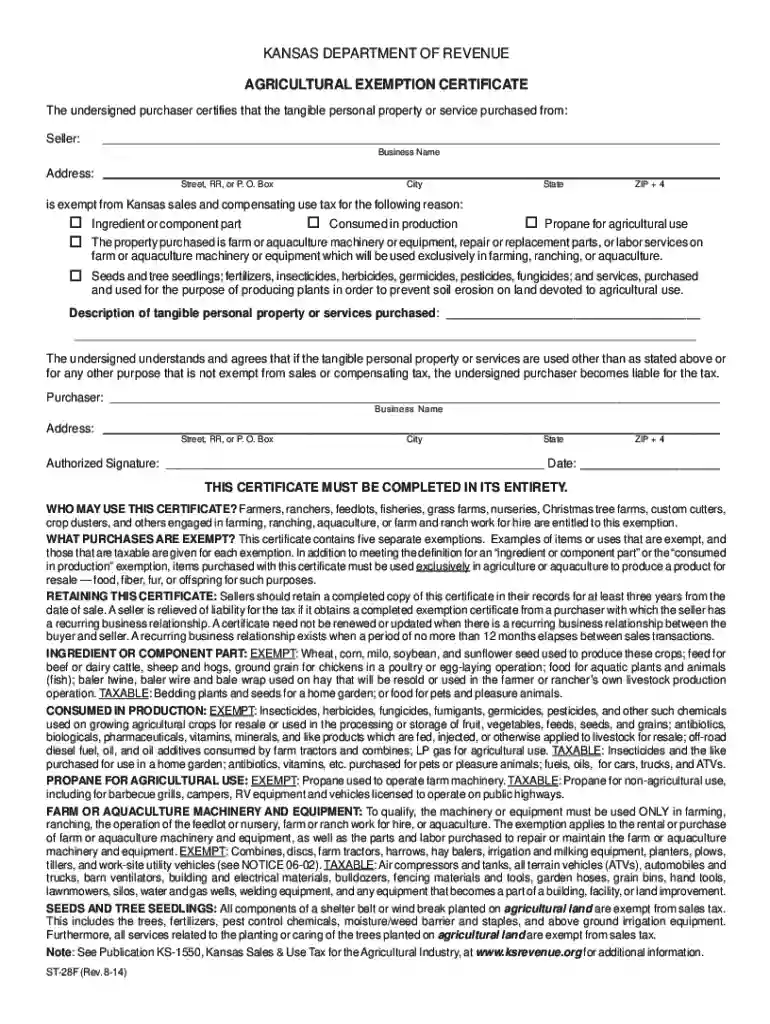
Kansas exemption form 2026

Get Form
kansas tax exempt form Preview on Page 1

Here's how it works

01. Edit your kansas tax exempt form online
Type text, add images, blackout confidential details, add comments, highlights and more.

02. Sign it in a few clicks
Draw your signature, type it, upload its image, or use your mobile device as a signature pad.

03. Share your form with others
Send kansas tax exempt form pdf via email, link, or fax. You can also download it, export it or print it out.

Definition and Overview of the Kansas Exemption Form

The Kansas exemption form, often referred to in the context of sales tax exemption, is a critical document that allows businesses and certain organizations to claim relief from sales tax in specific situations. This form enables qualified entities to purchase goods and services without paying sales tax, provided they meet necessary criteria set forth by Kansas law.

In Kansas, various exemptions exist under the sales tax regulations. These include exemptions for agricultural products, manufacturing, non-profit organizations, and others. Understanding the implications and applications of the Kansas exemption form is vital for businesses seeking to avoid unnecessary tax liabilities and comply with state regulations.

Key Features of the Kansas Exemption Form

  • Types of Exemptions: The form covers diverse exempt categories, including:
    • Agricultural purchases (Kansas Ag Exemption Form)
    • Non-profit organizations
    • Resale of items
  • Eligibility Requirements: Entities applying for exemption must demonstrate their qualifications based on Kansas state laws.
  • Documentation: Necessary supporting documents must accompany the exemption form to substantiate claims.

How to Use the Kansas Exemption Form

To successfully utilize the Kansas exemption form, several steps must be followed to ensure compliance and proper submission:

  1. Determine Eligibility:

    • Ascertain if your business or organization qualifies for an exemption based on Kansas regulations.
    • Common qualifiers include agricultural producers, schools, and certain non-profit entities.
  2. Obtain the Form:

    • The Kansas exemption form can typically be accessed through the Kansas Department of Revenue’s website or similar government resources.
  3. Complete the Form:

    • Fill in the required fields accurately, providing information about the purchasing entity, the nature of the exemption claimed, and any pertinent details regarding the items to be purchased.
  4. Review and Submit:

    • Before submitting, carefully review the form to ensure all information is accurate and complete to prevent delays or rejections.
  5. Documentation:

    • Attach any necessary supporting documents as specified for your exemption type, and retain a copy for your records.

Steps to Complete the Kansas Exemption Form

Completing the Kansas exemption form involves precise attention to detail. Below are the step-by-step procedures to ensure a successful submission:

  1. Download or Access the Form:

    • Locate the official Kansas exemption form, usually available in PDF format.
  2. Fill in Entity Information:

    • Input your business or organizational name, address, and contact details.
  3. Select Exemption Type:

    • Indicate the specific exemption category you are applying for (for example, agricultural, non-profit, or resale).
  4. Detail the Purchases:

    • Provide descriptions and the purpose of the goods or services that will be exempted.
  5. Sign and Date:

    • Ensure the form is signed by an authorized representative of the entity, along with the date of signing.
  6. Submit the Form:

    • Send the completed form and any supporting documentation according to the specified submission methods outlined by the Kansas Department of Revenue.

Important Terms Related to the Kansas Exemption Form

Understanding the terminology associated with the Kansas exemption form is essential for using it correctly. Some key terms include:

  • Exemption Certificate: A document issued to validate that a purchase is exempt from sales tax.
  • Qualified Entity: An entity that meets specific requirements under Kansas law to avail sales tax exemptions.
  • Agricultural Exemption: A designation for items purchased for farming or related activities that can be exempt from sales tax.

Familiarizing yourself with these terms will facilitate a smoother process when completing and submitting the Kansas exemption form.

Legal Use of the Kansas Exemption Form

The legal framework surrounding the Kansas exemption form is governed by state tax laws that outline who can utilize the form and under what circumstances. Legal compliance is paramount to avoid penalties and ensure that tax exemptions are properly executed.

Compliance Guidelines

  • Ensure that all claims made on the exemption form are truthful and substantiated.
  • Maintain accurate records of all transactions and the forms filed, as these may be subject to audits by the Kansas Department of Revenue.
  • Be aware of potential changes in tax law that may affect your eligibility for tax exemptions.

This understanding promotes responsible usage of the exemption form, which ultimately aids in maintaining compliance with state regulations.

Examples of Using the Kansas Exemption Form

Practical examples can elucidate the application of the Kansas exemption form. Here are several scenarios to consider:

  • Agricultural Purchases: A farmer may use the Kansas exemption form to purchase feed, seed, and other agricultural items without incurring sales tax, thereby reducing operational costs.
  • Non-Profit Organizations: A registered charity applies for exemption to purchase supplies and materials for its community programs, utilizing the form to ensure that tax liabilities are minimized.
  • Resale of Goods: A retailer uses the exemption form to buy inventory from wholesalers without paying sales tax, planning to charge sales tax at the point of sale to consumers.

These examples illustrate the diversity of applications for the Kansas exemption form across different sectors, emphasizing its importance in facilitating tax compliance while minimizing costs.

Eligibility Criteria for the Kansas Exemption Form

Before filling out the Kansas exemption form, it is critical to assess eligibility. The criteria may include:

  • Type of Business: Certain businesses, such as farmers, resellers, or non-profit organizations, may qualify based on their operational nature.
  • Intended Use of Purchases: The items being purchased must be for qualifying purposes, as defined by Kansas tax laws.
  • Documentation: Entities must provide proof of their status to validate their eligibility, which may differ based on the exemption being sought.

Evaluating these criteria helps ensure that only eligible entities apply for exemptions, aligning with state regulations.


decoration image ratings of Dochub

See more kansas exemption form versions

We've got more versions of the kansas exemption form form. Select the right kansas exemption form version from the list and start editing it straight away!
Versions Form popularity Fillable & printable
2023 4.2 Satisfied (30 Votes)
2015 4.8 Satisfied (215 Votes)
2014 4.4 Satisfied (59 Votes)
be ready to get more

Complete this form in 5 minutes or less

Get form

Got questions?

We have answers to the most popular questions from our customers. If you can't find an answer to your question, please contact us.
Contact us
WITHHOLDING ALLOWANCE AMOUNT The personal exemption amount is $9,160 for those who are single, head of household, or married filing separate. For individuals who are married filing joint, the personal exemption amount is $18,320 (equivalent to two exemptions of $9,160).
The state income tax withholding formula for Kansas has changed as follows: The annual allowance per exemption claimed has changed from $2,250 to $2,320. This applies to the number of additional dependents claimed. A new annual personal allowance has been added.
To apply, your doctor should provide you with an application form. If youre not sure about the name of your condition, speak to your doctor.
The Chancellor has confirmed that the capital gains tax (CGT) annual exempt amount will be reduced from 12,300 to 6,000 from 6 April 2023 and to 3,000 from 6 April 2024. This measure is forecast to raise 1.6 billion by the end of the 2027/28 tax year.
Appendixes Personal Exemption and Phaseout Threshold:$0 (suspended through the end of 2025) Individual $1,550 Individual who is unmarried and not a surviving spouse $1,950 Limitation on Itemized Deductions: Suspended through the end of 2025 Statutory Marginal Income Tax Rates, 202432 more rows Jan 31, 2025

Security and compliance

At DocHub, your data security is our priority. We follow HIPAA, SOC2, GDPR, and other standards, so you can work on your documents with confidence.

Learn more
ccpa2
pci-dss
gdpr-compliance
hipaa
soc-compliance
be ready to get more

Complete this form in 5 minutes or less

Get form

People also ask

You generally dont have to pay taxes if your income is less than the standard deduction or the total of your itemized deductions, if you have a certain number of dependents, if you work abroad and are below the required thresholds, or if youre a qualifying non-profit organization.

tax exempt form kansas