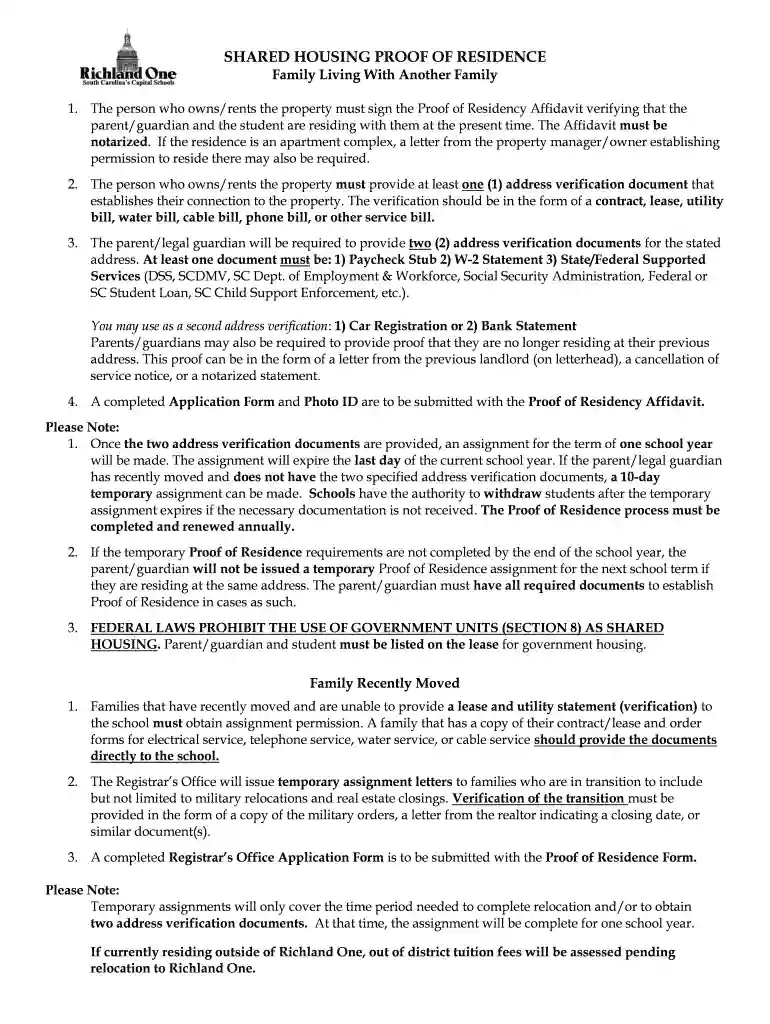
SHARED HOUSING PROOF OF RESIDENCE Family Living With Another 2026

Get Form
SHARED HOUSING PROOF OF RESIDENCE Family Living With Another Preview on Page 1

Here's how it works

01. Edit your form online
Type text, add images, blackout confidential details, add comments, highlights and more.

02. Sign it in a few clicks
Draw your signature, type it, upload its image, or use your mobile device as a signature pad.

03. Share your form with others
Send it via email, link, or fax. You can also download it, export it or print it out.

Definition and Meaning

The "Shared Housing Proof of Residence Family Living With Another" is a formal document utilized primarily for verifying the residency of a family living in a shared housing situation. This form is particularly relevant for school district enrollment processes, providing evidence that a family resides at a specific location, even if they do not own or lease the property directly. It is an essential tool for families in transitional living situations, ensuring that their children can access educational services without disruption.

Key Elements of the Form

The form consists of several crucial elements that must be accurately completed to establish legitimate proof of residence. These typically include:

  • Names and signatures of the occupants and property owner or primary leaseholder.
  • Address verification, which includes the complete residential address, ensuring consistency with other official records.
  • Duration of residence, indicating the start date and expected duration of the family's stay at the address.
  • Contact information for both parties, facilitating communication if further verification is necessary.

These components work together to verify the family's current living situation and eligibility for school enrollment within the specific district.

Required Documents

To complement the "Shared Housing Proof of Residence" form, several additional documents are typically required to substantiate the claims made. These documents enhance the reliability of the proof provided:

  • Copy of a utility bill or similar document in the property owner’s or leaseholder’s name.
  • Rental agreement or a notarized letter from the landlord, if applicable.
  • Identity documents for the family members, such as driver's licenses or government IDs.
  • Affidavit of shared residency completed by the property owner or leaseholder, if required.

These supporting documents help verify the actual residence status and ensure compliance with district regulations.

Steps to Complete the Form

  1. Gather necessary information: Collect the required personal and contact information for both the residing family and the property owner or leaseholder.

  2. Complete the form fields: Accurately fill out each section of the form, ensuring no fields are left incomplete.

  3. Attach supporting documents: Compile the necessary verification documents, such as utility bills and any required affidavits.

  4. Review for accuracy: Double-check all entries for spelling and factual accuracy to avoid potential issues.

  5. Obtain signatures: Secure signatures from both the family representative and the property owner or leaseholder to validate the residency claim.

These steps ensure the form is filled out correctly and supports timely processing by the relevant authority.

Legal Use of the Form

This document serves a legally binding role when used to verify residency for school enrollment purposes. It is crucial to provide accurate information; submitting false information can lead to penalties such as:

  • Loss of enrollment privileges: If the information is found to be false, the child may be required to leave the school.
  • Legal consequences: Providing false information can result in fines or further legal action.

Using this form correctly helps protect the family’s right to access education and comply with district policies.

Application Process and Approval Time

The process and time frame for approval may vary by district but typically involves:

  • Submission of the form to the school district’s enrollment office, either online or in-person, alongside all required documentation.
  • Review by district officials, who will verify the authenticity and accuracy of the submission.
  • Notification of approval or further requirements, often communicated within a specified period, usually ranging from a few days to weeks depending on the district.

It is advisable to begin this process well in advance of any enrollment deadlines to ensure timely completion.

Who Typically Uses the Form

This form is often used by:

  • Families residing temporarily with relatives or friends due to financial constraints or transitional housing situations.
  • Parents or guardians who need to enroll their children in a local school district without a formal lease or ownership documentation.
  • Property owners or primary leaseholders who facilitate the residency of another family and need to confirm their living arrangement legally.

Understanding who uses this form helps clarify its purpose in various real-world scenarios.

decoration image ratings of Dochub

Penalties for Non-Compliance

Failure to accurately complete or submit the "Shared Housing Proof of Residence Family Living With Another" form can lead to significant consequences, including:

  • Loss of eligibility for school services, jeopardizing the child's educational access.
  • Potential investigation into the residency status, which can affect both the residing family and the property owner.
  • Financial penalties or legal actions, as false claims may be pursued under district policies.

These penalties underscore the importance of diligent and honest form completion.

be ready to get more

Complete this form in 5 minutes or less

Get form

Got questions?

We have answers to the most popular questions from our customers. If you can't find an answer to your question, please contact us.
Contact us
To Whom It May Concern, I am writing to verify that my [Relationship, e.g., brother, sister], [Family Members Full Name], resides with me at [Full Address]. They have been living at this residence since [Move-In Date].
A Family Member Proof of Residency Letter is a written statement from a relative to confirm that someone lives at their address. Its usually provided when the person needing proof doesnt have documents like utility bills or a lease in their own name.
A Family Member Proof of Residency Letter is a formal document typically provided by a relative or household head to verify that a particular family member resides at a specific address. This letter serves as a crucial piece of evidence for various legal, educational, and administrative purposes.
A lease or utility bill in your name would work. If you live with relatives, a copy of a lease or utility bill in their name, with an additional document proving that relationship between you and that relative, should be fine.
A proof of residency letter is an affidavit used to prove that someone resides at a particular address or location (typically, in a particular state). A formal letter is usually written by a landlord, but for casual purposes, it could possibly be written by a roommate, parent, or even by the resident themselves.

Security and compliance

At DocHub, your data security is our priority. We follow HIPAA, SOC2, GDPR, and other standards, so you can work on your documents with confidence.

Learn more
be ready to get more

Complete this form in 5 minutes or less

Get form

People also ask

For family-based immigration, the letter typically highlights the personal connection, the strength of the relationship, and the applicants role within the family. It may emphasize the emotional and social ties that support the applicants case.

Related links