




01. Edit your form online
Type text, add images, blackout confidential details, add comments, highlights and more.

Type text, add images, blackout confidential details, add comments, highlights and more.

Draw your signature, type it, upload its image, or use your mobile device as a signature pad.

Send it via email, link, or fax. You can also download it, export it or print it out.
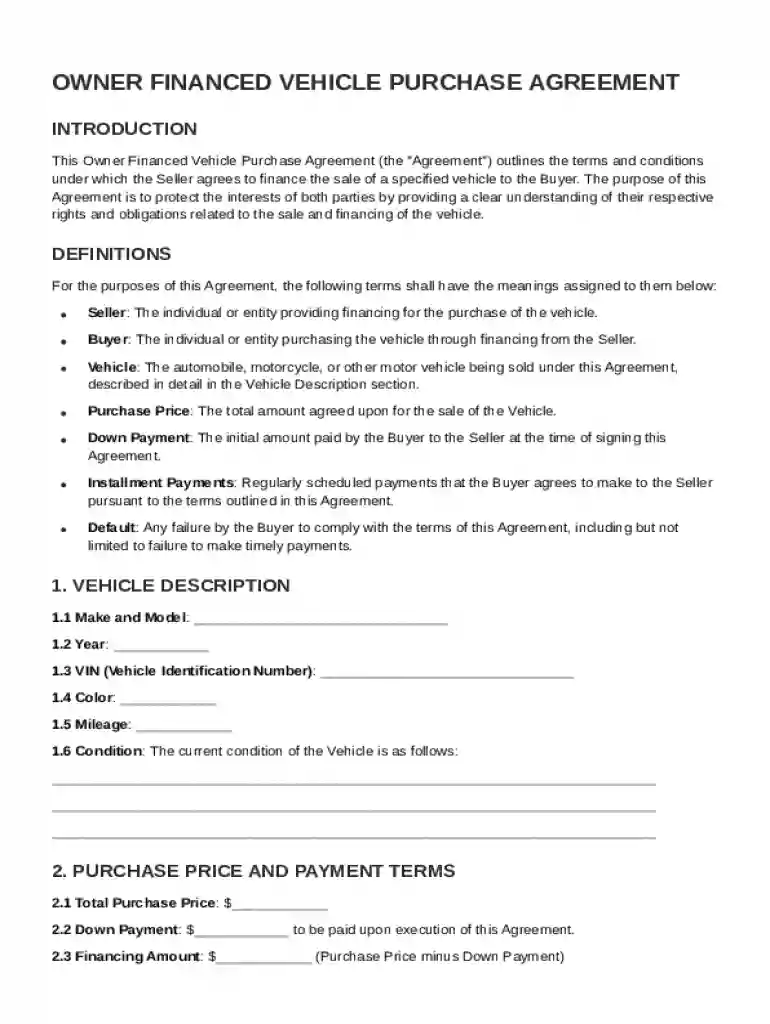
An Owner Financed Vehicle Contract Template is a legal document used to facilitate the sale of a vehicle where the seller provides financing to the buyer. This contract outlines the terms and conditions under which the vehicle will be sold and financed, including the responsibilities and obligations of both parties. The document serves to protect the interests of both the seller and the buyer by clearly defining payment terms, vehicle description, and actions in case of default.
Additionally, this template ensures both parties have a clear understanding of the transaction, reducing potential disputes. The contract also includes essential legal terms and conditions that comply with U.S. laws, making it suitable for transactions within the country.
The Owner Financed Vehicle Contract Template contains several critical components to ensure a comprehensive agreement is established:
These elements ensure that the contract is legally sound and provides clear guidelines for managing the financing agreement.
To complete the Owner Financed Vehicle Contract Template, follow these structured steps:
Completing the template accurately sets a strong foundation for a successful owner-financed vehicle transaction.
The Owner Financed Vehicle Contract Template must comply with applicable federal and state laws to be deemed legally valid:
Legal compliance provides protection for both parties and ensures the enforceability of the contract across different jurisdictions.
Understanding terminology within the Owner Financed Vehicle Contract Template is crucial:
Knowing these terms helps parties involved in the contract to comprehend their rights and responsibilities fully.
Different states may impose unique stipulations for owner-financed vehicle sales:
Being aware of these state-specific rules ensures compliance and helps avoid legal complications.
Using digital tools like DocHub offers the following advantages for completing an Owner Financed Vehicle Contract Template:
Leveraging these tools maximizes efficiency and security for both parties involved in the transaction.
Several scenarios highlight the utility of the Owner Financed Vehicle Contract Template:
Each example showcases the flexibility and comprehensiveness of the template in adapting to various transaction types.
At DocHub, your data security is our priority. We follow HIPAA, SOC2, GDPR, and other standards, so you can work on your documents with confidence.
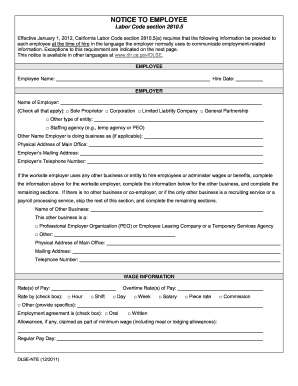



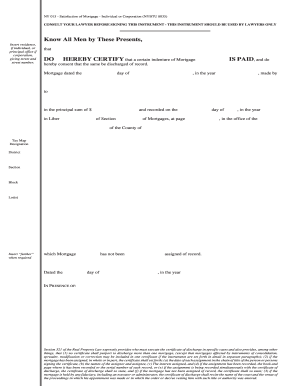

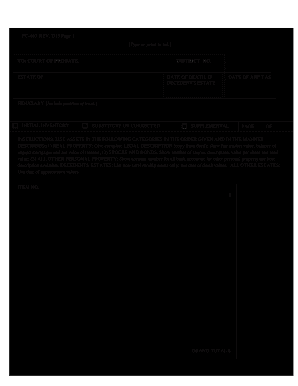
Seller shall be responsible for paying all past due registration fees and shall deliver the. Vehicle to Buyer with a current registration and a clear title.
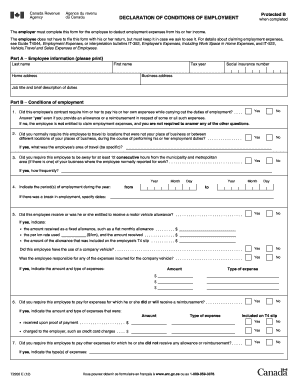
Vehicle/Other Chattel Details. Payout Finance Company. Goods Category. Finance Company Name. New / Used / Demo. Plus Amount Owing. $. Total Amount Financed. $.


