




01. Edit your form online
Type text, add images, blackout confidential details, add comments, highlights and more.

Type text, add images, blackout confidential details, add comments, highlights and more.

Draw your signature, type it, upload its image, or use your mobile device as a signature pad.

Send it via email, link, or fax. You can also download it, export it or print it out.
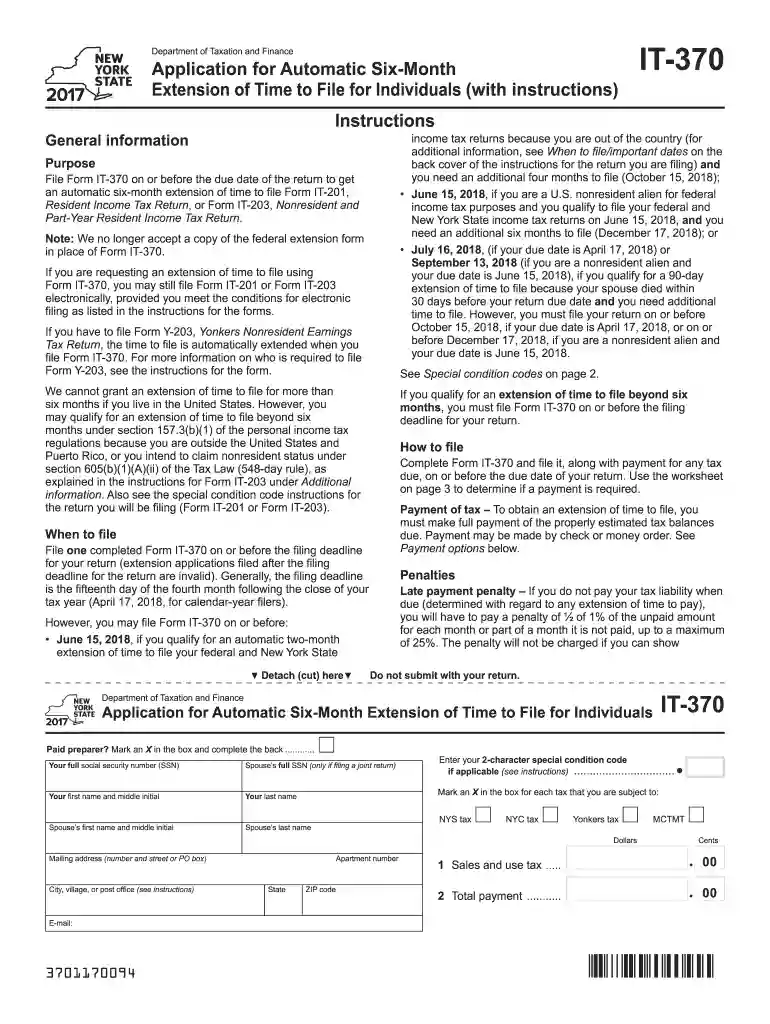
Form IT-370, specifically for the year 2017, is designed for individuals seeking an automatic six-month extension to file their New York State income tax returns. This form pertains to taxpayers who need additional time to submit their tax documents, such as Form IT-201 or IT-203. It outlines specific guidelines and requirements to remain compliant with state tax laws and avoid penalties associated with late filing.
To effectively use the IT-370 form, individuals must accurately complete and submit it by the original tax filing deadline. The form serves as a formal request for more time to file, not an extension for payment. Therefore, any tax due should be estimated and paid by the original deadline to avoid interest charges and late payment penalties. This section explains how to complete essential fields and what information is crucial for a successful filing.
Individuals can obtain the IT-370 form through several methods, ensuring ease of access:
Each method is outlined with detailed instructions on steps to secure the form, allowing filers to choose the most convenient option.
Filing Form IT-370 requires careful attention to detail. The steps include:
These steps are designed to help taxpayers navigate the filing process accurately and efficiently. Additional subsections offer example calculations and explain common errors to avoid.
Form IT-370 is commonly used by:
Understanding the typical users helps tailor instructions and address common concerns this demographic may encounter during the filing process.
Submitting Form IT-370 must occur by the original tax return due date to be valid. Typically, for tax year 2017, this deadline coincides with the federal tax deadline in April. Failure to file on time may result in the denial of an extension request, emphasizing the significance of timely submissions.
Certain taxpayers may have unique deadlines due to extenuating circumstances, such as military service or residing abroad. These exceptions are highlighted with relevant examples.
To successfully file Form IT-370, gather relevant documents, including:
These documents ensure accurate calculation of tax liability and payment amounts. A detailed breakdown of various forms, such as W-2s and 1099s, is included to help taxpayers prepare comprehensively.
Failing to file or inaccurately completing Form IT-370 might lead to penalties. These include:
Outlining the consequences reinforces the importance of compliance and proactive payment of estimated taxes due.
Form IT-370 can be submitted digitally or in paper form:
Discussing both options provides a complete understanding of submission methods, helping filers select the most appropriate path for their circumstances. Comparison of benefits and potential drawbacks aids in informed decision-making.
Tax preparation software such as TurboTax and QuickBooks can assist in filing Form IT-370, providing:
Users benefit from the software’s user-friendly interfaces and robust customer support, ensuring a straightforward filing process. Examples of software functionality help clarify its practical application.
We've got more versions of the it 370 2017 form form. Select the right it 370 2017 form version from the list and start editing it straight away!
| Versions | Form popularity | Fillable & printable |
|---|---|---|
| 2025 | 4.9 Satisfied (51 Votes) | |
| 2024 | 4.1 Satisfied (42 Votes) | |
| 2023 | 4.5 Satisfied (35 Votes) | |
| 2021 | 4.4 Satisfied (59 Votes) | |
| 2020 | 4.8 Satisfied (55 Votes) | |
| 2019 | 4.4 Satisfied (75 Votes) | |
| 2018 | 4.4 Satisfied (107 Votes) | |
| 2017 | 4.4 Satisfied (111 Votes) | |
| 2015 | 4.4 Satisfied (552 Votes) | |
| 2014 | 4.1 Satisfied (56 Votes) | |
| 2013 | 4 Satisfied (38 Votes) | |
| 2012 | 4 Satisfied (36 Votes) | |
| 2011 | 4 Satisfied (32 Votes) | |
| 2010 | 4.4 Satisfied (65 Votes) |
At DocHub, your data security is our priority. We follow HIPAA, SOC2, GDPR, and other standards, so you can work on your documents with confidence.
Obtain IRS Form 1040-ES (2017) and complete 2017 Estimated Tax Worksheet on page 8 of the. Form as follows (see page 4):. Student has completed their 2016 IRSRead more
Make the check or money order payable in U.S. funds to New York State Income Tax and write the last four digits of your Social Security number and 2025 IncomeRead more
Oct 5, 2018 To provide protections for certain sports medicine professionals, to reauthorize Fed- eral aviation programs, to improve aircraft safetyRead more


