




01. Edit your 2023 it 370 online
Type text, add images, blackout confidential details, add comments, highlights and more.

Type text, add images, blackout confidential details, add comments, highlights and more.

Draw your signature, type it, upload its image, or use your mobile device as a signature pad.

Send form it 370 via email, link, or fax. You can also download it, export it or print it out.
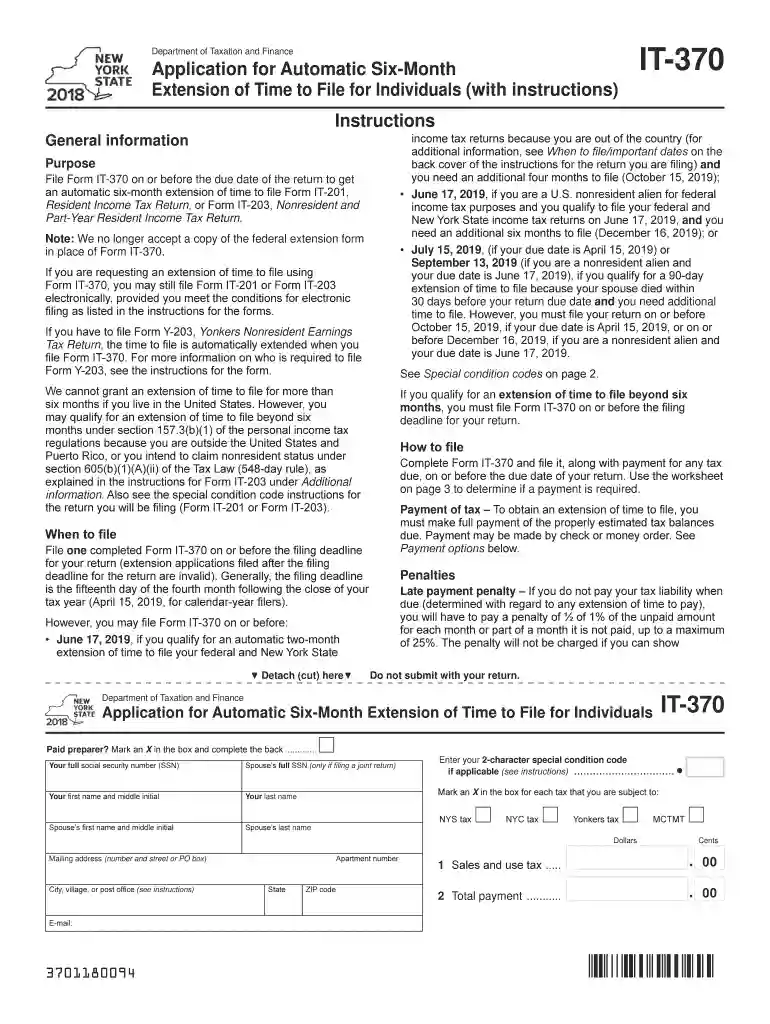
Form IT-370 is an application for an automatic six-month extension to file New York State income tax returns. This form is primarily used by individuals who require additional time to compile and submit their state income tax filings beyond the standard due date. It serves as a formal request to the New York State Department of Taxation and Finance, providing taxpayers with the flexibility to ensure the accuracy and completeness of their returns.
Filing Form IT-370 involves several steps to ensure successful submission:
To use the IT-370 form, certain eligibility criteria and deadlines apply:
When completing Form IT-370, specific details are necessary to ensure processing:
Form IT-370 offers several options for submission, allowing taxpayers to choose the most convenient method:
Failing to correctly file or pay taxes by the extended deadline can lead to significant penalties:
Various taxpayer groups utilize Form IT-370, including:


Using Form IT-370 adheres to specific legal guidelines to maintain compliance:
Taxpayers can select their preferred method based on comfort and accessibility:
Consider various real-world scenarios:
We've got more versions of the 2023 it 370 form. Select the right 2023 it 370 version from the list and start editing it straight away!
| Versions | Form popularity | Fillable & printable |
|---|---|---|
| 2025 | 4.9 Satisfied (51 Votes) | |
| 2024 | 4.1 Satisfied (42 Votes) | |
| 2023 | 4.5 Satisfied (35 Votes) | |
| 2021 | 4.4 Satisfied (59 Votes) | |
| 2020 | 4.8 Satisfied (55 Votes) | |
| 2019 | 4.4 Satisfied (75 Votes) | |
| 2018 | 4.4 Satisfied (107 Votes) | |
| 2017 | 4.4 Satisfied (111 Votes) | |
| 2015 | 4.4 Satisfied (552 Votes) | |
| 2014 | 4.1 Satisfied (56 Votes) | |
| 2013 | 4 Satisfied (38 Votes) | |
| 2012 | 4 Satisfied (36 Votes) | |
| 2011 | 4 Satisfied (32 Votes) | |
| 2010 | 4.4 Satisfied (65 Votes) |
At DocHub, your data security is our priority. We follow HIPAA, SOC2, GDPR, and other standards, so you can work on your documents with confidence.
Make the check or money order payable in U.S. funds to New York State Income Tax and write the last four digits of your Social Security number and 2025 IncomeRead more
This course will explore applications of analytics, such as online analytical processing (OLAP), dashboards, management reporting, performance measurement, andRead more


