




01. Edit your form online
Type text, add images, blackout confidential details, add comments, highlights and more.

Type text, add images, blackout confidential details, add comments, highlights and more.

Draw your signature, type it, upload its image, or use your mobile device as a signature pad.

Send it via email, link, or fax. You can also download it, export it or print it out.
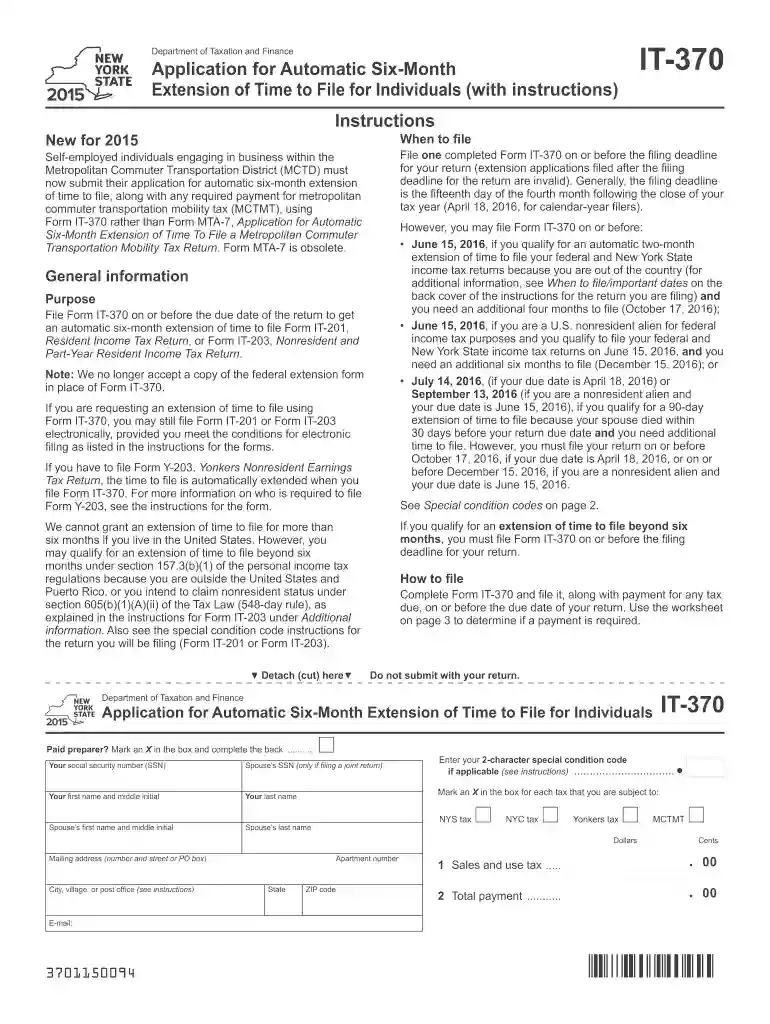
The IT form is a New York State document used by individuals to request an automatic six-month extension for filing their income tax returns. Specifically designed for those who might need additional time to organize their financial records, this form helps tax filers avoid penalties associated with late submissions, provided they meet specific conditions. It offers taxpayers a straightforward way to extend their deadline, ensuring they have sufficient time to accurately complete and submit their tax returns.
To effectively utilize the IT form, taxpayers must complete and submit it before the original tax filing deadline. This ensures the extension is granted without issues. Key steps include:
To ensure proper submission and approval of the IT-370 form, follow these straightforward steps:
The IT-370 form must be filed by the original deadline of the taxpayer's income tax return, typically on April 15. Filing dates can vary slightly based on weekends and holidays, so it's vital to confirm the exact deadline for the fiscal year in question. Meeting this deadline is critical to gaining the extension and avoiding penalties.
To be eligible to file the IT-370 form and receive an extension, taxpayers must have an existing obligation to file a New York State income tax return. Additionally, they should have made at least a partial payment, if any taxes are owed, as the extension applies only to the filing period and not to the payment of taxes themselves. Certain self-employed individuals may have specific additional criteria, especially those within the Metropolitan Commuter Transportation District.


Failure to file the IT-370 form or to meet the tax payment obligations can result in significant penalties. These can include:
The IT-370 form includes essential fields that every taxpayer should understand:
Taxpayers will need several documents to correctly estimate their tax liability when using the IT-370 form:
Common users of the IT-370 form include:

There are multiple ways to submit the IT-370 form:
By following these detailed instructions and guidelines, taxpayers can effectively manage their filing responsibilities, ensuring compliance and minimizing potential penalties.
We've got more versions of the it 370 2015 form form. Select the right it 370 2015 form version from the list and start editing it straight away!
| Versions | Form popularity | Fillable & printable |
|---|---|---|
| 2025 | 4.9 Satisfied (51 Votes) | |
| 2024 | 4.1 Satisfied (42 Votes) | |
| 2023 | 4.5 Satisfied (35 Votes) | |
| 2021 | 4.4 Satisfied (59 Votes) | |
| 2020 | 4.8 Satisfied (55 Votes) | |
| 2019 | 4.4 Satisfied (75 Votes) | |
| 2018 | 4.4 Satisfied (107 Votes) | |
| 2017 | 4.4 Satisfied (111 Votes) | |
| 2015 | 4.4 Satisfied (552 Votes) | |
| 2014 | 4.1 Satisfied (56 Votes) | |
| 2013 | 4 Satisfied (38 Votes) | |
| 2012 | 4 Satisfied (36 Votes) | |
| 2011 | 4 Satisfied (32 Votes) | |
| 2010 | 4.4 Satisfied (65 Votes) |
At DocHub, your data security is our priority. We follow HIPAA, SOC2, GDPR, and other standards, so you can work on your documents with confidence.
Introduction, Timing, Duty to segregate and release non-exempt information, Marking of withheld portions of records, Non-responsiveness not a proper basis.Read more
Make the check or money order payable in U.S. funds to New York State Income Tax and write the last four digits of your Social Security number and 2025 IncomeRead more
Number of Businesses and Business Receipts by Form, 2015 Tax Year (All figures are estimates based on samples.) Form. Number of returns. Percent of total.Read more


