




01. Edit your form online
Type text, add images, blackout confidential details, add comments, highlights and more.

Type text, add images, blackout confidential details, add comments, highlights and more.

Draw your signature, type it, upload its image, or use your mobile device as a signature pad.

Send it via email, link, or fax. You can also download it, export it or print it out.
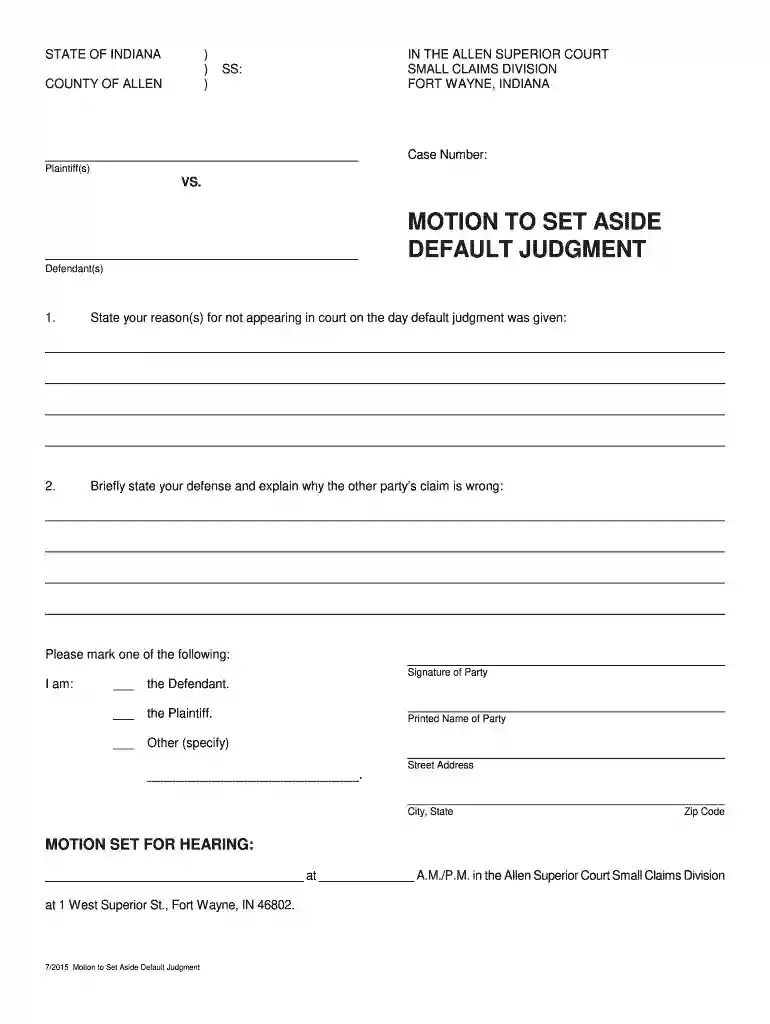
A "Motion to Set Aside Default Judgment" refers to a formal request submitted to a court by a party in a lawsuit, typically the defendant, seeking to nullify a default judgment that was previously entered against them. This type of judgment usually occurs when the defendant fails to respond or appear in court as required. In Allen County, Indiana, the motion must clearly articulate the reasons for not initially contesting the claims and provide a meritorious defense as required by law.
To effectively use the Motion to Set Aside Default Judgment in Allen County, the filer needs to follow a structured approach, ensuring compliance with local legal procedures.
Completing this legal document requires attention to detail and strict adherence to the format specified by the court.
Gather Necessary Information:
Draft the Motion:
Attach Supporting Documents:
Review for Accuracy: Double-check for errors or omissions that might affect the motion's acceptance.
The completeness of the motion impacts its success. Some critical elements must be addressed explicitly.
This motion serves a specific purpose in the legal system, aiming to ensure fair trial rights are protected.
Laws may differ significantly regarding handling default judgments based on region.
Understanding how others have successfully leveraged this motion can provide valuable insights.
Different filing methods can be more convenient or faster, depending on individual circumstances.
Failing to adhere to legal obligations following a default judgment can result in further penalties.
We've got more versions of the MOTION TO SET ASIDE DEFAULT JUDGMENT - allencounty us form. Select the right MOTION TO SET ASIDE DEFAULT JUDGMENT - allencounty us version from the list and start editing it straight away!
At DocHub, your data security is our priority. We follow HIPAA, SOC2, GDPR, and other standards, so you can work on your documents with confidence.
Motion to Seal Eviction Case (9-2022) View the PDF. Motion to Set Aside Default Judgment (Revised 2016) View the PDF. Notice of Claim for Claims Calendar
by D Cherinchak 1985 The Third Circuit has most recently considered a meritorious defense as a threshold requirement in having an entry of default or a default judgment set aside.
Feb 24, 2017 The matter is pending before the U.S. District Court for the Southern District of West Virginia on our subsididarys motion for summary judgment


