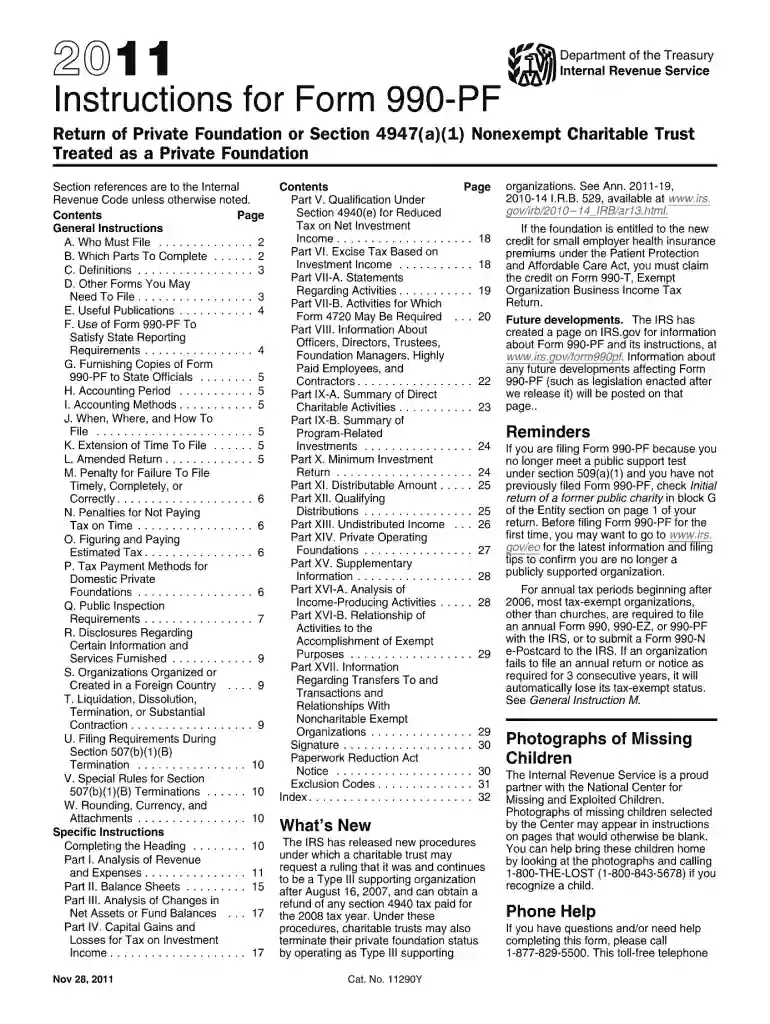
990 pf instruction 2011 form-2026

Get Form
990 pf instruction 2011 form Preview on Page 1

Here's how it works

01. Edit your form online
Type text, add images, blackout confidential details, add comments, highlights and more.

02. Sign it in a few clicks
Draw your signature, type it, upload its image, or use your mobile device as a signature pad.

03. Share your form with others
Send it via email, link, or fax. You can also download it, export it or print it out.

Understanding Form 990-PF: Definition and Purpose

Form 990-PF is a critical document used by private foundations in the United States to report their financial activities to the Internal Revenue Service (IRS). Officially known as the "Return of Private Foundation or Section 4947(a)(1) Nonexempt Charitable Trust Treated as a Private Foundation," this form serves to disclose detailed financial information about revenues, expenses, and the distributions of funds to fulfill charitable purposes. The 990-PF form provides transparency, ensuring that such organizations adhere to federal regulations.

Key Features of Form 990-PF

  • Reporting of Financial Activities: Details include revenue sources, asset holdings, and expenditures.
  • Operational Overview: Information about the foundation's operations, including its board members and compensation.
  • Charitable Distributions: Documentation of grants and distributions made to charities, offering insight into philanthropic activities.

Understanding the definition and purpose of Form 990-PF helps organizations maintain compliance with IRS requirements and uphold their charitable missions effectively.

Steps to Complete Form 990-PF

Completing Form 990-PF requires a meticulous approach to ensure all necessary information is accurately reported. Here's a step-by-step guide:

  1. Gather Required Financial Information: Collect documentation that shows all sources of revenue and expenses.
  2. Complete the Basic Identification Section: Fill in the foundation's name, address, and Employer Identification Number (EIN).
  3. Provide Financial Data: This includes detailed income statements, balance sheets, and statements of revenue and expenses.
  4. Report on Board Members: Include names, roles, and compensation details of board members and key employees.
  5. Detail Charitable Distributions: Itemize grants and other forms of assistance provided during the tax year.
  6. Ensure Accuracy in Calculations: Double-check all figures and computations to avoid discrepancies.
  7. Prepare Supplemental Information: Provide additional explanations or schedules if necessary.

Completing the form accurately is crucial to avoid penalties and ensure compliance with IRS regulations.

Legal Use and Compliance for Form 990-PF

Form 990-PF plays a vital role in legal compliance for private foundations. It ensures transparency and accountability in financial activities, which is mandatory for maintaining tax-exempt status. Failure to properly file can result in significant penalties or revocation of tax privileges.

Legal Considerations

  • Mandated Reporting: The IRS requires specific elements to be reported to monitor proper financial conduct.
  • Public Disclosure: Completed forms are public records, emphasizing the need for accuracy and transparency.
  • Adherence to IRS Guidelines: Ensures foundations meet federal requirements to retain funding advantages.

Understanding the legal implications of Form 990-PF assists private foundations in aligning with statutory obligations, preventing legal disputes, and preserving their philanthropic focus.

Important Terms Related to Form 990-PF

Understanding the terminology associated with Form 990-PF is essential for accurate completion and compliance. Here are some critical terms:

  • Private Foundation: A non-profit organization established primarily through a single primary donation source to provide grants to charities.
  • Charitable Distribution: Financial allocations made to support tax-exempt charitable activities.
  • Revenue and Expenses: Involves all forms of income (donations, investment gains) and outflows (grants, operating costs).

Familiarize yourself with these terms to better navigate the reporting mandates and maintain compliance.

Filing Deadlines and Important Dates for Form 990-PF

Timely filing of Form 990-PF is crucial to ensuring compliance with IRS regulations. Understanding the deadlines and critical dates prevents penalties and preserves tax-exempt status.

Key Filing Deadlines

  • Annual Due Date: Generally, the form is due on the 15th day of the fifth month after the end of the organization's fiscal year.
  • Extensions: May be requested using IRS Form 8868, granting an additional six months to file.

Awareness of these deadlines allows for proper preparation and submission, minimizing the risk of incurring late filing penalties.

Examples of Using Form 990-PF

Form 990-PF is widely used in various scenarios where private foundations seek to report financial details to the IRS. Below are two illustrative examples:

  • Foundation A distributing multiple scholarships: Uses Form 990-PF to disclose the criteria and beneficiaries of its scholarship programs.
  • Trust B handling significant endowments: Reports investment income and corresponding charitable expenditures to ensure regulatory compliance.

These examples underline the practical applications of Form 990-PF in different private foundation contexts.

Penalties for Non-Compliance with Form 990-PF

Non-compliance with Form 990-PF filing requirements can lead to severe repercussions for private foundations. Understanding these penalties is crucial for maintaining compliance.

Potential Penalties

  • Monetary Fines: Imposed on organizations that submit inaccurate or incomplete information.
  • Loss of Tax-Exempt Status: In severe cases of non-compliance, a foundation's tax-exempt status can be revoked.

By comprehending these penalties, organizations can better prioritize accurate and timely form submissions to avoid adverse consequences.

Software Compatibility for Completing Form 990-PF

Leveraging software solutions can streamline the completion and filing of Form 990-PF. Here are some common compatible tools:

  • Tax Preparation Software: Programs like TurboTax and QuickBooks offer modules tailored for non-profit filing.
  • Document Management Systems: Tools that provide secure data handling, ensuring form accuracy.

Using compatible software enhances efficiency and accuracy, assisting foundations in maintaining compliance with regulatory mandates.

See more 990 pf instruction 2011 form versions

We've got more versions of the 990 pf instruction 2011 form form. Select the right 990 pf instruction 2011 form version from the list and start editing it straight away!
Versions Form popularity Fillable & printable
2023 4.4 Satisfied (53 Votes)
2022 4.4 Satisfied (28 Votes)
2021 4.8 Satisfied (91 Votes)
2020 4.3 Satisfied (62 Votes)
2019 4.3 Satisfied (97 Votes)
2018 4.3 Satisfied (201 Votes)
2017 4.4 Satisfied (174 Votes)
2016 4.3 Satisfied (104 Votes)
2015 4.1 Satisfied (97 Votes)
2011 4.4 Satisfied (222 Votes)
be ready to get more

Complete this form in 5 minutes or less

Get form

Got questions?

We have answers to the most popular questions from our customers. If you can't find an answer to your question, please contact us.
Contact us
Form 990-PF is used: To figure the tax based on investment income, and To report charitable distributions and activities.
The primary difference between Form 990 and Form 990-PF is that Form 990 is required for tax-exempt organizations in general (such as public charities) while Form 990-PF is required specifically for private foundations.
The Form 990-PF, entitled Return of Private Foundation is a report that must be filed each year with the Internal Revenue Service (IRS) by organizations exempt from Federal income taxes under section 501 of the Internal Revenue Code, and whose annual receipts are normally more than $25,000 a year.
Form 990-N (e-Postcard) is an annual notice. Form 990 is the IRS primary tool for gathering information about tax-exempt organizations, educating organizations about tax law requirements and promoting compliance. Organizations also use the Form 990 to share information with the public about their programs.
Organizations that are classified as private foundations are required to file a Form 990-PF. The Form 990-PF serves two essential purposes. First, it provides information that helps government agencies (the IRS and state charity regulators) enforce the laws that govern nonprofits.

Security and compliance

At DocHub, your data security is our priority. We follow HIPAA, SOC2, GDPR, and other standards, so you can work on your documents with confidence.

Learn more
ccpa2
pci-dss
gdpr-compliance
hipaa
soc-compliance

People also ask

There are several versions of Form 990: public charities file a Form 990, 990-EZ, or 990-N; private foundations file Form 990-PF (PF stands for Private Foundation). Learn more about the difference between public charities and private foundations.
Tax-exempt organizations must file a tax return called a Form 990 with the IRS each year to comply with federal regulations. There are several versions of Form 990: public charities file a Form 990, 990-EZ, or 990-N; private foundations file Form 990-PF (PF stands for Private Foundation).
No Hidden Fees. Powerful Features. Complete Peace of Mind. FormsCost Per Form Form 990-PF $149.90 Form 990-T $89.90 CA Form 199 $69.90 Form 8038-CP $69.905 more rows

Related links