




01. Edit your form online
Type text, add images, blackout confidential details, add comments, highlights and more.

Type text, add images, blackout confidential details, add comments, highlights and more.

Draw your signature, type it, upload its image, or use your mobile device as a signature pad.

Send it via email, link, or fax. You can also download it, export it or print it out.
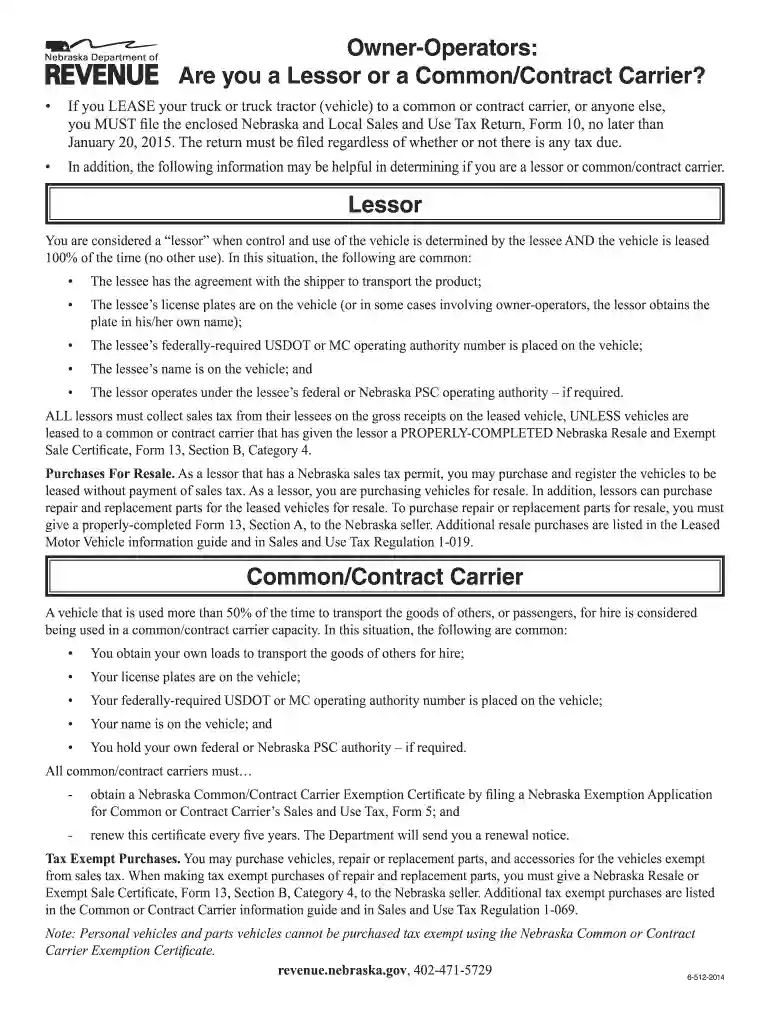
The "Owner-Operators: Are you a Lessor or a Common Contract Carrier" form dictates classification criteria for individuals and businesses involved in the transport industry, specifically in Nebraska. This classification impacts tax obligations, legal responsibilities, and eligibility for exemptions. Lessors typically lease equipment or vehicles, collecting sales tax unless exempted. Common/contract carriers, however, provide transport services and are allowed tax-exempt purchases with the correct exemption certificate. Understanding these classifications is crucial for legal and financial compliance within the transport industry.
Using the "Owner-Operators: Are you a Lessor or a Common Contract Carrier" form necessitates an understanding of your business model. Determine whether you lease equipment (making you a lessor) or operate as a transport service provider (qualifying as a common or contract carrier). This form assists in documenting and categorizing your operations for accurate tax filings and legal compliance.
Proper completion of the "Owner-Operators: Are you a Lessor or a Common Contract Carrier" form is vital for ensuring compliance with state regulations. Follow these steps to complete the form accurately:
This form serves a legal purpose in distinguishing operational types within the transportation sector. Accurate completion ensures compliance with Nebraska's tax laws. Lessors are obligated to collect sales tax, whereas common/contract carriers must secure exemption certificates for tax-free purchases. Misclassification or failure to properly complete the form can result in legal penalties.
Filing the "Owner-Operators: Are you a Lessor or a Common Contract Carrier" form necessitates various documents to validate your classification. These include lease agreements, service contracts, and proof of operations. Having these documents ready ensures a smooth application process and compliance verification.
Failure to accurately complete or submit the form on time can lead to significant penalties. Misclassification may result in incorrect tax filings, leading to fines or legal action. It's essential for owner-operators to understand their responsibilities and adhere to filing deadlines to avoid such penalties.
Nebraska imposes distinct regulations regarding the operation and classification of lessors and common/contract carriers. Ensure all state-specific guidelines are met, especially concerning tax collection and exemption claims. Understanding these rules helps prevent legal issues and financial discrepancies.
Eligibility for classification as a lessor or a common/contract carrier depends on business activities. Lessors engage in the leasing of equipment, while common/contract carriers provide transport services. Proper identification ensures accurate tax obligations and legal compliance, pivotal in the transport sector.


We've got more versions of the Owner-Operators: Are you a Lessor or a Common Contract Carrier form. Select the right Owner-Operators: Are you a Lessor or a Common Contract Carrier version from the list and start editing it straight away!
| Versions | Form popularity | Fillable & printable |
|---|---|---|
| 2023 | 4.1 Satisfied (43 Votes) | |
| 2022 | 4.3 Satisfied (56 Votes) | |
| 2022 | 4.6 Satisfied (32 Votes) | |
| 2021 | 4.9 Satisfied (38 Votes) | |
| 2021 | 4.8 Satisfied (46 Votes) | |
| 2020 | 4.3 Satisfied (140 Votes) | |
| 2020 | 4.9 Satisfied (42 Votes) | |
| 2020 | 4.8 Satisfied (55 Votes) | |
| 2020 | 4.4 Satisfied (231 Votes) | |
| 2019 | 4.8 Satisfied (152 Votes) | |
| 2019 | 4.6 Satisfied (38 Votes) | |
| 2017 | 4 Satisfied (58 Votes) | |
| 2017 | 4.8 Satisfied (95 Votes) | |
| 2017 | 4.8 Satisfied (119 Votes) | |
| 2016 | 4.3 Satisfied (60 Votes) |
At DocHub, your data security is our priority. We follow HIPAA, SOC2, GDPR, and other standards, so you can work on your documents with confidence.
The term owner or operator does not include a unit of State or local government which acquired ownership or control through seizure or otherwise in connection
The auditor needs to know the number of vehicles in a licensees fleet and if the licensee has any lease agreements with owner-operators. The lease agreements.


